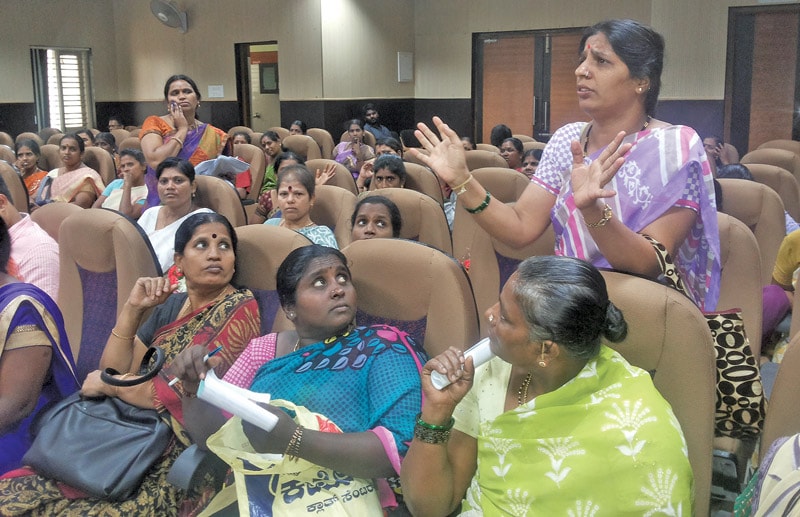
Most of us must be having Aadhar cards and Ration cards, and may be fully satisfied by the nutrition, health and education levels provided – being among our top priorities – but alas, these very important ‘life essentials’ are the missing elements for women workers in various garment factories of Bangalore. Surprisingly, a big chunk of these women workers do not have these basic necessities including a national identity (both Aadhar and Ration cards) and due to this they are suffering a lot.
A recent survey done by the Centre for Advocacy and Research (CFAR) on total 600 respondents in Bangalore, out of which 120 (i.e. 20%) of them were garment workers, showed the sad plight of women workers in the city. The report, Community Centered Baseline Study on Extent and Quality of Access of Marginalized Women to Key Welfare Schemes, Program and Entitlements, in support with Azim Premji Philanthropic Initiatives (APPI) was done with the purpose of gauging the extent of and perception of exclusion from key citizenship and universal schemes and its impact on access to other schemes. It also tried to capture the perception of inclusion across schemes, prioritize schemes and build on the support and assistance that communities received from Self Help Groups, Mahila Arogya Samiti, the Domestic Workers Union, Garment Workers Union and Construction Workers Union.
Once again issues like nutrition, health and education were highlighted as the serious concerns, which have not been improving. Out of 120 workers of garment factories surveyed, 48 (40%) of the respondents prioritized nutrition, followed by health 47 (39%) and education 45 (38%). The fact which creates more worry is that among them 52 (43%) respondents were between 21 to 30 years of age, 16 were from women-only families and 36 were from women-headed families. These respondents largely belonged to Ashraya Nagar and Buddha Nagar. Although these workers can avail of Employees’ State Insurance (ESI) facilities and also access healthcare services, many of the respondents complained that ESI did not cover all health problems and they were often referred to other hospitals for further investigation and tests. Garment workers are not covered by accidental benefits by the Labour Department, hence 41 garment workers gave higher preference to accident benefits and 25 respondents for marriage assistance, because a majority of them were from women-only and women-headed families.
This report also highlights allied aspects of women workers on various issues, especially their social network or their reach/benefit from various samitis/SHGs/unions, etc. Only 33 garment workers had heard about the Anganwadi Bala Vikasa Samiti (critical for strengthening community participation in the functioning of Anganwadi centers). While only 16 workers were aware of the School Development and Monitoring Committees, but interestingly 52 garment workers said that they wanted to be part of such committees. This shows that how much willingness they have to become part of such social network which is in-fact helpful for them. Another such enthusiastic approach can be noticed in the fact that apparel workers prioritized subsidy loan for self-employment because they want to put their specific skill sets to use through small and micro enterprises. This was particularly evident in settlements like Ashraya Nagar and Ullalu Upanagar. Whatever may be the case, out of 120, only 30 garment workers (25%) belong to Self Help Groups and Mahila Arogya Samiti (MAS), while 22 garment workers were helped by various unions. It also highlights statement of Lakshmi, a union member, who says that the Garment Labour Union (GLU) adopted various methods to educate workers and build awareness including one-to-one meetings and group meetings near factories and settlements.
Out of almost 5,00,000 apparel workers working in and around Bangalore, more than 65 per cent are women, but they are not able to fulfil their ‘basic needs’ which this report highlights in detail.
The report raises the ground level situation as it says, “The exclusion was most pronounced among garment workers. Even in the case of the much accessed Aadhar Scheme, 26 (22%) of respondents had not secured their Aadhar number and 39 (33%) of garment workers had not got Ration cards. With more than 95% of garment workers being women-headed families, such exclusion could prove extremely detrimental to them. Moreover, since they have to report to work very early in the morning they found it difficult to use the ICDS centers and instead admit their children in private crèches. Lack of awareness, especially among garment workers, is as high as 75% who do not even know how to apply or get access to various schemes. Their tight work schedule is also one of the biggest reason for the same. Despite all these difficulties, 36 garment workers tried to secure the schemes. Family support is an important issue here too as out of these 120 workers of apparel sector, 25 garment workers availed the schemes on their own or with the support of family members.
Most of the factories in Bangalore are compliant and taking care of their workers as per the law of the land. There are many NGOs in Bangalore working for apparel industries, and some of them are dedicated to women alone, but despite that condition of women workers is not good.
How the report was prepared: Seventy six trained community researchers, representing various industries like construction daily wage labourers, garment and home-based workers conducted the survey in eight settlements of Bangalore Urban. 32 Focus Group Discussions (FGDs) were also conducted to assess the extent of access these women and their households have to various social welfare schemes and social development programmes which can help improve their lives.
Recommendation: Bruhat Bangalore Mahanagara Palike (BBMP), CFAR and APPI have come up with many recommendations for the improvement. One of them is that Food and Civil Supplies Department Will provide BPL Ration cards to all urban poor women particularly single and women-headed families of garment workers.



 Bharat Tex Special Report 2026