As coronavirus started tightening its grip over Bangladesh, the Government on 23 March took a decision to declare 10-day countrywide shutdown from 26 March to 4 April. As expected, garment manufacturing units decided to wind up operations temporarily and let go of thousands of workers for the time being.
Most of the workers hailing from the hinterlands of the country started moving out from the garment manufacturing hubs in around capital Dhaka to their respective villages. However, as the number of COVID-19 cases in the country started increasing, the Government subsequently extended the shutdown till 14 April.
Now whether it was due to lack of communication between the concerned authorities and the apparel exporters, many factory owners allegedly asked their workforce to report to work by 5 April. As per some reports, the apex garment makers’ body, the Bangladesh Garment Manufacturers and Exporters Association (BGMEA), allegedly did not notify workers about the extension of the shutdown declared by the Government. Citing a lack of authority to close factories, it waited for the Government’s Department of Inspection for Factories and Establishment (DIFE) to make the announcement as factories need DIFE’s permission to shut down.
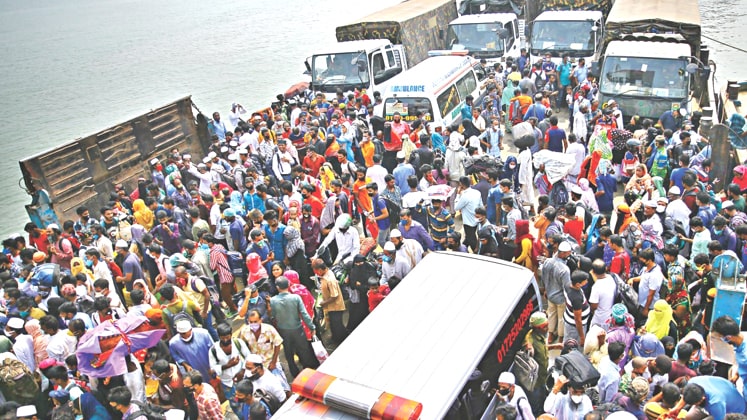
What ensued was something that many had not even imagined. Thousands of garment workers started flocking to the entry points to Dhaka. Since Saturday was the last day of the holidays for the garment sector in Bangladesh following the partial lockdown imposed by the Government, an eight-kilometre-long crowd of people, mostly garment workers, queued up to enter the capital city.
Workers hailing from Sherpur, Jamalpur, Netrokona and different other parts of Mymensingh gathered at the Patgudam Bus Terminal. From there, they were seen riding on Dhaka-bound trucks, pick-ups and the other modes of transport available to reach the capital. On the Barishal-Dhaka highway, thousands were seen travelling by trucks and small pick-ups. In Gazipur, at Maona intersection on the Dhaka-Mymensingh highway, hundreds were seen waiting for vehicles.
However, unable to avail any mode of transport due to the lockdown, many started their journey to Dhaka on foot.
“I had called the factory authorities on 3 April to tell them that there is no transport and it is not possible for me to travel from Netrakona to Gazipur right now. But I was told that I must show up for work,” said a garment worker employed at one of the many RMG units that dots the Gazipur area, who had to traverse a distance of around 150 kilometres by walking, taking rickshaws, hitchhiking on pickup trucks to reach his work place.
Meanwhile, as workers were rushing back to the factories, Dhaka Metropolitan Police completely locked down the city borders. “Nobody would be allowed in, and those inside will not be allowed out,” said a statement circulated by the police. Many incoming garment workers were stopped at Keraniganj by the police, and they had to take refuge at the police station for the night.

“Thousands of workers went to the factories on foot, risking their health and the spread of coronavirus. They need salaries and livelihood but many factories laid off workers and fired them without pay,” alleged Nazma Akter, President, Sammilito Garment Sramik Federation.
Meanwhile, interacting with the pressmen, BGMEA President Dr. Ruabana Huq said, “I am sincerely requesting the owners of all factories to keep the factories shut considering the overall situation. I would also like to reassure our workers that they will get the salary for the month of March. They don’t need to worry about that. I request all the sides not to fire any worker for staying away from work.”
Opining on the situation that arose due to this confusion, public health specialist Dr. Taufique Joarder said BGMEA’s actions reflect lack of coordination. “Pandemic is a health issue. People in the sector must be consulted before taking decisions. BGMEA should have been aware of that,” he said, adding that if a worker gets infected, the virus will spread to others through their daily movement.
The backlash that followed from different quarters including the civil society forced most entrepreneurs to not operate their respective units for the time being.
Also Read: COVID-19: What the stakeholders are doing to prevent worker layoffs
However, as per media reports, many apparel manufacturing units – around 40 – notwithstanding repeated pleas from the BGMEA and the Government decided to resume work. Of these 40 factories, around 30 are located in Savar, eight in Gazipur and at least two in Narayanganj. However, the Bangladesh Export Processing Zones Authority (BEPZA) has decided to keep all factories shut under its jurisdiction till 14 April in the country’s eight export processing zones (EPZs) under BEPZA.
Production at all factories in the EPZs will remain halted during the period, underlined a press release signed by BEPZA General Manager, Nazma Binte Alamgir.
The turn of events and flouting of orders by many apparel exporters ultimately led Prime Minister Sheikh Hasina to step in.
At a weekly cabinet meeting held at her residence, Ganabhaban, Hasina ordered all apparel manufacturing units to remain shut excepting the ones that are currently involved in making masks and Personal Protection Equipment (PPE). She also reportedly came down heavily on some business leaders and trade associations for their alleged attempts to resume work in the factories.



 Bharat Tex Special Report 2026