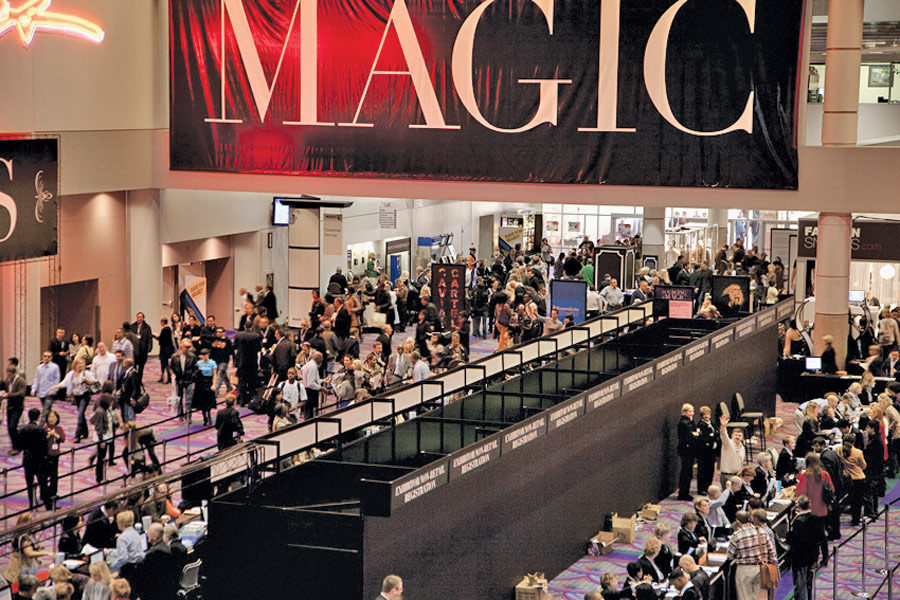
 In the recently concluded edition of Magic, more than 700 participants from 40 countries exhibited there offering at the Sourcing Zone. ‘India’ with 44 exhibitors was this season’s focus country at the event. Though this is the biggest contingent that India has carried to the magic so far, it was a disappointing presence for many as the pre-event publicity had projected over 75 exhibitors from the country.
Moreover, of the 44 companies that participated, only 13 exporters were repeat exhibitors from the last show, all the others were first time participants. Analyzing the participation trend at Magic by Indians over the last four seasons, it seems that only a handful of exporters repeatedly participate at the Fair.
Team Apparel Online talks to some participants on why and why not…

The Magic Market Place, held twice a year at Las Vegas, USA has become the Mecca for the Garment industry worldwide. While a majority of the exhibitors are brand/label owners either offering collections or looking for licensing arrangements with retailers, there is a relatively large contingent at Sourcing @ Magic, which showcases their manufacturing capabilities. During the latest edition of Magic two new sourcing categories were introduced – Design Elements, showcasing original design manufacturers (ODM), and Footsteps, representing both suppliers and manufacturers of footwear.
“The MAGIC Marketplace is definitively the most efficient one-stop shopping resource in the world for the entire fashion industry, and Sourcing at MAGIC’s incredible international scope is a tremendous asset for both our exhibitors and retail attendees,” said Chris DeMoulin, MAGIC International President and Executive Vice-President of Advanstar’s Fashion Group. However, it appears that the platform has not been a major attraction for Indian manufacturers as the number of participants remains low with only few exporters using the event as a regular mmarketing tool.
It is estimated that around 1,000 buyers from various countries visited the India pavilion during the four-day show, which included some big names like Macys, JCPenney, American Eagle, Chico’s, Perry Ellis and Tommy Hilfiger. However, the majority of buyers were small to medium sized chain stores and boutiques looking for small quantities at very competitive prices. For first time participant Eastman Exports, the fair presented an opportunity to connect with 7-8 new potential customers and though no orders were actually placed, the contacts generated more than compensated for the participation. “As major suppliers to GAP and Tommy, 50% of our exporters are already going to the US, but we wanted to explore new options. Among the new contacts are Perry Ellis and Macys, both of whom we are keen to work with,” said K. Muralidharan of Eastman Exports.
Not many big exporters in the league of Eastman Exports are exhibiting at fairs; most of the participants are small and medium exporters, many of who are also regular participants at the India International Garment Fair (IIGF). These exporters take the magic show as a meeting venue for their contacts in the US. “We have been consistently participating at the fair and besides meeting regular customers, it is a good platform to meet new potential buyers and also update on what is the feel of the market both in terms of trends and business directions,” says TC Dewagan, Rawsitasa Exports. The feeling is shared by all the regular participants.
However, the percentage of exporters that consistently repeat participation is not very impressive and even the total number of exporters that make up the Indian contingent does not augur well for the value that the platform provides to Indian exporters. The increased participation this edition is primarily because of the thrust to create an India focus. In all other events where participation was around 20 plus or minus a few, only few companies are repeat ones… from February 2009 to August 2009 only four companies out of 16 who participated in February 2009 repeated participation.
On a macro level, over the last four shows, a total of 80 exporters have exhibited at the Sourcing Zone of which two companies have participated in all four shows, seven have participated thrice and nine have exhibited in two shows. “We participated only once at Magic, but the effort was not worth it as no business could be generated. India has a very small participation level and ironically till a bigger presence is not made, little attention will be given to the pavilion,” says J. L. Sehgal, Kiran Associates, Gurgaon who participated last session but decided not to exhibit this show. “Because the buyers are mostly looking for small quantities and very sharp prices, it did not make much sense to try the platform again as it does not fit into our product profile,” says Deepak Agarwal, BL International, another one-time participant.
But not all participants who drop out agree that the fair could not give them value. “With business getting back on track we were keen to participate again, but not being regulars we forgot to apply in time, but we certainly intend to attend the February show,” says Mukesh of Charisma Apparel Impex. Some exporters who were not very satisfied the first time decide to go again for continuity. “Results cannot come in on just one standalone participation; buyers need to see you again and again to feel that you are reliable,” says Vikas Ghai, Impex V. He further adds, “We were participating for the first time at MAGIC in the February edition, but we met lot of buyers from all over the world which gave us a wide panoramic view of what is happening in international markets and this time we met a few of the same ones and exchanged notes and some sample ideas, which just could translate into business.”
It will be interesting to see how many of the 44 participants will decide to exhibit in the February show… when asked most of them circled the question saying that it is too early to make a commitment, the regular ones however were enthusiastic.
Design Directions from Magic
In the meanwhile, the general opinion of the participants was that buyers were looking for defferential products but at competitive rates. “Most stores were looking for the best quality at the cheapest price,” says Navin Adwani, The Choice Fashions, which was participating for the first time. With the price of cotton shooting up, many buyers were also seeking other options in blends, viscose, silk and polyester. As usual it was mostly ladies wear that attracted attention. “Buyers from small retail chains were looking for affordable fashion in ladies wear and carrying forward from last season prints which were in great demand,” says Ankit of Eves Fashion.
The colour trends that emerged strongly for spring were palettes washed in neutral hues, such as taupe, gray, navy and olive green, with pops of coral, peach and varying shades of blue. The neutral palette played into the military motif that continued to prevail, but feminine touches such as lace, crochet and floral prints also were seen in many of the collections by designers and brands. In fact, combining military and feminine trends was a popular option.
Many buyers also showed interest in organic and other sustainable products. “Mostly those buyers who already carry organic lines took interest in our collection,” says Alexander Job of NC John & Sons, who have been working with organic for a long time.