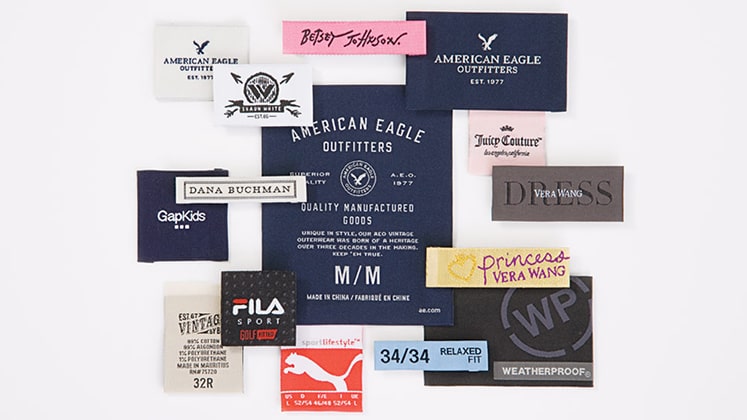
The market for tags and labels is increasingly becoming competitive with almost all big garment manufacturers setting up their own units to manufacture tags and labels, to cater to their in-house demand. Though this has been done primarily to save cost and time, they also see it as another business vertical. But the real question is how competitive can these garment manufacturers be as compared to specialized tag and label manufacturers. “No doubt, apparel manufacturers have increased their label and tag manufacturing capabilities, but they generally invest only in manufacturing a certain type of label or tag, which are the most in demand, instead of a whole range, whereas we, as a specialist, are manufacturing all types of labels and tags, and are in tune with the latest trends and evolving retailer preferences. We are also ready to invest in new forms of tags and labels,” asserts Imtiaz Ahmed Kamiss, Managing Director, r-pac Bangladesh.
A multi-national American company, with its presence in 25 countries worldwide, and providing complete packaging solutions for brands and retailers, r-pac is being spearheaded in Bangladesh by Kamiss. The operations in the country include a label manufacturing unit in Adamjee EPZ and through a joint venture with a leading industrial conglomerate of Bangladesh. The scope and expanse of labels have increased manifolds and today, a garment uses many types of labels namely, brand identification labels, size/care labels, promotional hangtags and stickers, self-adhesive size-strips and promotional stickers, logistics stickers and special labels for enhancing the aesthetics of a garment, resulting in a market size of around US $ 400 million, when calculated based on the number of garments exported from Bangladesh.

“Overall, we satisfy almost 10 per cent of the total consumption of labels and tags of various retailers and brands that we service in Bangladesh,” says Kamiss, adding that instead of targeting the entire market, their target is to achieve minimum of 40 per cent of market share from each of the customers they serve in Bangladesh. “Our growth targets are also planned in the same manner. As of now, we are catering to nearly 60 per cent to 80 per cent of all labelling requirements of the 4 major US retailers/brands operating in Bangladesh,” explains Kamiss. Being an American company, majority of the brands for which the company manufactures and provides labels in Bangladesh are American retailers. However, since 2009, the company has been exploring the European market more aggressively, and has already entered a working relationship with retailers such as Tesco, C&A and Decathlon, to name a few.
Every six months to one year, and sometimes even earlier, buyers review their portfolio of labels and tags from the perspective of shape, material used, printing technology, and colour scheme. Label manufacturers are expected to be equipped to incorporate all the changes in the labels, and ship the goods on time as it is very critical for the entire supply chain. r-pac’s expertise lies not only in manufacturing a variety of labels and tags, but also in product development, which requires extensive interactions with the buyers, developing collections in-house, and also keeping a tab on global trends. The company manufactures all types of identification products on a garment: rotary and screen printed fabric labels, woven labels, heat transfer labels, offset printed tags, thermal printed logistic stickers, RFID stickers and tags and self-adhesive size strips. The company has also recently started manufacturing leather patches. “No particular technology or label type is more favoured over another label type or technology. Earlier, the heat transfer labels were a big hit, when they were launched 10 years back, and were expected to replace woven labels as a product, but it did not happen, even though costs have come down a lot. Their applications too have changed from labels to graphics on the garments. Besides the manufacturing techniques, buyers are now looking at labels and tags made of recycled tapes, recycled yarns, and recycled paper, while trying to reduce the number of tags on a garment, and using the space on a tag more efficiently,” informs Kamiss.
After years of heated debate, RFID tags have now become widely acceptable (albeit for limited use) by the end-consumer, and hence, all big retailers such as Walmart, Macy’s, JCPenney, Jockey, and Levis have started tagging their garments with RFID labels. Their use has also increased due to the drastic reduction in the cost of the tags. “We have started production of RFID tags and stickers for a large UK-based retailer, and would be supplying to its vendors in Bangladesh, Sri Lanka, Vietnam and India as well,” shares Kamiss. The tags and label business virtually runs on nominations, but in this case, r-pac is presently the only nominated supplier, since sourcing of raw materials and production cost of RFID tags and stickers is very high and is very technical too, a lot of planning and investments need to be made, hence retailers tend to keep with maximum of one or two suppliers. “Attaching RFID tags on garments is of no additional cost for apparel manufacturers, as RFID is usually embedded into an already existing tag or sticker which the garment has been carrying already,” adds Kamiss.
The company double checks the information put on each tag – EPC numbers, UPC numbers, style numbers, sizes, etc. before releasing the consignment. It’s the retailer or brand who decides how much and what information should be added to the tag, keeping in mind whether inventory management is required at the POS level, and if real time updation is necessary for keeping track of stocks. Not only that, RFID can also help apparel manufacturers to monitor the output status of a particular style by installing RFID readers. “Due to the ever increasing variations per style, retailers are asking for RFID tags because the technology is faster, the reaction time is shorter, and you can even know the location of a garment. Moreover, it is not just about billing and inventory but also about tracking every product in retail stores,” explains Kamiss.
With a 40% growth year-on-year, r-pac Bangladesh is looking at doubling its turnover in the next 3 years. Since demand is increasing from existing customers, and many new customers have also been added to the company’s portfolio, r-pac is looking at setting up another factory with a JV partnership. The company is also eyeing at the lingerie segment, which has grown significantly in the last 10 years, and requires a unique presentation and packing. “This would be our next area for growth, and being a specialist in providing packaging solutions, we can certainly be a dominant player in the market,” concludes Kamiss.