
One of the hottest debates in the industry today is ‘whether relocating to newer manufacturing bases will bring down the cost of production and make Indian factories competitive to low cost countries like China, Bangladesh and Cambodia. There is unanimity in the thought that there is nothing like ‘buyer loyalty’ and given an opportunity, buyers shift to cheaper manufacturing destinations in search for better prices. The debate is how best to counter the move and ensure that the factories keep costs to the minimal…this is very challenging as ‘cost’ for a factory is impact by too many variables, many of which are not even controllable. Yet, labour wages, the next major cost after fabric is the focus of attention today, more so as availability of labour is also a problem.

It cannot be denied that relocating to new bases is easier said than done, yet in the 90s the garment industry in Delhi made a highly successful relocation to what is now the NCR – Gurgaon, Faridabad and Noida. Today, more than 500 companies have successfully running factories in these areas, which have now moved into the main pool of garment manufacturing hubs. “When I first decided to buy property in Gurgaon for the factory, most of the industry then located in industrial segments of Okhla, Mayapuri, Nangloi etc thought I was foolish, but now practically every exporter in Delhi has a factory outside Delhi and slowly the infrastructure and support industry to sustain the business has also developed. A decade ago we moved further away to Manesar and two years ago to Bhiwadi (Rajasthan) and now the destination is Bihar,” says Sudhir Dhingra, CMD, Orient Craft. The search is still the same…cheaper manufacturing destinations.
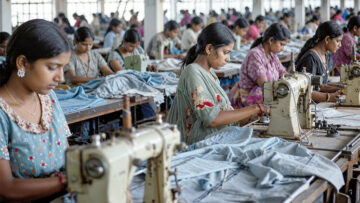
The story is almost the same for all metros and while Mumbai industry moved to Bangalore, Mysore and Tirupur, the Chennai industry moved to the outskirts and now Bangalore players are going further interior. There are a number of companies that have in the past two years moved into the heart of Karnataka like Shahi and Laguna with success. “We set up a factory 50 km from Bangalore at Seegekote village in Kanakpura in 2010 and have since experienced good availability and stability of workers,” says Sarabjit Ghose, CEO, Laguna Clothing. The unit employs around 3,000 people from the rural district and has the capacity of producing 15,000 world-class formal shirts a day.
Is going deeper into the rural areas really a viable option?
[bleft]
- Moving to the villages is not always a solution as moving to remote interiors might fetch you cheap labour, but the infrastructural support may not be so good.
- There is always benefit in running a factory in villages provided norms basic to running a garment factory like availability of labour, raw material, business-friendly atmosphere, low wages, besides civic amenities are available.
- In Bihar, though the difference of labour cost in urban and rural areas is around 25%, the biggest constraint is energy, as rural areas do not get even 10 hours/day uninterrupted electricity supply [/bleft]
Shahi, which has opened a unit in Belgaum, also in Karnataka did not make the selection of the location randomly; there was a lot of homework done to ensure that the right type of workers would be available. Belgaum has a high literacy rate and most of the engineers from Karnataka come from this region. “There is always benefit in running a factory in villages provided those rural areas fulfil certain parameters and norms basic to running a garment factory like availability of labour, raw material, business-friendly atmosphere, low wages, proximity to airport and sea port, cost of transportation/electricity/water, to name a few of them,” says Ravi Shanker, who is currently working on a project to study the viability of setting up garment unit in Bihar.
Adds Asmita Sen, Manager – Exports, Garment Division, Mallcom, Kolkata, “Moving to the villages is not always a solution as moving to remote interiors might fetch you cheap labour, but the infrastructural support may not be so good. The transport of all other employees of support departments is also to be considered and all these arrangements add extra cost. The logistics of material movement will also be affected as remote villages do not have good roads for the transport of big containers. Facilities like electricity are also a constraint as a factory needs to have a strong power back-up and other details like good water supply, etc. could take a very long time to develop in these zones.”
Besides the infrastructure and operational issues there are other concerns too. “Though there is a need to go to the interiors of the country to mobilize the huge dormant work force and surely this is the only way forward to have more inclusive growth, however, meeting various international compliances is going to be the most challenging factor,” reasons Anil Buchasia, Director, Amrit Exports, Kolkata. Adds Rajiv Dewan, CEO, Ma’am Arts, Jaipur, “I just fail to understand how companies can manage to shift to rural places with issues like quality to be controlled. Although the labour will be a lot cheaper, they will not be skilled enough at least not with my kind of customers. It is better to pay more, as it leads to more orders, better orders and better quality delivered to the customers.”
The dichotomy of the situation is not lost and efforts are on for allotment of 250 acre land in upcoming industrial area Tapukara (Extension) for setting up of an Apparel City to Rajasthan Integrated Apparel City Ltd. (an SPV) by Apparel Export Promotion Council (AEPC). Gautam Nair, MD Matrix Clothing and spear heading the initiative says that the idea of setting up the Apparel City is to create a successful self-sustaining module that can be duplicated elsewhere. “Our vision is to make it an environment-friendly, sustainable, compliant city where the workers are well looked after and focused training is provided to enable cost-effective and high quality manufacturing,” says Nair.
The city is visualized as a green initiative by using sustainable, environment-friendly methods of construction, energy saving and water recycling, having linkages with service providers who will select and train workers in rural areas in Rajasthan and elsewhere and bring them to the city for employment, dormitory accommodation and various HR initiatives provided for these workers and a world class training centre provided in the city to provide focused product specific training as well as skill upgradation programs for workers, supervisors and managers.
According to a StitchWorld Survey conducted last year that compares 113 locations in India on 50 different key performance indicators to settle on the best apparel manufacturing locations, Mahindra city SEZ, near Chennai in Tamil Nadu and Bhubaneswar in Khordha district of Orissa were considered the best locations in India for making apparel manufacturing as they offer a good infrastructure and logistics are also taken care of. On paper this may look good, but it is also important to consider the investment environment and lucrative incentives offered by the State Government before taking the plunge. As off today the two States that have come forward strongly to encourage investment in rural areas is Bihar and Karnataka. Yet many issues remain unsolved…
In Bihar, though the difference of labour cost in urban and rural areas is around 25%, the biggest constraint is energy. Under a drive to promote industry in Bihar the Government has made available electricity at the rate of Rs 4.5 per unit under open access system (OAS) for SMEs. The normal effective rate charged by Bihar State Electricity Board (BSEB) from consumers is around Rs. 7 per unit. This seems attractive, but despite repeated promises by the Bihar Government to improve availability of electricity, so far rural areas are struggling to access even 10 hours/day uninterrupted electricity supply. Many villages of Bihar do not get more than 5-6 hours/day electricity access and if generator is used the running cost of power goes up to Rs. 11- 12 per unit.
“The labour cost in Bihar is around Rs. 150 per day in the urban areas and Rs. 120 per day in rural areas, if an organization is having a workforce of over 1000 he can make additional Rs. 30,000 income from labour cost saving, but running a factory on generator in rural area of Bihar adds an additional (fuel charge + Maintenance) cost of around Rs 25,000, so where is the benefit of cheap labour,” argues Ravi.
Transportation is also one of the major constraints of setting up factory in Bihar, as many villages are cut off from highway, broad roads and accessing of ports in either Orissa or West Bengal is a task. “Another lacking could be availability of managerial skills and official work would need to be done in cities only,” adds Ravi.
In Karnataka, the ‘Suvarna Vastra Neethi’ (2008-13), which envisaged new investments to the tune of Rs. 100 billion over a period of five years by setting up of textile and apparel parks in various districts of the State with the target of creating 5,00,000 new job opportunities for the following sectors – Garments, Handlooms, Powerlooms, Spinning, Knitting, Processing and Technical Textiles – has been instrumental in many invests by garment exports to the rural areas, but unfortunately not many have gone ahead with construction of factories. “It is not practical to go to the villages, firstly how can the wage rates be different in different parts of the same State, when the State governments are defining the minimum wages… and if this is so would it not be better to pay the price of a skilled worker in the metro where all other facilities are easily available,” argues Jagadish Hinduja, MD, Gokaldas Images, logically.
Indeed there are many companies, which are confident that cutting down cost can be done without relocating factories. “All the companies should maximize their productivity, while finding other methods for cost cutting and reducing extra expenditure,” concludes Ravindra Aggarwal, Jt. MD, Mudra Lifestyle, Bangalore





 Bharat Tex Special Report 2026