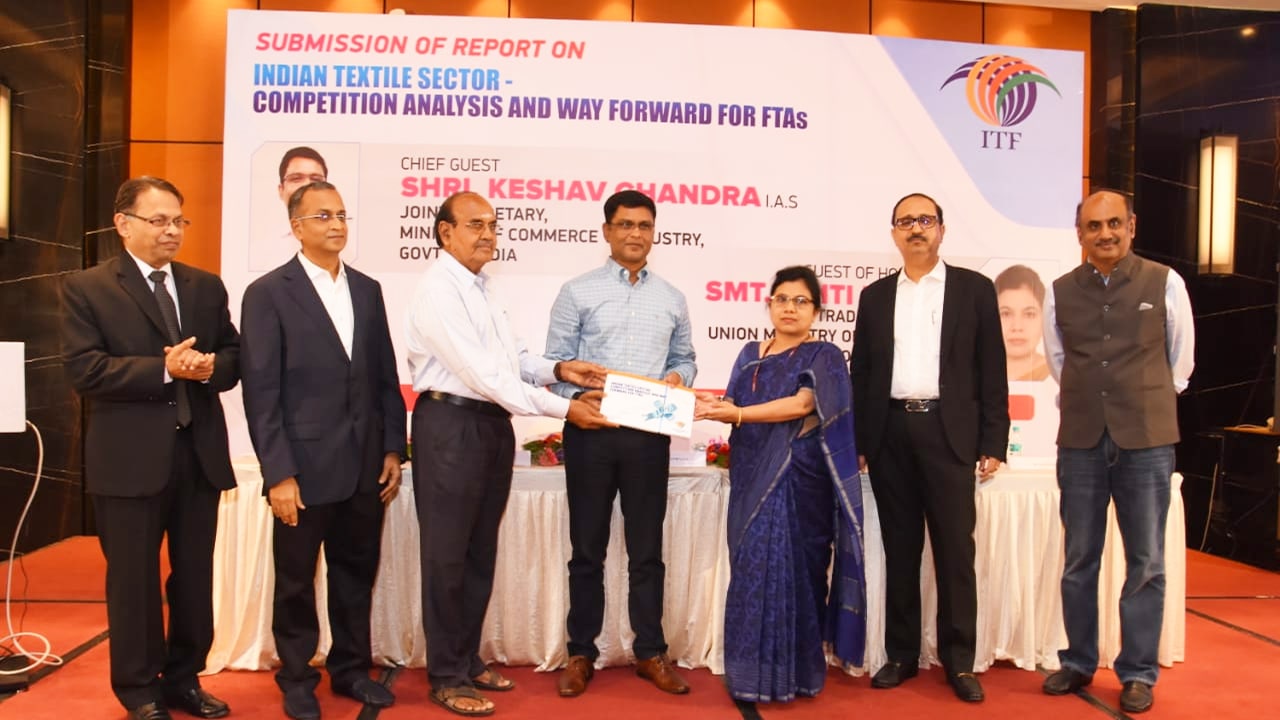
The Indian Texpreneurs Federation (ITF), a leading textile entrepreneurs association, recently organised an event in Coimbatore to put forth its report on Competition Analysis and Way Forward for FTAs for the country’s textile sector.
International trade firm, GNBC, Mumbai helped in creating the report, that marked out various challenges and obstacles faced by the export sector and the way to move forward.
Notably, Keshav Chandra, I.A.S, Joint Secretary, Union Ministry of Commerce & Industry and Aditi Rout, Trade Advisor, Union Ministry of Textiles were the chief guest and guest of honour of the event, respectively.
ITF elaborated that India’s exports of clothing and textile declined significantly last year. The association urged the government and stakeholders to seriously look into this downfall. The decline was due to different known and unknown reasons like infrastructure, high transaction costs and others.
It is important to mention that, the nation’s export of clothing and textile covered by chapter 61, 62 and 63 witnessed a dip of 23.21 per cent, 31.64 per cent and 18.99 per cent respectively during the previous year.
There are various Free Trade Agreements (FTAs) across the world, due to which FTA member countries enjoy tariff advantages and not everyone is aware of this fact, which is why a study was undertaken to understand where the country’s textile and clothing industry face difficulties and how can they overcome them.
The ITF report also had a mention on the Non-Tariff Barriers employed on this sector and its impact on the trade.
Reportedly, the contribution of the top 20 exporting countries is over 85 per cent of the whole World Exports. Though, India finds a place in the top ten of the same, its contribution is less compared to its neighbour countries like Vietnam and Bangladesh.
Major contributors and India’s competitors are China, Bangladesh, Vietnam, Cambodia, Pakistan and Turkey. Bangladesh and Cambodia, being (Less Developed Countries) LDCs, have tariff advantage in Developed and Developing countries due to Duty-Free-Quota-Free Treatment provided to them.
It is also being reported that India has tariff disadvantage ranging in between 1 per cent to 40 per cent in almost all top importing countries such as USA, EU, Canada, China, Australia, Switzerland, GCC Countries, Israel and Chile. The way forward therefore is to look out for a better market access under current FTA negotiations conducted by the Ministry of Commerce and Industry (MOC&I) with EU, RCEP, GCC, SACU, Russia, Canada, and others.




 Bharat Tex Special Report 2026