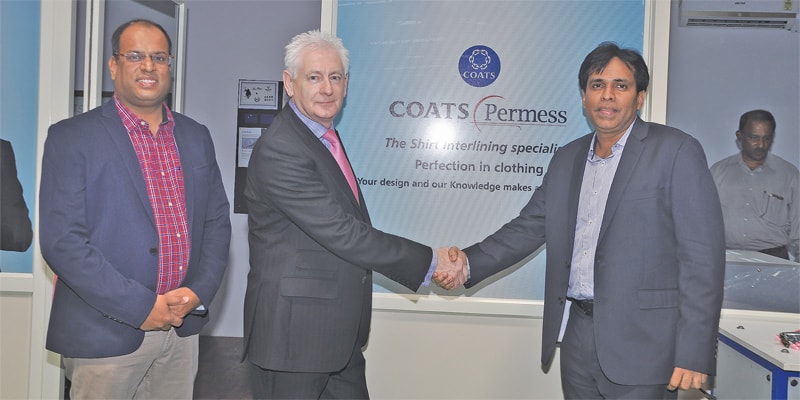
Though many industry collaborations exist, there have been only a few where both partners have successfully executed their core strengths and strategies for combined growth. And one such is the collaboration between Madura Coats and Permess. Recently, the collaboration has resulted in opening a design studio in Bangalore, to meet the sampling requirements of customers, enabling them to quickly launch new products and designs, while also finding solutions for technical concerns. In conversation with Apparel Online, V Jaigopal, Executive Director, Madura Coats and Ken Miller – Sales Director, Permess International, talk about the collaboration and how it benefits both company’s future strategic directions, while supporting customers.
Madura Coats, a part of Coats, the world’s leading industrial thread manufacturer and Permess, based in the Netherlands, makers of dot coated woven, knitted and non-woven fusible fabrics for garment interlining applications from cotton, viscose to polyester, through their year-and-a-half partnership are jointly promoting, selling and distributing interlining products for the Indian market, delivering a full range of superior woven, non-woven and tricot interlinings catering to both exporters and premium domestic manufacturers. “When we crafted our strategy, we wanted to focus on two areas – performance material threads and to become a value-added partner to our customer base. Interlinings market was an area that interested us, but when we looked around, we found established players in the market, who had established networks. So, we needed to align with a company who had the technology but not the reach and could benefit from our market penetration. That is when we zeroed in on Permess,” reveals Jaigopal.
An offshoot of the global Dutch company, Ten Cate, Permess had its presence amongst high-end brands and products, manufacturing in locations such as Bangladesh, Holland and China. “Obviously, it was a stock and sell model and the quality had immediate acceptance in the market,” adds Jaigopal. The initial discussion between both the partners focused on India as the first market for business penetration, as Permess has had its presence in the market for the past 30 years, mainly through European brand nominations. “So, the name has already been sitting here but not been promoted vigorously. The management of Ten Cate took on the business of interlinings as a private company PMQ Holdings, which has been growing steadily. But the 2015 collaboration between Coats has really consolidated our business,” confirms Ken. Permess market reach globally in terms of interlinings is at par, and therefore Coats has focused on supplementary markets, for example India, where Permess is present, but not necessarily visible. So far, the synergy between both companies has been good, with both complementing each other’s strength!
Still the Indian market is flooded with industry leaders in interlining, where the competition is not just restricted to selling the product, but it’s also a lot about application and technical know-how. “I think one of the big points of having competition is that it keeps you sharp, and keeps you on your toes. We are nominated by major brands and so also are the other players. So, it literally boils down to service, price, testing facilities, etc. which gives us an edge over others through our new design studio. Also, it’s about shorter lead times, which we are providing by stocking up in the Chennai and Bangalore warehouses,” reveals Ken. But what has also given the company edge is that “even with the biggest names in interlinings, Permess is a preferred choice amongst all big brand names. It gave us confidence that in this market there are gaps to fill. We did a survey and we found the gaps. This is the advantage of being a local sales partner with credible data base,” asserts Jaigopal.
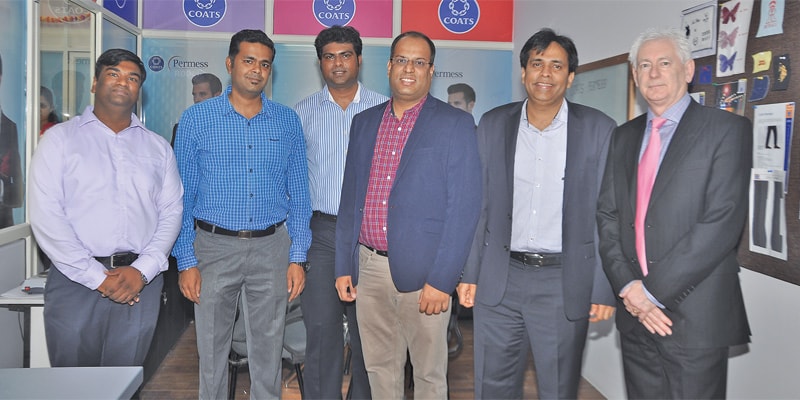
Apart from this, most of the interlining players in the Indian market do not have 100 per cent domestic production, and a substantial portion of their import base is China-centric. Through Permess manufacturing facilities in Bangladesh, which is closer to the South Asian ecosystem than China, the company has been able to solve this, resulting in shorter lead times. And most importantly, “even compared to the big global players that are present in India, we have a penetration deeper than anybody when it comes to sale. During need we can bring 27 warehouses into play, where we can stock sell and service more than any other competitor in the market,” claims Jaigopal. Ken further adds, “With the enormous sales network that Coats offers, we are bringing value-added products through R&D, such as seam tapes, seam pucker, etc. to the local market and we are market leaders in this.”
This growing synergy between the two, has also been achieved through a lot of trainings, which was a smooth transition as Coats had people working with them, who were familiar with interlinings. This is because Coats produces interlinings in India for the tailoring market, which only a few are aware of. “The basic knowledge was there, but we had Permess sending teams to give extensive training. We also sent our teams to Permess factories in Holland so as to be proactive in problem solving as we didn’t want to discover any issue downstream,” states Jaigopal.
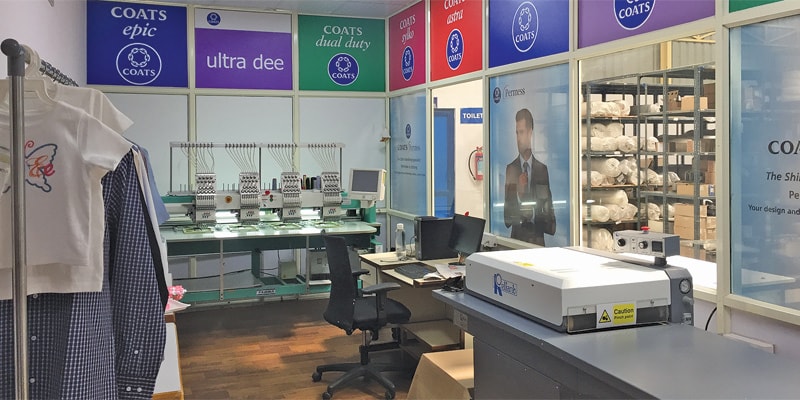
The recently opened design studio is more than just a lab or a workshop space. Providing a range of garmenting solutions rather than just trim components, the studio is equipped with state-of-the-art technology and equipment with in-house sewing, fusing, washing and testing facilities to provide all the required technical and back-end support for garment manufacturers and brands. “Everybody is looking for something new and when people are experimenting with a new fabric, this studio will provide them the right interlining. This studio opens the choice regarding the look and feel of the garment,” adds Jaigopal. The company was earlier also providing such solutions and services to its customers, but they were generally given in the market and often copied, restricting its exclusivity for the customers.
The design studio, which also houses the embroidery service centre, will provide customized solutions, while maintaining the exclusivity of suggestions made. “When it comes to trims – whether it’s interlining, zips, or embroidery trends – there is one umbrella which will help make choices, not generating designs but supporting the customer’s ability to experiment. It’s a starting point,” informs Jaigopal.
Giving something different and new to the industry is what Coats and Permess are doing, while also being pro-pricing. “I think that’s the beauty of having our production. We can tweak and alter coatings and bring products into play that other suppliers in the market who are only trading and buying from China cannot do. We have the facility with our production plant in Bangladesh, Holland and the UK to innovate,” asserts Ken. Currently, Permess is nominated through various European brands such as M&S, Next, TM Louis, Thomas Pink, etc. While challenges of lead times are persistent, these two names coming together has viably reduced it dramatically, by combining both their manufacturing and outreach strengths. “By stocking goods in the bonded warehouse, instead of goods taking 14-18 days to come from China, we have addressed the challenge of lead times,” confirms Ken.
The two companies are very upbeat and positive of the future. “Our challenges are not different from what the other players in the market are facing. E-commerce is eating into market share rather than margins. Perhaps it’s an opportunity for us, as we are a smaller player with equivalent quality as against it being a bigger challenge for a market leader. But by doing these little changes, we have the realistic possibility to be one of the top three players in the interlinings space,” reasons Jaigopal. By setting the India chapter right, both Coats and Permess are looking at a successful stint in many more countries hoping to establish the same footprint that they have successfully managed to create in India.



 Bharat Tex Special Report 2026