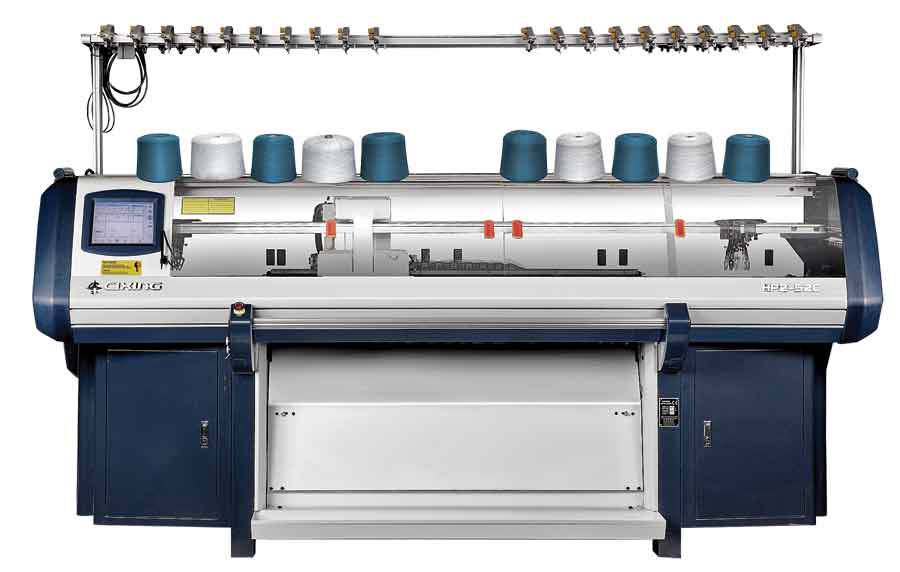
 There are 1,908 knit goods factories affiliated to the BKMEA and during the fiscal year (FY) 2010-11, the export growth of the local knitwear sector was 46.25%, with total earnings of US $ 9,482.06 billion. The core strength of the knitwear sector in Bangladesh has been its backward linkage. As a result, the knitwear sector has become almost self-sufficient for its fabric needs. Though popular for basic product categories, primarily using circular knit fabrics, Bangladesh is a huge exporter of flat knitted products as well, mainly sweaters. Thus the opportunities for flat knitting machine manufacturers in the country are tremendous. Eyeing the same opportunities is the Chinese flat knitting technology provider CIXING, which had recently overtaken Swiss flat knitting manufacturer STEIGER. Strengthened with the R&D from the latter, and coupled with its humongous production capability of 4,500 machines a month, CIXING is filled with ambition to tap the huge Bangladeshi knit sector.

Earlier, the Bangladeshi industry was extremely dependent on hand-flat machines for their flat knitted fabric needs, but the industry is seeing a huge shift to fully computerized machines with jacquard capability. CIXING is also a partner in this technology shuffle in Bangladesh. “We have sold 1,600 CIXING flat knitting machines this year and we are awaiting a confirmation of 1,400 more from another client. Our clientele includes 18 companies with prestigious names like Nexus, Scandex, Softex, and Ananta Target, Garib&Garib to name a few,” exclaimed Zalal Uddin Tuhin, Managing Director, Cixing Bangladesh Ltd., the Agent of the company in the country. He further adds that the reason to his stupendous success is that “Most companies are trying to move to the sweater sector, because margins are better. Basic knitwear is a safe category but the profit is minimal. Sweater is still a risky proposition, but profit is higher.”
Market acquisition in Bangladesh is not a piece of cake for CIXING, and its major competition lies with industry leaders like Shima Seiki and Stoll who have been in the country for more than 18 years. With the typical mindset that European machines are better than the Chinese machines in quality, it remains perplexing how CIXING counters this opinion. Tuhin explains, “There is a certain competitive advantage that our machines provide to our customers. Our machines are not just cheaper than that of our Japanese and German rivals, but they give the same productivity as them too. The cost of spare parts in our machines is lesser by almost 1/15th of the spare parts used by our competitors. The technical personal required for those machines is expensive. We do accept that their machines give excellent quality, but our quality is no less, it is well accepted in the industry.” Tuhin further stresses that cost-effective spare parts are a game changer in the longer run. “On an average the computerized flat knitting machine lasts for 10-12 years, but from the very second year, you have to keep changing the sliders, the jack, and other such parts,” he adds. So in the long run, our rival machines end up costing many a time more than our machines, putting a direct impact on CM.”
On asking, how does a company provide similar quality and productivity, at nearly half the price, Tuhin answers by quoting an example, “CIXING machines and Europian machines come with software from Logica, Italy. Since CIXING holds 1/3rd market share in the company, we don’t have to incur the same software cost. Also, our acquisition of STEIGER has enhanced our R&D, especially in intarsia. Thus the scale of the company allows us the benefit to achieve similar performance at a reduced price.”
After-sales service is the key determinant of a technology provider success in any industry. All CIXING machines come with 2 years warranty, of which the first year is directly under warranty from Ningbo Cixing, while the second year warranty is covered by CIXING Bangladesh. Further, CIXING Bangladesh provides free training, as well as regularly carries workshops to update the industry on new technologies. Tuhin says, “Our machines run two programs, one is pattern program and other is the technical program. We have admitted 36 people from BGMEA university of Fashion Technology, and prospective customers who are being trained under us, 20 in patterns and 16 in technical field. We plan to train 40 more. We have called for the teachers from China itself.”
The biggest challenge that Ningbo Cixing faces now in catching up its rivals is that both Shima and Stoll are selling machines on credit, something which is not under CIXING policy. Instead Tuhin is trying to work on the financial side. He further adds, “Bangladesh is can only open LC for 360 days’ time. If we give them 5 years or 3 years’ time, they would buy more machines.”
Presently the company has a turnover of US $ 300 million. Although apprehensive of the political instability in the country, Tuhin concludes, “We are planning to sell another 3000 machines next year, if everything goes right.”