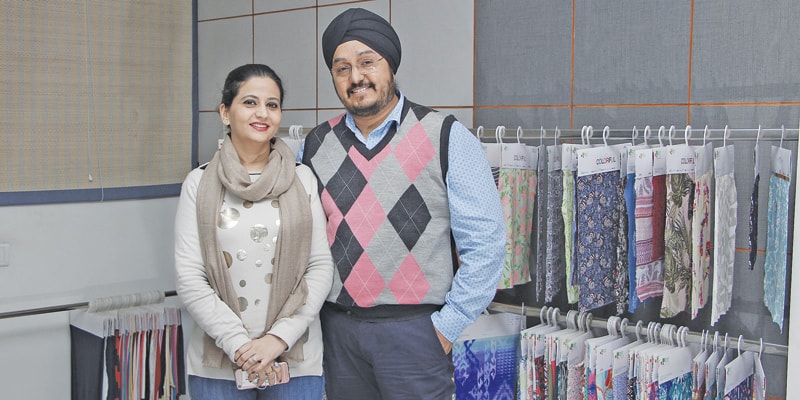
Being one of the top fabric manufacturing and process houses in Delhi-NCR region, Bir Horizons is known for its knitting, dyeing, rotary printing, raising and sueding capabilities. The company derives its strength from real assets – manpower and experienced management, besides manufacturing in-house fabric with installed machines to deliver an array of premium quality fabrics. In conversation with Apparel Online, Jasbir Singh, MD of Bir Horizons shares how Delhi-NCR is growing as a knitting hub and firming the internal strengths of his company in fabric and processing.
Primarily known for value-added services such as beadwork and hand-embroidery, the Delhi-NCR hub is continuously finding favour amongst buyers, as ‘differential’ products are becoming a norm. Added to the above good quality processing houses for washing and finishing, and the latest demand for beadwork or value-added services in knits, mostly printing, has made this region grow significantly as a knitting hub. “It is not investment in machines which makes this region good in value addition, rather it is the quality and expertise that is available in Delhi-NCR, which gives the region its reputation. Exporters are not interested in doing only stitching, they need beadwork which is the niche of this area. Though knits are mostly popular in Bangladesh and Vietnam, but there is no one who does these kinds of products globally. Also, Turkey does it but it’s more expensive than us. The demand started with beadwork in knit tops,” claims Jasbir.
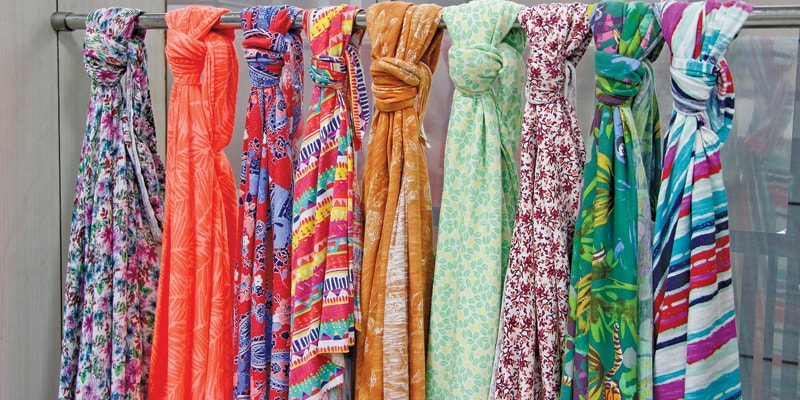 Taking advantage of the growing popularity of the hub in knits, the company has also ventured into overall printing that is visible on the fashion circuit for the past two seasons, even in men’s T-shirt. Earlier AOP (all over prints) had very little application, as 80 per cent knits produced were solids (without print) and only 20 per cent was with a print, out of which 15 per cent was taken over by placement prints and only 5 per cent was AOP. “Our printing unit was supposed to start in 2009, but it was delayed because AOP in menswear or ladieswear was missing and it made no sense to invest at that time. But now we are doing AOP,” confirms Jasbir. The company’s USP lies in rotary printing to ensure perfect prints with a capacity of 50,000 metres of printed fabric per day. Skilled and competent, the company can print on any fabric irrespective of it being viscose, 100 per cent cotton, georgette, pima cotton, etc. Of late the company has also stated processing and printing on woven fabrics, creating expertise in both segments.
“Printing is a tough game. It’s difficult to achieve a perfect print, quantity and price is regardless. You need to have sound knowledge and expertise in it. I am an opponent of digital printing; I feel technically if you see a good rotary print, it’s far better than digital. The manufacturers of digital printing highlight only the beauties of digital, but if anyone can create that in rotary, which is possible, it has so much depth,” asserts Jasbir. He points out that the manufacturers of digital printing highlight the shading effects of a print because Rotary technicians are not taking initiative to do it, but it is possible and gives better lustre. The only real problem is that Rotary needs longer runs to be viable while digital prints are only for smaller runs.
In times of the growing popularity of digital printing, the company relies on rotary printing and is passionate to create better designs from the technology. Jasbir refutes, “Water consumption is not more in rotary, but it is only in techniques/inks used. Pigment uses less water and not the machine that uses less water; it is after wash that it consumes more water depending on the ink. Also, depth of colour is only in rotary and nowhere in digital, although manpower and speed is much better in digital as compared to rotary.” The washing and finishing expertise includes various and latest techniques as also colour perfection in dyeing.
With a production capacity of 500 tonnes of knitted fabric per month from 11 circular knit machines – from the best European companies, Bir Horizons has a processing capacity of 500 tonnes per month and caters to 50 per cent of the fabric produced for job-work and another 50 per cent for its own consumption for final product.
Currently the company is nominated by 3 groups – Inditex, M&S and NEXT, demanding for their factories to be compliant and their processes transparent. The company’s unit is integrated by highly developed ERP system, which thoroughly checks all the stages of production efficiently and improves the department coordination in the unit. Bir Horizons has also been accredited with the ‘Certificate of Compliance’ by Global Organic Textile Standard (GOTS) and ‘Certificate of Confidence in Textiles’ as per Oeko-Tex Standards, ensuring best quality in fabric and processes used in manufacturing. Currently the company, which has its manufacturing unit in Greater Noida, is in process to implement a Zero Liquid Discharge plant, which should be operational in a month’s time.
With a 24-hour R&D laboratory that dedicatedly put efforts in making technical innovation and research in improving the quality of several fabric and structures, the company also has a team of designers.
Going forward, the company and its Managing Director have a mission that will make them a very niche player. “Right now I am in a run to do more prints; and I want to copy digital prints on my rotary. We have to do that otherwise in NCR we cannot survive. Also, if Delhi-NCR continues to do unique value-added work in knits, it will grow in the segment, otherwise it cannot compete on price alone,” concludes Jasbir.