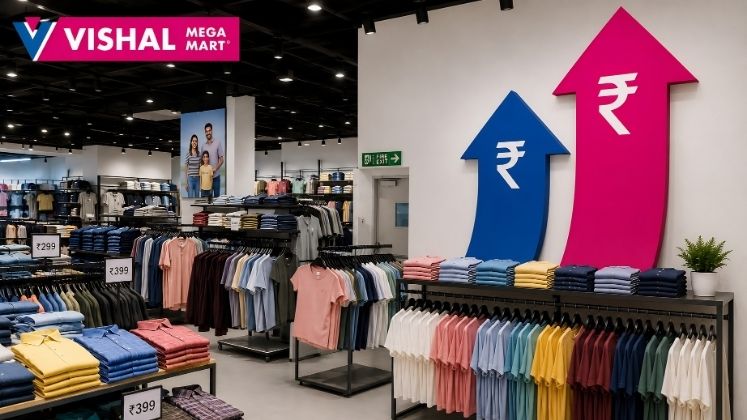
Vishal Mega Mart reported strong growth in revenue and profitability for FY ’26, driven by steady demand across its apparel, FMCG and general merchandise segments, alongside continued expansion of its store network across India.
The company’s consolidated revenue from operations for FY ’26 rose 20.44% year-on-year to Rs. 12,906.32 crore (US $1.34 billion), compared with Rs. 10,716.35 crore (US $1.12 billion) in FY ’25. Net profit for the financial year increased 32.8% to Rs. 839.23 crore (US $87.49 million) from Rs. 631.97 crore (US $65.88 million) a year earlier.
For the fourth quarter ended March 2026, consolidated revenue from operations increased 22.22% year-on-year to Rs. 3,114.10 crore (US $324 million), compared with Rs. 2,547.89 crore (US $265 million) in the corresponding quarter last year. However, revenue declined 15.16% sequentially from Rs. 3,670.41 crore (US $382 million) reported in Q3 FY ’26.
Quarterly net profit rose 45.88% year-on-year to Rs. 167.92 crore (US $17.51 million) in Q4 FY ’26, against Rs. 115.11 crore (US $12 million) in the same period last year. On a sequential basis, net profit declined 46.34% from Rs. 312.92 crore (US $32.62 million) recorded in the previous quarter.
Over the last five years, Vishal Mega Mart’s revenue and net profit recorded a compound annual growth rate (CAGR) of 23.72% and 47.8% respectively.
Apparel contributed 28.5% to the company’s revenue during FY ’26 and 29.1% during the fourth quarter.
Vishal Mega Mart continued to strengthen its physical retail footprint during the year, adding 25 new stores in the fourth quarter and 105 stores during FY ’26. As of March 2026, the retailer operated 795 stores across 535 cities in 30 states and union territories, with a total retail area of 13.45 million square feet. North India accounted for the largest share of stores with 305 outlets, followed by South India with 213 stores and East India with 197 stores.
The company also maintained a strong presence across different city categories, operating 205 stores in Tier-1 cities, 189 in Tier-2 cities and 401 stores in Tier-3 cities, underlining its focus on expansion in smaller towns and semi-urban markets.





 Bharat Tex Special Report 2026