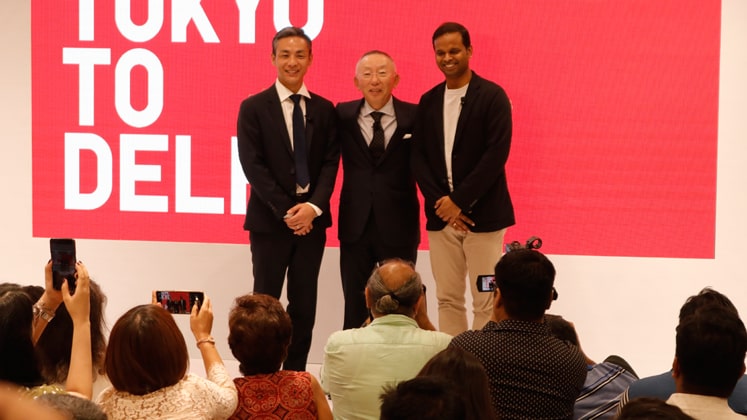
Even as the country is talking about the slowdown that the economy is facing, and there has been fear of apparel sales remaining subdued for months to come with the consumer demand and average ticket size getting comparatively smaller, national and international brands have not slowed down in their endeavour to offer the best to the Indian consumers. And one such major development in the Indian retail industry has been the entry of Japanese clothing giant Uniqlo in the country. In this struggling scenario, the fashion retail brand has bet big on the Indian market that is both ‘vast and diverse with a young population that is exceptionally talented, ambitious and diligent’. Uniqlo opened its first-ever store in India’s national capital, one of its largest worldwide, becoming the most recent global brand to take a plunge into this huge but considerably tough market. Was it a good time? Will the slowdown adversely impact the retail giant? Tadashi Yanai, Founder and Chairman of Uniqlo and President and Chief Executive Officer of Fast Retailing Group, smiles as he says, “I’m not worried. The economic slowdown is cyclical. Fast Retailing has long wished to open stores in India, in view of the tremendous potential of a nation of 1.3 billion people… (with) an average age of 27, that generates annual GDP growth of 7 per cent. Launching ourselves in this market is a step ahead towards globalisation. We aim to enhance lifestyles in India by creating more innovative apparel that draws on the nation’s distinct culture and traditions. We wish to contribute to India’s economic development in the process.”
India – a market like no other
Besides a major investment magnet, India has been fighting against the odds to remain at the forefront of growth. Even World Economic Forum (WEF) President Borge Brende remained positive about India’s crucial role in the development of South Asia and sustainability of global economic growth. A top official of WEF has maintained that India has demonstrated remarkable strength and resilience amid global slowdown. This and other such sentiments across the world form testament to Uniqlo’s confidence in the Indian market. “Recession or economic slowdown does matter, but we believe in sustainably taking the business forward and doing our best. We are not looking at short-term but are concentrating on long-term partnership with Indian consumers. Despite the recent slowdown, India’s growth rate is still higher than other countries. It’s a diverse market with different culture seasonality and regulations in different states, and for now, our focus in only on establishing strong operations and offering the best to the consumers. I don’t think that the slowdown will have much impact on Uniqlo,” asserts Tomohiko Sei, CEO, Uniqlo India. The brand entered the country as a wholly-owned subsidiary.
India has been home to a number of international as well as successful Indian fashion brands and while each of them is fighting against the other to grab a piece of this ever growing market, Uniqlo feels that the timing for its entry has been apt and the brand need not operate in accordance to other brands but rather bring to the people what they have been yearning for – quality product and excellent service. “For us, this was the perfect time to enter the Indian market because I think there are three components which fall in place right now. Firstly, the consumer taste and evolution for accessibility of our philosophy; we are a very simple brand but offer high quality. Secondly, I think the Government policies have been a great enabler for us, so much so that we applied for entering India in January 2018, and within only 20 months, we are here with our first store. I don’t think there is a better example of ‘ease of doing business’ than this mammoth scale of operation. Also, the Government’s move to relax the FDI norms and to liberalise its single-brand retail policy will enable the company to accelerate growth in India. All these components – our readiness, consumers’ readiness and the micro-macro economics – facilitated our entry to India,” informs Shantanu, Head of Marketing, Uniqlo India.
Look and location is the key
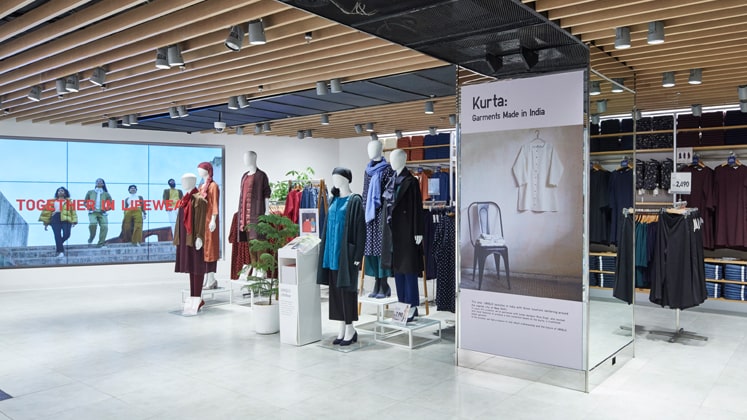
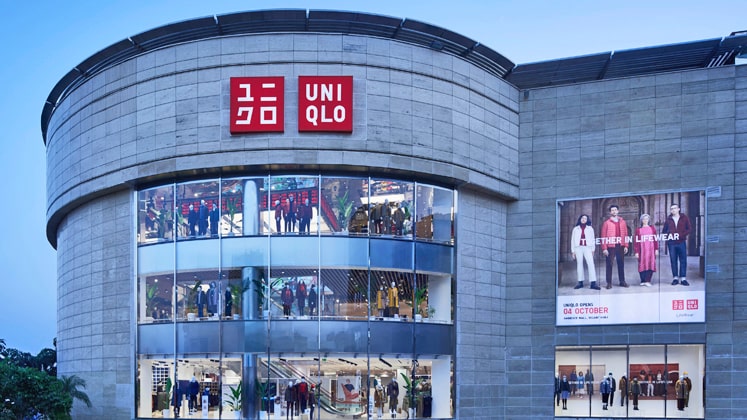
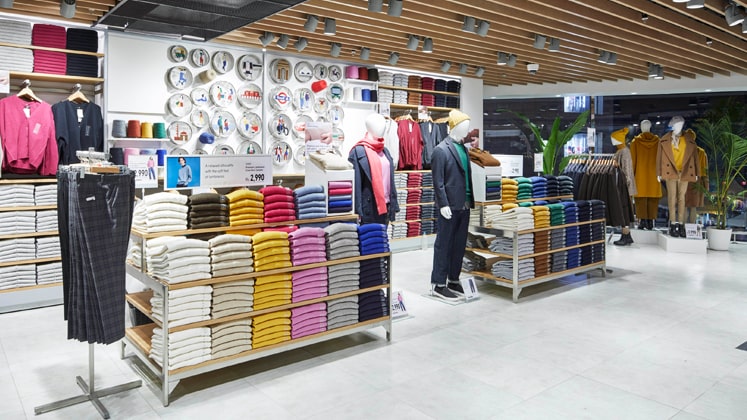
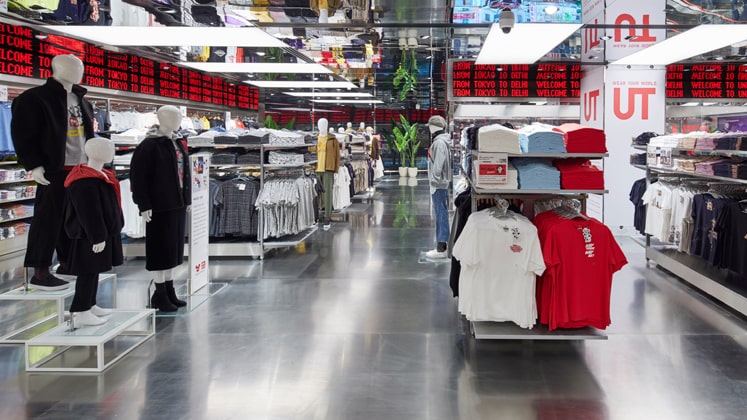
The Japanese LifeWear brand, which operates around 2,200 stores across 23 countries, opened its India store spread over a total retail space of close to 35,000 sq.ft. at Ambience Mall, Vasant Kunj, Delhi on 4th October. Covering three floors, the newly opened store welcomes customers with its high bay window façade even as the interior designs vary floor-wise, moving from soothing elements with natural materials that integrate the Japanese and Indian aesthetics to the high-energy LED ticker screen and stainless fixtures that convey a contemporary mood. In addition, the new store presents a large mural on all three walls facing inside the shopping mall that capture the essence of daily life in the capital created by illustrator Dattaraj M. Naik, while local artist Johnson Kshetrimayum has worked with embroidery craftspeople to create an installation using Uniqlo lambswool.
So, what really facilitated the decision to zero down on Delhi’s Vasant Kunj as the address of Uniqlo’s first largest store in the country? “Delhi has a lot to offer like diversity and seasonality. The city has a mixed population from different states across the country. Also, with our special collection including that of Heattech, Airism, etc., Delhi has the most to offer with its extreme weather conditions and an offering like ours will have optimum utilisation in a city like this. Our philosophy matches the lifestyle of Delhi and starting here would help us know better about the overall market,” avers Shantanu. While the brand started with Ambience Mall, it has plans to open two more stores in and around Delhi. The second Uniqlo store, slated to open in Fall 2019, will be spread across an area of approximately 21,500 sq.ft. over two floors in the newly rebranded and renovated DLF Avenue, Saket. The third store, again spread in two floors, will have a total retail space of around 12,200 sq.ft., at DLF CyberHub in Gurgaon. “All these location are decided on the basis of the right quantity of customers who are around, the kind of retail experience that the malls have, the accessibility, the availability of right size for the store, right set of brands around, etc. Ambience Mall fulfils our criteria and we have entered into a very good relationship with the management team of DLF, which has made the process rather seamless,” informs Tomohiko.
A product range that speaks for itself
Uniqlo Ambience Mall store carries a full line-up of LifeWear for men, women, kids and babies. This includes iconic Uniqlo products such as the innovative and functional Ultra-Light Down (ULD) and Heattech garments, as well as products featuring premium fabric like denim, cashmere, extra fine merino and more. Furthermore, special partnerships are on display throughout the three-floor store, such as the Kurta collection in collaboration with Delhi-based designer Rina Singh. Global collaboration lines include Ines de la Fressange and Hana Tajima, as well as the Uniqlo U collection created by the UNIQLO R&D Centre under Artistic Director Christophe Lemaire. One of the special features of this first Indian store is the UT section which offers a range of graphic T-shirts that are drawn by artists and graphic designers from around the world. With the UTme! service, customers can create personalised T-shirts with their own designs or with a range of Uniqlo stamps, including designs featuring tennis legend and Uniqlo Global Brand Ambassador Roger Federer. Tadashi asserts, “LifeWear represents our commitment to create perfect clothing that meet the needs of everyone’s daily lifestyles – high quality, highly functional, affordable and constantly evolving. LifeWear is inspired by life’s needs to provide thoughtful and timeless clothing available in a variety of colours and styles for people of all age groups. Keeping up this very philosophy, we have introduced the Kurta collection, developed by one of our garment factory partners in India and is inspired by the everyday wear of women all over the nation. In the years ahead, we aim to enhance lifestyles in India by offering more innovative apparel that draws on the nation’s distinct culture and traditions. We wish to contribute to India’s economic development in the process.”
Uniqlo has set itself apart from other competing brands, in that, it ensures that the brand understands the Indian market thoroughly and how it encompasses under the philosophy of LifeWear. The brand has entered India ‘not just to make revenue but to connect with the Indian consumers’ and so the brand has not set itself any short-term targets. Uniqlo prides in its diverse quality product range and is assured of the fact that the brand would not need loyalty programmes or measures to try to convince and lure the consumers. Shantanu elaborates, “It was shocking for me to know that there is nothing like loyalty programme in Uniqlo because the brand considers product experience as the biggest customer acquisition strategy. At Uniqlo, we don’t need to incentivise consumers every time to retain them. Once a customer uses Uniqlo, they become loyal to the brand and that’s the biggest loyalty programme ever. If a product is making a fundamental difference to one’s life, he/she cannot go out of the brand. For example, a simple product like wireless bra that brings about a difference in the lives of breastfeeding mothers who go through a lot of emotional and physical stress. We are talking about offering such life-changing experience. Uniqlo offers assurance and quality and that’s our biggest loyalty programme.”
Furthermore, Uniqlo gives special emphasis to customer experience and the brand is attempting to make it as convenient as possible to shop at its store. Customer service is a mandatory aspect at Uniqlo store. The brand had hired a number of employees from India last year for its new stores in the country, who underwent extensive training in Philippines for one year. “It’s a big investment for a company and is unheard of in the retail industry. The staff members are trained to offer the same level of customer experience as in any other Uniqlo store across the world. They are trained to observe the customer and not disturb them unless a customer looks confused or is struggling with something. Such service exists nowhere in retail but only in best of service industry. The brand’s endeavour is always to delight the customer,’’ boasts Shantanu.
Sourcing plans for India
Uniqlo has long-term expansion plans in India. The brand is betting big on Indian Government’s liberalised single-brand retail policy to accelerate its growth plans in the country – both on its own and through partner-led supply chain and local sourcing. As Tadashi puts it, “Rather than just selling clothes in India, we want to produce in India as well and will move forward with the ‘Make in India’ initiative.” Uniqlo does contract manufacturing and does not own any manufacturing facility anywhere in the world, but makes sure to oversee all the processes in order to offer quality product range. “We are working very actively within India as well to get the manufacturing done in the country itself. A key component of Uniqlo in India will be ‘Design in India, Make in India, Sell in India and Export from India’. We are working towards it and will ultimately reach there in time. While some of our products are being sourced/ manufactured in India, we are trying to scale it up in the times to come. We are working with the right partners and are scouting for more partners to scale. Given that, it is a 20-billion dollar sales group, there is a huge opportunity globally and we will get there and build a huge Indian manufacturing process. While Government requirement for local sourcing is a basic necessity, that’s not really our goal and we want to go much beyond it. Our goal is to develop Indian talent, creating employment opportunities through our plants and ultimately ‘Making in India’,” maintains Shantanu.
What’s for future?
Interestingly, India has welcomed Uniqlo with open arms. Overpowering economic slowdown, the Japanese retailer has clocked sales of Rs.2.2 crore in the first two days of starting operations in India, according to people aware of the matter. The company’s plans for the Indian market is an expansive growth in terms of retail presence as well as an array of innovative collection in line with its philosophy of Life Wear. The brand’s immediate plans to open two more stores in Delhi-NCR this Fall underlines its commitment to the Indian market and is a major step forward for its global business expansion. While the brand is not revealing its plans for the Indian market right now, ‘sky is the limit’ for Uniqlo in the country. “In Japan, every 7 in 10 customers use Uniqlo, which is an unheard kind of number for an apparel brand. This is the level we want to be at in India as well, going forward. Whatever it takes to achieve it, how so long it takes, we are targeting at reaching that level of consumer acceptance. To make Uniqlo accessible, we are working actively towards establishing a seamless online-offline experience,” says Shantanu. Uniqlo is yet to finalise on its online strategy but will definitely take the e-commerce route in India in the times to come. Talking about the future investment in India, Shantanu apprises, “There is certainly no limit to investment in India. India is a strategic market and investment will not come in the way of fulfilling consumers’ expectations.”

 Bharat Tex Special Report 2026