The global retail industry has been undergoing dramatic shifts since the past few years and even though there are some concerns about a recession period dawning over us, the sentiment remains hopeful – not to mention that consumers are still spending even though it’s not from any one particular place or platform.
Among the fastest growing industries in the world, the Indian retail industry is expected to grow to US $ 1,200 billion by 2021 from US $ 672 billion in 2017.
The Indian retail environment also poses as a fertile ground for retailers and brands alike, both domestic and international, owing to the massive growth opportunities it has shown in the recent past.
The current fashion retail landscape stands at Rs. 3,61,160 crore or US $ 54 billion, and is expected to grow at a promising CAGR of 8.1 per cent for next ten years to touch Rs. 7,88,532 crore or US $ 118 billion by the year 2028.
As retailers compete with each other to provide the best products and widest ranges at the lowest possible price in the market, the e-commerce industry expounds as a lucrative opportunity for retailers.
Fashion and apparel brands are taking advantage of digital channels to create demand and attract more and more consumers. Apart from inventory management, this also enables retailers to spend less on real estate while reaching out to prospective consumers in Tier-2 and Tier-3 cities. Services such as in-store pick-ups and omnichannel retail have matured the Indian market to the level of most international countries and are slowly gaining favour among consumers – both young and old.
Still, no opportunity comes without its own set of challenges. Leading Spanish fashion giant Zara’s profit after tax (PAT) dipped by 13.43 per cent to Rs 71.49 crore in FY 2018-19 in the Indian market.
This is to suggest that the price-sensitivity coupled with the thirst for newness in the consumer psyche. Medium priced apparel has proved to hold majority of market share followed by economy range and discount-driven purchasing options.
Apparel Resources rounds up its biannual report of seasonal bestsellers – for the Spring/Summer 2019 season, wherein we spoke to various retailers in the domestic market, from both Indian and international brands.
The purchasing behaviour of consumers in India still remains value-driven to a large extent.
“The customers today, are aware of the trends – however, now, they want to be safe in wearing something which is (a) very fashionable and (b) something that would continue for next season as well. They want to pick up a piece of clothing that can be worn in summer as well as winter,” told Anshul Grover, Sourcing Head for Jack & Jones and Only & Sons to AR.
Commenting on the overall consumer sentiment towards shopping, Anshul said, “Of late, in this particular season, footfalls have gone down across all the brands and that’s one thing which is quite concerning. However, it also brings us to the question of what exactly is the customer looking for?”
As explained further by Anshul, “Earlier there used to be consumers who would lap up a product even at full price, but today, the entire market has been disrupted by discounting which is a major concern among retailers and brands.” Thereby, he stated, “This is also the reason why we need to evolve and bring in something very different to the mix which would make the customer want to shop – something we as a brand, are already working on and will be unveiling in our upcoming seasons.”
There is no doubt that increased exposure to malls and technology-driven smart devices have positively impacted total apparel sales in India turning cities such as Delhi, Mumbai, Bangalore and Hyderabad, etc. as the top spenders. In a survey conducted across major malls and retail spaces in India, we found out that youth aged between 18-25 years, shop more, followed by working professionals between the age group of 28-32 years.
Gap, American Eagle Outfitters and Levi’s, etc., have all recorded success in their denim sales and are experimenting with new product offerings within their collections. Their highest raking shapes include the bootleg jeans as well as high waist styles with distressed finishes or washes.
Keeping the concerns surrounding sustainability in mind, fast-fashion retailer Zara, has refocused its business on offering sustainable products under an initiative called ‘Join Life’, an environmental labelling standard characterised by excellent environmental attributes. According to the Water Action Plan – Inditex’s Global Water Management Strategy, by applying the Join Life Standard, products are manufactured with sustainable raw materials and/or with best technologies under at least one manufacturing process.
Even though India as a market is highly dominated by tradition and festivities, there has been a surge in the interest for womenswear offerings. Keeping this shift in mind, the ethnicwear market is expected to account for 65 per cent growth by 2023.
Furthermore, brands have been concentrating on growing their menswear and kidswear segments as more and more men emerge as spenders in the Indian market.
STRIPES
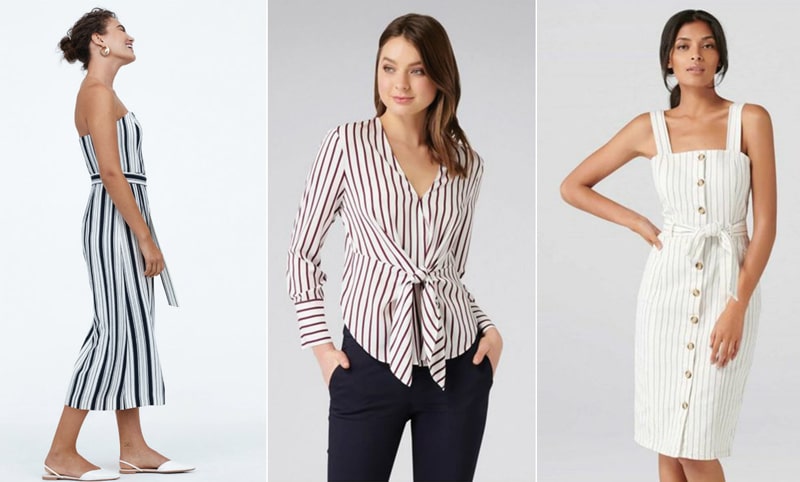
Cinched waistlines and knots have been doing the rounds since the past few seasons. Add to that the success enjoyed by stripes, and you have a winning combination.
Even within stripes it is observed that broad, vertical stripes in multiple and neutral colourways have performed better than nautical styles. The aftermath of Section 377 in India, also led to an outpour of rainbow coloured stripes.
“One of our sell-out styles has been the blue and white striped maxi dress with slits. A lot of middle-aged women have picked up this piece this season,” store manager of Promod, New Delhi, told AR.
Majority of retailers had striped midi-length dresses with a knotting detail at the waist over a white base. Forever New also introduced a striped knotted waist detail top in 3 different colourways.
DENIM
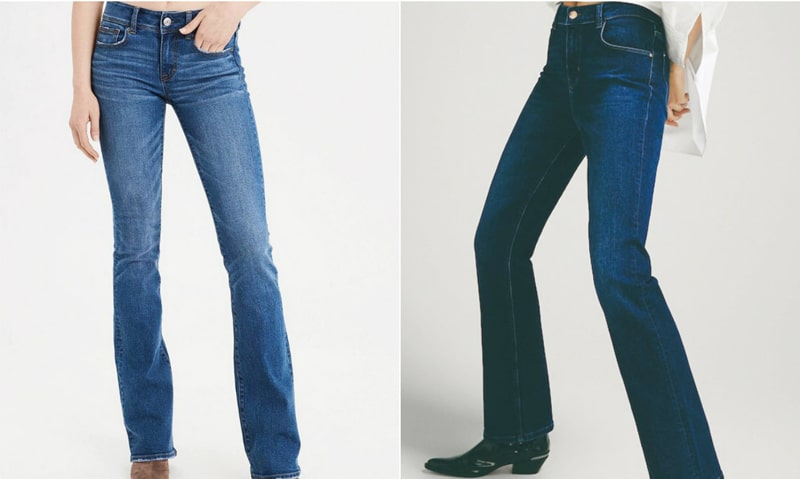
“Slim straight styles for men observed some of the highest contribution for us, whilst for women, high waist and distressed denim took up the major market chunk. Bootleg was also one of the fastest sellers for women in Northern India, and for men in Chandigarh,” store manager for American Eagle informed AR.
Global top performers such as baggy and mom style jeans are observing a slow pick up in the domestic market with consumers still preferring body fit and skinny styles more.
Speaking about trend, Anshul aptly noted, “In terms of denim, for us, cut and sew and distressed denim have been performing well, however, what we have noticed is that the focus of the customer has also increased towards a more smooth, cleaner and neat sort of finish. The fits are changing – earlier there was a demand for a slim fit and a super slim fit, but now it is more relaxed. Fabrics have turned – the customer wants to feel very comfortable wearing them, hence, the demand for rigid denim has gone down and stretch has come into play. For S/S ’19, knit denim did really well.”
American Eagle offers a wide variety of style in washes and ripped styles for both men and women, whilst retailers such as Zara, Levis and Forever 21 play around with bootleg styles in solid colours such as whites, dark blues and black.
POLKA DOTS
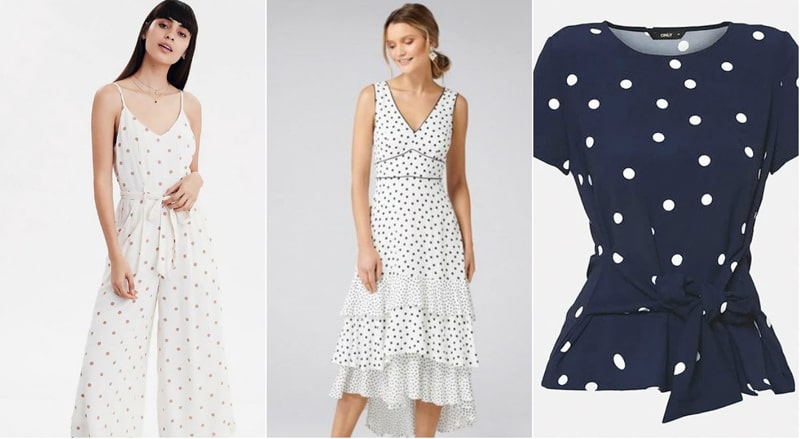
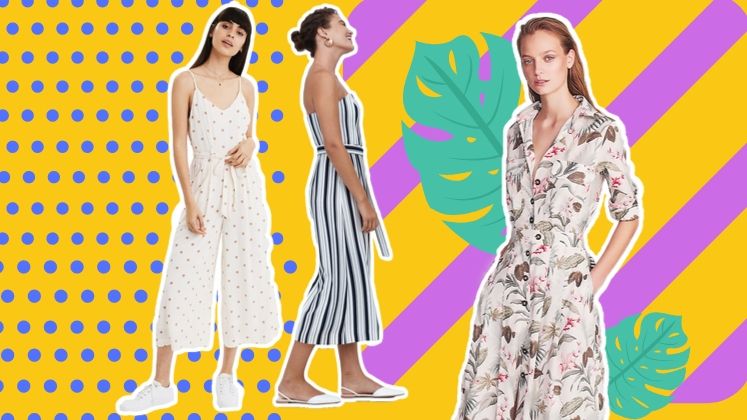
First gaining momentum in the 1940s, polka dots have reappeared time and again with variation in colours and/or sizing. Moving past their monochromatic aesthetics, Spring/Summer 2019 saw the sartorial specks evolve into more mature colourways and across product categories – not only limited to feminine dresses.
The growth in the domestic market has been quite astounding with domestic players such as Ajio.com and Koovs also introducing interesting styles in jumpsuits and skirts categories.
MOODY FLORALS
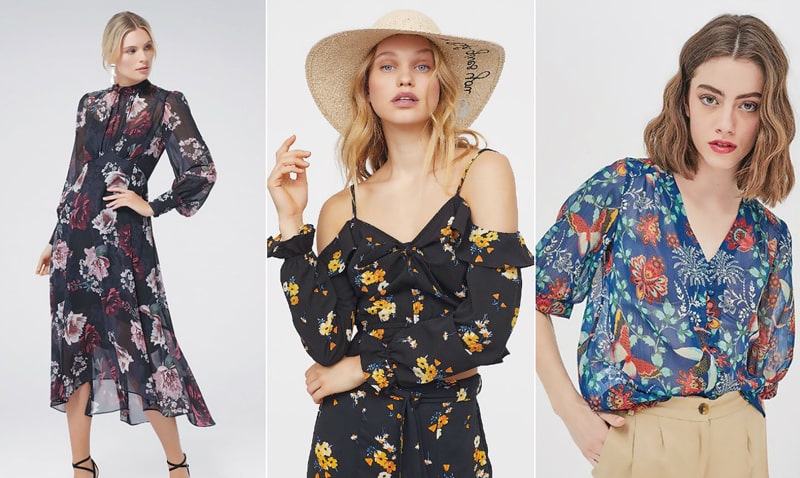
This summer took a backseat from overly refreshing and vibrant florals to instead embrace darker, moodier tones. Retailers across the board, stocked full blooms and ditsy floral patterns in darker colours over a black, blue or brown base.
Tops and dresses with a V-neck detail performed well for retailers such as GAP, Promod, Forever New, Forever 21, among others.
“Consumers have been moving away from pastel tones and asking for more darker and sunset-inspired tones. Florals over solid bases such as black, dark blues and greens have been prominent,” store manager at United Colors of Benetton, told AR.
TROPICAL PRINTS
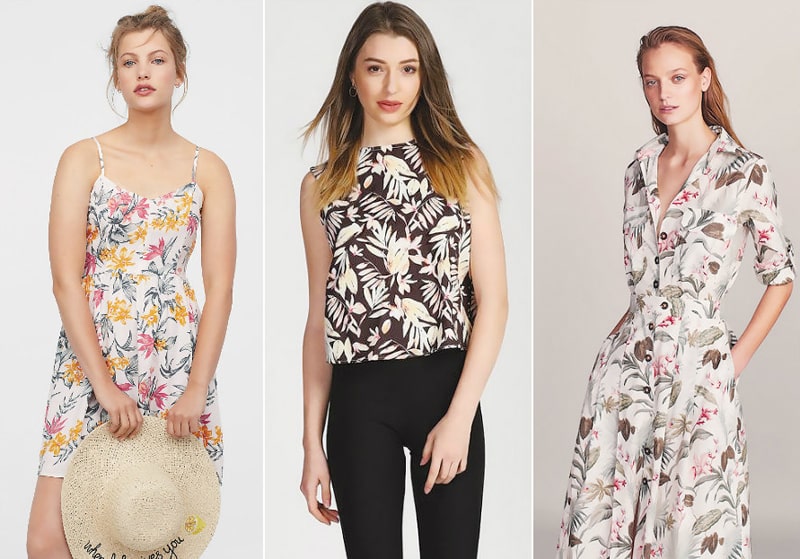
Tropical is the holy grail of fashion this year.
A by-product of the vacation and jet-setting millennial lifestyle, anything with a bit of tropical inspiration on it would sell.
Palm trees, cacti, bananas, watermelons, pineapples, waves, surf boards – you name it and brands have got it. Forever 21 tapped onto the festival lifestyle a la Coachella and introduced dessert-inspired sunset views, Massimo Dutti and Promod played around with soft pastels mixed with browns whilst Kazo went for a moodier look with leafy patterns.