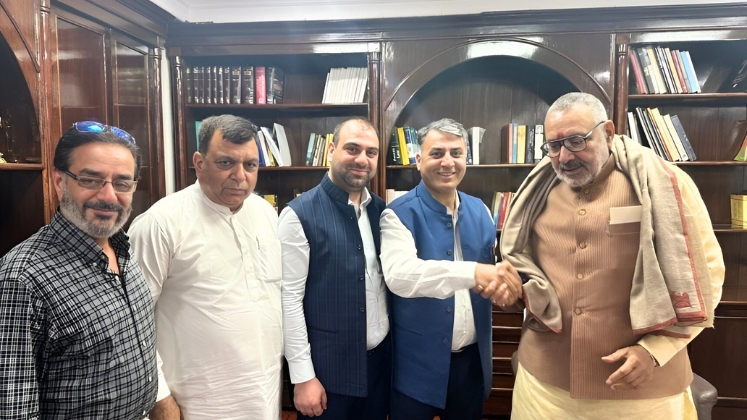
Giriraj Singh, Union Minister of Textiles, met with a delegation from the Kashmir Chamber of Commerce & Industry (KCCI), headed by President Javid Ahmad Tenga, at Udyog Bhawan. The meeting was called to address key concerns confronting the handicraft sector in Kashmir, which employs tens of thousands of artisans and weavers, according to a statement released by the KCCI.
The KCCI delegation underlined the importance of the Pre-Export Pashmina DNA Testing Lab at SKUAST Srinagar receiving accreditation from the Wildlife Department and NABL. This accreditation would expedite export procedures, avoiding seizures and hold-ups that frequently result in order cancellations and harm to exporters’ reputations.
The delegation outlined the problems with the current woollen and pashmina shawl ROSCTL (Rebate of State and Central Taxes and Levies) system. They made the point that expensive goods, like Pashmina shawls, which can cost hundreds or even lakhs of rupees, are disproportionately affected by the current maximum of Rs. 438. To secure proper export benefits, the KCCI advocated adopting a separate HSN code for Pashmina and value-added shawls.
The designation of handicraft clusters in Kashmiri districts was another important subject. The success of Kanihama village in Budgam District, which was designated as a Handloom Village because of its prolific production of Pashmina and Kani Shawls, was highlighted by the KCCI. They recommended giving the north belt of Kashmir, which is well-known for its handcrafted silk carpets, and other areas with sizable concentrations of handicrafts the same distinction.
In order to encourage the export of handicrafts and other goods, the team also suggested going on market research trips to the US, Europe, and the Middle East.




 Bharat Tex Special Report 2026