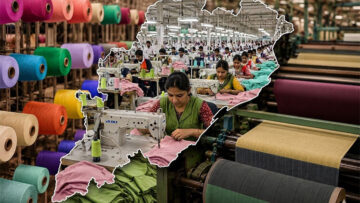
Mass manufacturing for export and domestic is synonymous with StitchWorld, where the technology and management of manufacturing segment is well highlighted. Continuous dialogue between technology users, developers/suppliers of technology and the management consultants has helped companies to imbibe best practices and benchmark solutions.
However, the manufacturing for haute couture segment is usually neglected due to smaller scale of operations or overemphasis on glamour, and is often in need of technological intervention.
This might also be due to the reason that this segment is not that big or mainstream, but will surely share a huge chunk of the retail segment in the time to come. With this new series, Team StitchWorld will cover the manufacturing of haute couture, the philosophy, process and challenges.
A total of 1000 people are employed in the manufacturing operations, at Tarun Tahiliani’s unit in Manesar, on the outskirts of Delhi, of which 400 are completely dedicated to hand embroidery, which shows how much importance Tarun gives to the quality of the product, as exquisite embroidery is the niche of the brand. Rightly so, Tarun Tahiliani is looking at achieving a turnover of Rs. 55 crore by the end of the next financial year from a present turnover of Rs. 45 crore.
Signature style
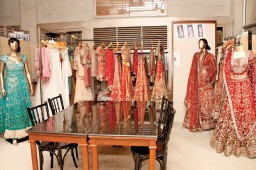
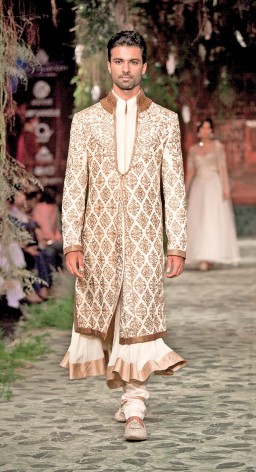
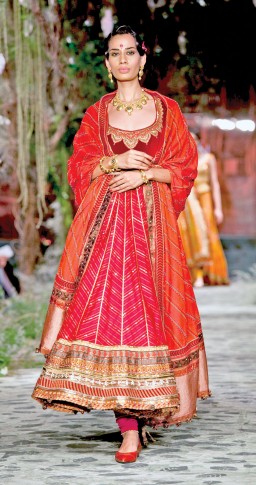
Just like any haute couture manufacturer and fashion designer, Tarun Tahiliani also has two collections – Ready to Wear (RTW) and Haute Couture. The RTW range starts from Rs. 4,000 and goes up to Rs. 6,00,000 and the haute couture range starts from Rs. 6,00,000 and goes up to Rs. 20,00,000. The USP of brand Tarun Tahiliani is brilliant drapes, subtle detailing, along with ethnic embroideries like aari, zardozi and chicken work including crystal work. Apart from that, fagoting, smoking and other techniques are also used beside surface ornamentation through printing and texturing. However, embroidery is still the signature of value addition, while other means of surface ornamentations like embossing, laser engraving, laser cut work, computerized stone and metal attaching are less explored.
For the RTW collection there are two seasons with different collections divided across a set of months throughout the year. The lead time for the RTW collection is about 30 days and for the haute collection it can extend from anywhere around 45 days to two months. The sizing research done by Tarun Tahiliani for catering to the Indian domestic market actually gives its RTW collection the definite edge. While the sizing research effort by Tarun might aim to solve his specific problem, it reminds the importance of a nationwide sizing survey for Indian consumers, which is still missing.
Fabric development
[bleft]For the RTW collection there are two seasons with different collections divided across a set of months throughout the year. The lead time for the RTW collection is about 30 days and for the haute collection it can extend from anywhere around 45 days to two months.
The sizing research done by Tarun Tahiliani for catering to the Indian domestic market actually gives its RTW collection the definite edge. While the sizing research effort by Tarun might aim to solve his specific problem, a nationwide sizing survey is still missing. [/bleft]
The design house uses a lot of silks, georgette, chiffon, crepe silk, mix of cotton silk, handloom fabrics, cotton based fabrics and brocade in the garments. There is a strong focus on development of new fabrics with innovative prints and weaves, and they develop their own designs for jacquard, burn-out fabrics and satin. Most of the fabrics are sourced from India, whereas the silks are usually imported through Indian agents from China. Fabric testing like GSM check, tearing strength and rubbing test for dyeing, etc. takes place in the in-house testing lab.
Designers involved at all stages
Similar in setup with any other good manufacturing unit, the first sample garment is checked for style and fit and final finished garment is handed over to the production team along with the techpack having all the minor but necessary details like measurements, colours and embroidery. Since the company is design-driven, the complete communication channel is very transparent, swift and both-ways. Unlike an apparel manufacturer where the job of the junior designer ends after the product’s design has been finalized, the designer would be involved in the manufacturing, dyeing, fitting and routine quality checks.
Product development

A lot of research goes into the product development, Tarun would finalize a concept and theme for the season or a collection and the designer would start designing and sketching the styles based on the range plan given to them by merchandisers, as an example if kurtas are seen as a trend than there will be more kurtas designed. Even for embroidery the design house has an embroiderer supervisor working along with the designers. All the swatches are prepared and then they are clubbed and a final drape session takes place to see how it will look on the garment.
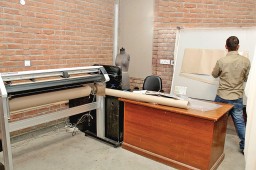
Like any other design house, after the fabrics, embellishments and designing, comes the most critical part of any customized high-end apparel – the fitting. To address that, the company has a well-defined sizing chart specifically for its RTW (Ready to Wear) collection, and on the lines of the same, measurement charts have been finalized for precise fitting and draping of the garments. Mannequins are used for all fitting related purposes and the fall of the garments is also checked on the same. While for pattern making TukaCAD system is used, marker making is still done manually due to too many styles in multi-colours. Preventive quality checks takes place at the pattern making stages only, via precise placement of notches and darts, for the operator to work upon.
The sampling of all the garments in the RTW segment is done with the cooperation of the designers and the production staff, and only they are responsible for exact conversion of a design into the perfect apparel.
Production & Quality control
[bleft]Since the company is design-driven, the complete communication channel is swift and both-ways. Unlike an apparel manufacturer where the job of the junior designer ends after the product’s design has been finalized, the designer would be involved in all the stages of manufacturing [/bleft]
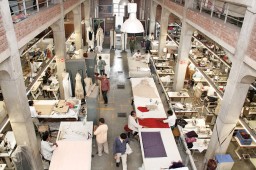
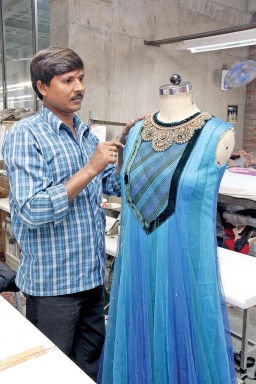
A single tailor is responsible for complete sewing operations of a single haute couture garment. Being a design house, apparel manufacturing is not considered to be its core competence, and also the price of the final product is not of too much of a concern, even then the emphasis is given to productivity and efficiency of operators. Most importantly the quality of final product is of supreme importance and a quality control specification sheet of the garment is given to each sewing operator or attached with his machine, exercising all controls. The provision of specification sheet to every sewing operator confirms to the principle of ‘every sewing operator is a quality inspector’ and it is the priority; to ensure the same focus is on the training of the sewing operators. For further ensuring the right garment first time, mannequins are placed in the sewing line for perusal of the sewing operators.
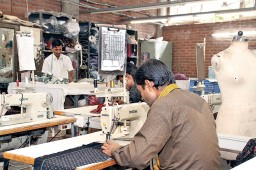
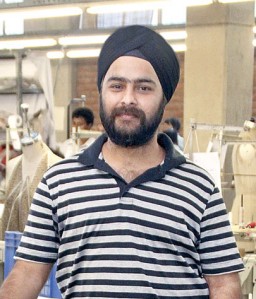
The company enjoys low attrition rates, as its pay grades are well above the industry norms, and since the job is not production, but rather quality-driven, the operator is never under pressure of output. Only skilled (not high but basic) operators are recruited by the brand and trained for a period of 1 month, as more than the operations, understanding the quality of garment, material handling and the drape and fall of a garment needs to be developed in an operator. Unlike export houses, where emphasis on sewn garment is more, draped garment is common with many designers. According to Tarun a good tailor also requires a month time just to get the feel of the drape of the garment. Neither expertise nor training is available for this skill currently in market..
Due to the same reasons the company doesn’t have any sort of in-line quality checkers, although to ensure quality a line quality inspector monitors the sewing operators twice every day. Due to smaller quantities, the same QC checks the garments at the final stage of finishing, i.e. after completion of all the sewing operations, for the measurements, fall and fit of the garment. Meetings are held daily to discuss shop floor related quality issues and a record of defects per hundred units (DHU) is kept by the organization. Moreover Tarun himself checks every garment produced under the brand’s haute couture collection.
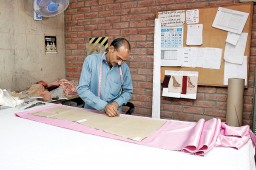
The cutting room doesn’t have automated cutting and spreading equipment, as none are available in the market for handling heavy embroidered fabric handled by the brand. Hence the cutting is done manually with scissors, and especially for haute couture extra seam allowances is given as compared to regular garments, to have enough scope for many alterations.
This could be avoided if trained fit technicians were freely available, however since no such course exists with any institute it has become a handicap for the company and also 3D simulations software used for draping virtual garment on dress form and check fitting is too expensive at present, Since cutting by scissors throughout the day is painful as well as non-ergonomic and time consuming for cutting masters, the company is planning use of mechanical scissors or hand held round knife cutting machine, which will reduce the problem and once scale permits, automatic single ply cutter will be used.
[bleft]The provision of specification sheet to every sewing operator confirms to the principle of ‘every sewing operator is a quality inspector’ and it is the priority; to ensure the same focus is on the training of the sewing operators. For the same purpose, mannequins are also placed in the sewing lines [/bleft]
To ensure quality of the cut parts provided to the sewing department, 100% cut part inspection is carried out, prior to bundling. In the ready-to-wear collection, various components like collars, cuffs and plackets are done in various group assembly lines.
This helps in defect detection as it is easy to back track the point from where the defect has risen, as if the defect is in collar preparation it would be the responsibility of the part preparation line, and if it has not been attached properly it is the responsibility of the final assembly. In RTW, it’s like 20 operations divided among 4-5 people. While all 4 of them are capable of making that garment individually, but to achieve better productivity and standardize quality in all parts, part wise allocation is done.
The way forward
There is an absence of high-end automated machines due to shorter quantities and intricate designs, as the ROI cannot be worked out. Moreover no machine manufacturers and suppliers have any sort of solution or machine for Indian ethnic wear. For example the company did try using blind hem machine for hemming saree bottoms, but was not possible due to the unmanageable dimensions of the garment as the machine starts sucking the fabric. It would be a worthwhile challenge for machine supplier to suggest the right feed type, skip ratio and thread tension adjustment to solve the problem, as most of the machines are available for mass production of regular garment, whereas the company needs the exact opposite. Although the basic lockstitch, chainstitch and overlock machines from well-known German and Japanese companies are available. Microsoft Navision ERP solution is also used by the company for accurate inventory control and record of all the internal and external transactions.
As the company has lots of styles and quantities are small, neither assembly line nor whole garment tailoring system would be appropriate. The sewing department should explore adopting teamwork or modular system where a group of multi-skill workers complete the garment. The modular system uses best of both, just the right mix of specialized machines and attachments to give the quality consistency and productivity while still retaining the flexibility of sewing multiple operations in one machine and small quantity in small team.