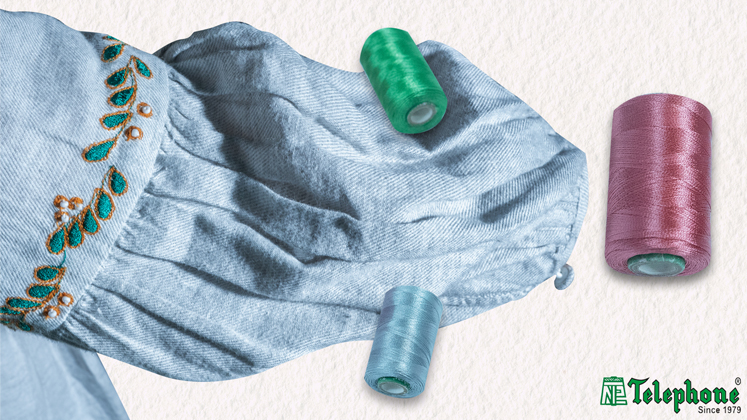
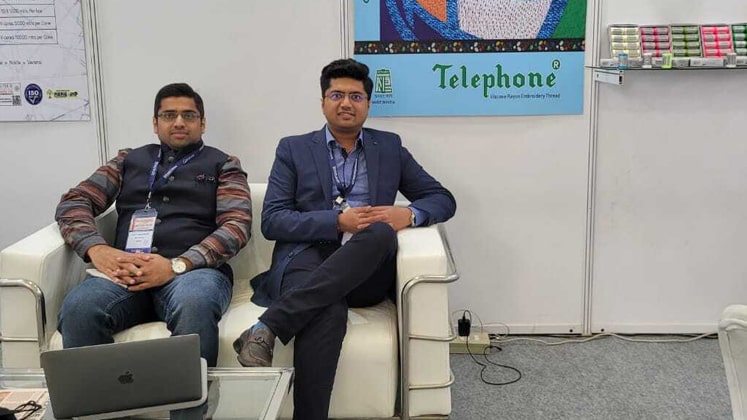
Delhi-based Neelam Thread Pvt. Ltd.(Telephone brand) – a pioneer of the Indian thread industry and a leader in supplying Viscose Rayon embroidery threads – has been holding strong grounds in the segment for nearly four decades. The company is now increasing its thrust on spun polyester threads and is geared up to expand its infrastructure and add more colour shades. Ankit Jain, Director, Neelam Thread– a young and dynamic next-gen entrepreneur carrying the legacy of his father Late Satender Kumar Jain(Founder of Telephone Thread brand)along with his brother Amit Jain who is also the Director of the company– recently sat with Team Apparel Resources and, in the freewheeling conversation, he shared the company has positively sailed through hardships caused by increased raw material price, and liquidity crunch among many more and is now well on track to ensure it follows a well-defined growth track.

Satender Kumar Jain, Founder of the company was a visionary and philanthropist. He was known for his caring nature toward his workers and employees. He started from the scratch and with his hard work and passion, served his clients in the best way and helped Telephone to become a successful brand in the thread segment.
“From day one,our Founder Satender Kumar Jain focuses on quality and customer service and these are the two major reasons that have taken the company to where it is today. We are also following the same policy and will continue it always,” shares Ankit, who joined the business in 2009 after completing his MBA and immediately found that the major challenge he was about to encounter was to align with the established working systems of the company and improve the existing traditional methodologies to make it more organised and automated. All this was successfully done with a lot of mutual discussions among the internal teams that were open for change. The company systematically invested in high-end machine dyeing, spectrometers, radiofrequency dryers, etc. that paved way in tough time like COVID-19.
Upbeat about business…
The demand for embroidered products has always been there and India has been a preferred place for buyers in this segment. Ankit sees that this demand is only increasing as buyers are looking for garments with a heavy embroidery design, while they avoid digital print! This is exactly where Telephone Thread is capitalising on the situation, hopping on to the embroidery trend and finding it easier to push its high-end embroidery threads…
“After October 2021, the business has revived with good demand for embroidery threads and this year might result as the golden period for Indian textile and apparel industry as many buyers from across the globe are coming to India for apparel sourcing. I feel that buyers have now become more quality conscious for sourcing accessories, especially thread. We are very positive and looking forward to doing great business with new innovations and opportunities,” mentions Ankit.
He further adds, “India’s top designers to leading garment exporters are using our threads. And as both markets are improving, I am sure that 2022 is the year of doing great business and we are grateful to all our buyers for being so loyal and consistent over the years. We acknowledge their continuous support and trust on us and look forward to the same in the years ahead.”
Amit Jain, B.Tech in Electronics and Communications Engineering, takes care of production and over the years, he has developed an expertise in thread manufacturing. Leading a team of technical professionals, Amit is the backbone of quality and timely production.
Expansion in product offering on the cards…
To give best of the services to its clients, the company has made it a practice of keeping three months’ stock of its 600 shades, though the inventory cost always puts pressure on the margin of the company, yet it helps in immediate delivery. “This helps us deliver the products in 2-3 hours, while other companies usually take at least 2-3 days for the same,” informs Ankit who further avers that, to take maximum advantage of this enthusiastic scenario as apparel manufacturing businesses are on the rise, the company is going for an expansion plan with an investment of around Rs. 7 crore and will help to increase the production capacity by 40 per cent.
“Currently, our thread production capacity is 50 tonnes per month which is supposed to reach 70 tonnes after the expansion takes place. As our dyeing capacity is still underutilised, thanks to initial investment we made in the segment, we will be able to dye around 70-80 tonnes per month with in the existing infrastructure,” tells Ankit.
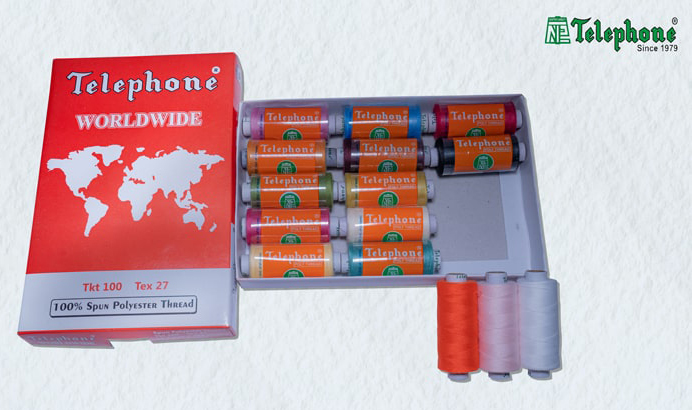
Just a few months back, the company introduced 120 new colour shades in its viscose embroidery thread, aiming to tap fashion designers, apparel export and buying houses as they can play with new vibrant shades. These shades will be available in market very soon. The company has a total of 600 colour shades in its colour chart and is continuously developing the same. Neelam Thread has long been focusing on viscose threads, however it is well aware of the fact that spun polyester thread is also a huge market and it needs to grow its focus on polyester embroidery threads as well. Ankit observes that the buyers are on continuous look out for more polyester threads now and the major reason behind the same is comparatively less costing of spun polyester threads. It also gives matt finish embroidery on garments.
“As of now, the company is catering mainly to garment exporters and fashion designers in India. While with the spun polyester threads, we will be able to enhance our reach,” sharesAnkit.
Along with the viscose and polyester threads, the company also offers Trilobal Polyester Embroidery Thread and metallic zari thread, and in long run, it has a vision to offer the entire range of threads including cotton-based threads also.
Ensuring Quality…
A good quality thread in viscose depends on twisting consistency as its raw material is natural and has variations, while, in spun polyester, major concerns are elongation and lubrication.
To maintain consistent colour throughout all orders, the company is maintaining a thorough due diligent process –a proper lab, colour eye patching system, use of spectrometer for colour matching and use of a delta e-ratio which should not be below 1 for export quality. It is using all the parameters as defined internationally to maintain consistent colours throughout orders.
From the raw material sourcing to final packaging of threads, there are almost 7 processes and along with the state-of-the-art infrastructure, there is a very well-experienced and trained team for monitoring at every stage. “And every single tube is checked by two experts at every stage of processing in the company before final packaging,” says Ankit.
Challenges to overcome and strategies…
The major difficulty for companies like Neelam Thread is the high yarn price. In the last few months, viscose price has increased by almost 30 per cent and polyester by 40 per cent. Not only high price, even availability of the raw material is also a concern.
“We make an advance payment of raw material, while our finished goods go on credit. At the same time, we have inventory costs also, so the combination of all this creates a financial crunch. We pass a certain percentage of the increased raw material price to our clients but not the burden of the financial cost. It has resulted into a very thin margin for us,” says Ankit who also believes that all this will repay the company in the next few years with improving business.
To minimise the cost and at the same time to support the environment, units of the company in Delhi are running completely on solar energy. In the coming years, its unit in Barhi industrial area (Sonipat) will also be using solar energy. Similarly, all 3 units of the companies also have a system of rainwater harvesting and, very recently, the company has replaced all lights with LED.“Sustainability is our focus, so we were the first Indian company having Oeko-Tex certificate for viscose thread,” claims Ankit.
Neelam Thread believes there is no major competition in the viscose thread segment for them, while, as the company is following a slow and steady approach in spun polyester threads, Ankit doesn’t see competition in this segment also.





 Bharat Tex Special Report 2026