India’s recognition in the international market benches on its ability to do hand work on a garment, and the garment exporters too exploit it well for profits. But for how long can they keep doing it! Today, most of the home workers doing hand work are a dwindling lot with not many wanting to join the trade and only a few wishing to continue with the profession, all because of no gains as a result of lack in fresh design inputs and training opportunities to know more, so as to improve more and produce more to earn more.
It is encouraging to know that a training module does exist for hand embroidery with the Government of India, which includes practical training, theory part and the issue of health and safety. These courses are running in various institutes like ITI’s (Industrial Training Institutes), by few NGOs like SEWA in their two centres at Ashok Nagar and Sunder Nagari (Delhi) and by some independent bodies such as SPYM (Society for Promotion of Youth and Masses) in Haryana. But all these centres have their limitations as they are not in designated areas of the home workers like in their villages or sites, neither does this training module encourage new designs and improved productivity of the persons.
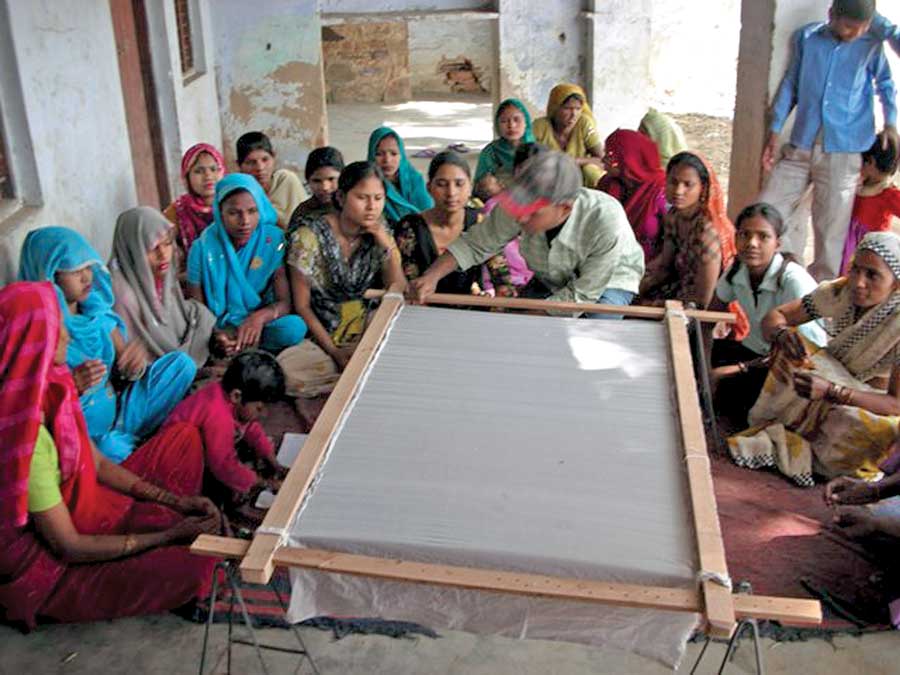
These training modules are meant for freshers, but in actual practice the children learn the trade from the family members and do not seek courses to get the first feel. Probably what is required, is an advance training for the practitioners, a small but comprehensive knowledge on the input material like thread selection or creating colours as also extensive knowledge of work aids and tools for embroidery, proper and efficient use of needles to increase productivity and improved workmanship of a person. In nutshell, a regular kaizen exercise in progress; and certainly not in a classroom environment but at the place of their work and in the comfort of their homes.
Delhi-NCR alone has more than 500 contractors offering hand work from home workers and a majority of these contractors have no information about training options, nor do they have any arrangements of the same at their offices/centres. Not only that, even exporters have never asked or showed any interest for their training. Whenever a new style comes, their master or designers explain it to the contractor what they need and who in turn conveys the message to the sub-contractor or the ladies directly who by hit-and-trial make the design work.
Kapashera, Delhi (near Gurgaon), Kotla, Shahpur Jat, Molarband village in Delhi and some areas of Faridabad and Noida are hubs of such home workers where big or small, every order can be completed but there is nothing in the name of systematic training. In fact, contractors feel strongly that training will be a major skill booster for home workers. At Kalchina, a village near Modi Nagar (UP), more than 2000 women have expertise in smocking embroidery and they pass the art of the work to new workers; however, if smocking is not in fashion they have no work. “We do realize that these workers need to be trained in other allied areas too but the export houses are not interested to train them,” admits one contractor. He also feels that with the training these ladies will be more productive and quality-focused. The training will make their work like professionals, as of now they take the work very casually, just as a source of extra income.
Few exporters of Delhi-NCR have their centres in Bareilly, Sikandrabad, Garhmukteshwar, Moradabad (all in UP); however the prime focus of these centres is not training, but to eliminate the contractors and sub-contractors from the chain and ensure ethical practices. Other hubs like Lucknow, known for Chikan Kaari, don’t have any such centre, even if one tries to train the artisans, the local goons and contractors put hurdles as they don’t want them to grow. Even companies, which have hand workers in their factories, do not take initiative to enhance their skills.
What the Industry has to say…
“Quality and similarity of work was the achievement of our training efforts in Kanpur and its surrounding villages. We regularly sent small batches of women from Kanpur to Malihabad (27 kilometres from Lucknow) to get training on very fine handwork. These trained women further train others and we were able to get the same work in Kanpur for which we were earlier dependent on Lucknow. Still I feel women need training at two levels; to understand the values of quality as these garments have high FOBs, so no fault can be ignored; secondly, they should realize the value of their work, as they are working for the top retailers of the world.” – Sujata R Seth, Director, Sujata Enterprise, Kanpur (Export house working with more than 600 women of Kanpur and Farrukhabad).
“With the help of Rotary Club we initiated a centre in Kamta village near Lucknow but it could not continue due to local issues. Training will empower such ladies working at their homes and help the industry to get quality; more availability of such workers will ultimately save time. There are thousands of home workers in Lucknow who need this type of training.” – Shishir Kapoor, Director, MLK Exports, Lucknow (Export house known for Chikan work in its collection).
“We did a lot of training in Hatin and surrounding areas of Mewat and trainers provided by Orient Clothing were quite impressed by the learning ability of the home workers. Workers had a good base and we upscaled them, which enhanced their productivity and quality so that alteration rate was almost nil, which was a good achievement. It also became easier to get the minimum wages for the women. Now after a gap of two years, we are starting training of adda work by 4 industrial professionals without even having any work from export houses. So we can be prepared whenever we will get the orders.” – Rajesh, Executive Director, Society for Promotion of Youth and Masses (SPYM), Delhi (SPYM is connected with more than 1,000 home workers having command of adda work and crochet.