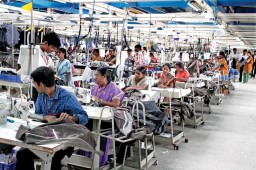
The suit manufacturing facility of Aditya Birla Nuvo Ltd. was started way back in 2001, by the name of Crafted Clothing with an initial capacity of 400 suits per day, which was later increased as per the rise in demand to 2500 suits and 4000 trousers per day. The facility manufactures suits for all of Madura’s brands, namely, Louis Philippe, Van Heusen, Allen Solly and Peter England, both for the men and women segment. The manufacturing facility is a culmination of visits to various suit manufacturers around the world by the team before establishing the factory. Team StitchWorld recently visited the facility, specializing in Made to Measure (MTM) segment, to better understand the many criticalities of suit manufacturing and how Madura has maintained the title of ‘World Class Manufacturing’ since its inception.
With quality and on-time delivery at its core, Madura Clothing has always outdone standards set by itself by not only focussing on concepts of Lean manufacturing but also keeping employee engagement and involvement at the core of its operations. The facility was setup under the guidance of Italian technicians for the first two years, and currently has 3 lines for jackets and 9 lines for trousers, translating into near-about 337 sewing machines for jackets and 423 for trousers – a total of 760 sewing machines along with 185 pressing and ironing machines. “We are arguably the biggest suit brand house in the market today,” says Jayarajan K R, General Manager – Category Operations (Suits and Trousers), Madura Clothing proudly. “The distribution ratio of sewing machines between the part preparation lines and final assembly keeps changing as per the style in production but is roughly 65:35 in case of jackets and 35:65 in case of trousers,” he adds.
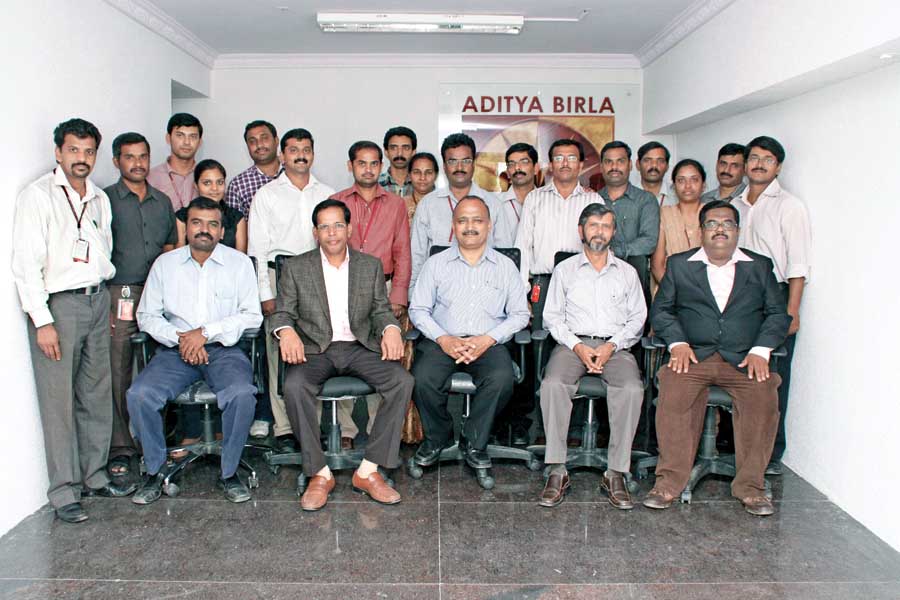
The company is now looking at increasing the suit manufacturing capacity to 3000 pieces per day by the next year to satisfy the growing demand of its in-house brands. “The machines have already been purchased and we are currently training people,” informs Jayarajan. However, he admits that suit manufacturing is a seasonal business, and it is difficult to ensure 100% capacity utilization, therefore in the lean period the company also does production for other domestic brands and at the same time takes up export orders also, during this period. “Almost all the Indian brands have been manufactured at this facility at some point of time or the other,” avers Jayarajan. “We are very flexible in terms of order size which varies from 1 piece to 300-400 pieces per buyer. The people involved in manufacturing are multi-skilled to handle different styles and changeovers,” he adds.
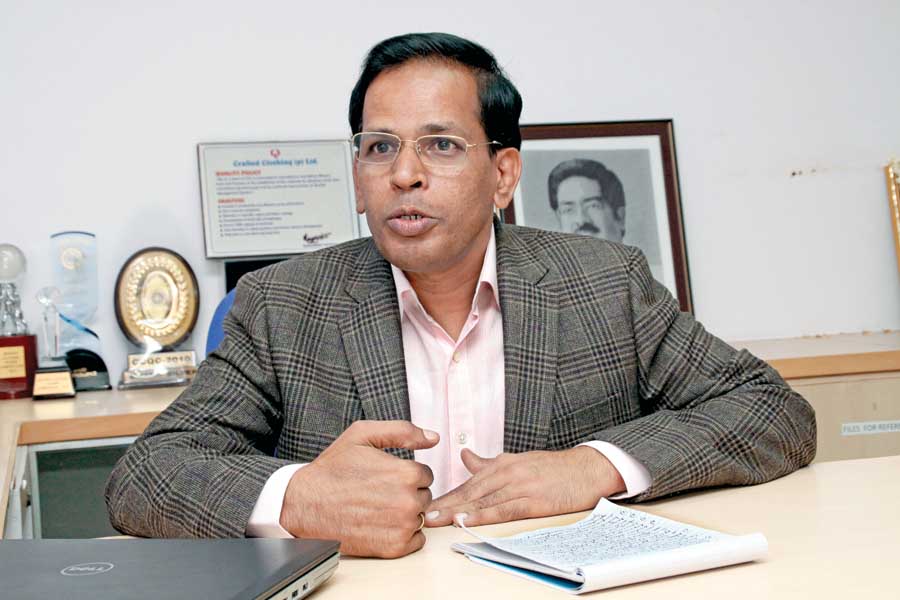
Category Operations (Suits and Trousers)
Being a premier and the biggest suit brand house in India, Madura was the first to introduce Made-to-Measure services for the Indian customers in 2006-07, under Louis Philippe, extended subsequently to Van Heusen. But at that time Madura had difficulties in managing 60-70 different samples per store due to which it had to discontinue the service for two years. In the same two years, Madura focused on training its workforce both at the retail and manufacturing end to work upon the criticalities of Made-to-Measure business.“In the current system there is no need of so many samples which helped in not only reducing the sampling cost but also the store space requirement for MTM, considered very critical, in the current scenario of high retail cost. Also, earlier we used codifications to communicate the customers requirements, whereas in the new system we capture the entire requirements right from personal details, fabric, style, measurement and alteration details through web-based software such that the data flow between the store and the factory is seamless and online,” avers Jayarajan. Patterns being the key to any MTM garment, measurements at the retail end have to be taken precisely and hence proper training was also given to retail personnel regarding how to take key measurements like across shoulder, sleeve length and across chest. Currently Madura uses 3D measurement solutions in its R&D but not at the store level as of now due to the cost factor.
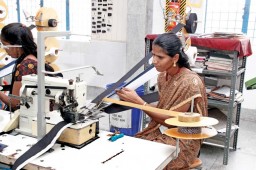
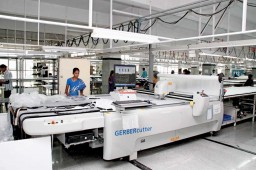

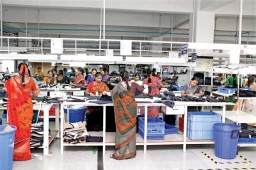

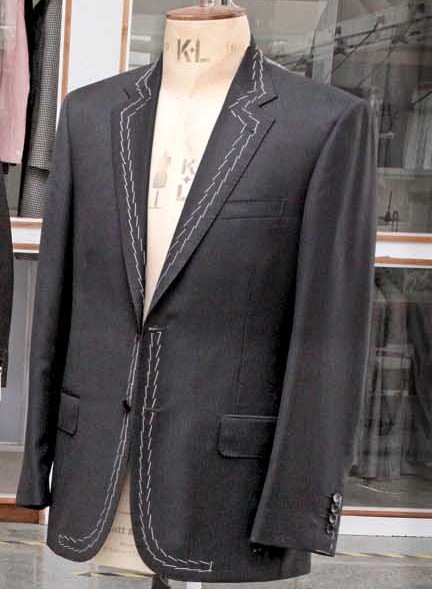
The company re-launched the MTM service last year with a lot of improvements under Louis Philippe brand. “We have improved our capacity as well as the quality of Made-to-Measure products by adding handmade jackets in half and full canvas, which is a premium category. Some of the Made-to-Measure suits retail up to US $ 2500,” says Jayarajan. In handmade, most of the operations like chest canvas preparation, chest canvas attach, armhole stitch, sleeve attach, button – both on front and sleeve, decorative pick stitch on front, bottom lining close, etc. are done by hand, whereas the remaining long seams like side seam, centre back seam, lining seams, sleeve seams are done by machine. For premium handmade suits, there is a separate section altogether with craftsmen specially trained under Savile-Row technician. Savile-Row Bespoke is the acknowledge home of the best bespoke tailoring in Europe. “Fine craftsmanship is what sets apart Savile-Row from all other suit manufacturers. The attention on detail from a single stitch to the fit to the fabric is quite exquisite,” explains Jayarajan.
The Madura brands regularly conduct anthropology study of different regions in the country and also collect regular feedback of changing customer preferences and trends; based on these inputs different fits are developed. Currently Madura offers 11 different fits across all its brands, of which 4 are exclusively available for Louis Philippe’s MTM customers that offers them a unique opportunity to create their own masterpiece – a Tuxedo, mandarin or any suit of their choice, spun from luxury blend of the finest fabrics, ranging from poly wools and linens to Super 150s Merino wool. A wide range of Made-to-Measure suits with 90 different style options in four different fits, namely, Classic Fit – comfort at chest and waist – perfect for stout body shape; Ultra Fit – Slim at chest and waist compared to Classic Fit; Times Fit – Italian classic fit-shaped chest and waist as per body contour and is comfortable; and Futura – Italian Slim Fit that is slimmer at chest, waist, armhole and perfect at shoulder. All these can still be customized according to individual preferences in their body measurements at various price ranges in 80 different fabric and lining options.
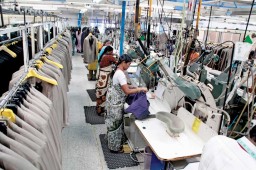
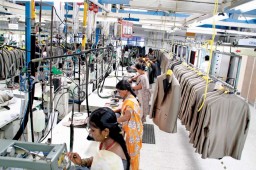
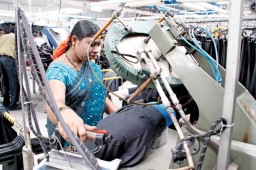
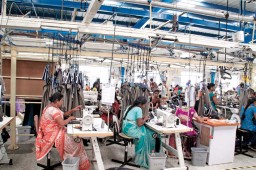
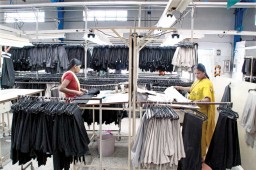
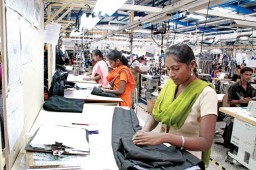
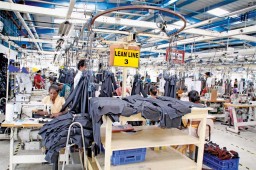
“We have developed a detailed measurement capturing system at the store which gives the required information to the factory about the fit and body measurements of the customers. Based on this input, the CAD personal customizes the pattern on the specialized Gerber CAD system for MTM and it is stored for future references. The system and MTM team ensures the delivery of the suit as per the customer specification within a time period of two weeks from taking the order,” elaborates Jayarajan.
Premium wool fabric is sourced mostly from Italy, while the other fabric options are sourced from India and China. Linen fabrics manufactured at the Group unit Jayashree Textiles, are used for the MTM segment. Most of the fabrics are exclusive for MTM customers and are not used for manufacturing readymade suits.
World Class Manufacturing Through People Involvement
[bleft]“Getting the people is difficult, retaining them is more difficult. By conducting two Employee Satisfaction Surveys’ (ESS), the whole gap between what is being done and what is required has narrowed down to a great extent. After every survey, a team actually looks into all the issues, as the problem might have evolved or changed after the first survey.” Jayarajan K R, General Manager – Category Operations (Suits and Trousers) [/bleft]
Madura has long highlighted the ‘World Class Manufacturing’ status of its manufacturing facilities, which represents the company’s conformance to the seven principles of – reducing lead times, increasing speed to market, cut operations costs, exceed customer expectations, manage the global enterprise, streamline outsourcing processes and improve business performance visibility. Out of this, increasing speed to market and lead time reduction were one of the major changes that happened in Madura, when the company started its Lean journey about three years ago. “In the garment industry, one of the biggest problem is the dormancy and the quantity in stock which is not getting sold and is later discounted. due to which not only a Lean Manufacturing setup is required, rather a Lean Supply Chain needs to be developed,” said Srinath KC, Group Manager – WCM, Madura Clothing.
With Kaizen as the backbone on consistent improvement at Madura, the company has implemented a ‘Listen Kaizen’ scheme under which a person who wishes to suggest a better method or develop a Kaizen, instead of discussing with seniors, implements it first and then presents it at forums like Kaizen Melas will be given due credit. It also encourages others to do something on their part. For monitoring and managing these Kaizen projects, Madura has nurtured a team of 6 Black belts and 64 Green belts in Six Sigma. “Among the group, our unit recorded the highest number of Kaizens. We have a rate of something like 8.98 Kaizen per employee. We have maintained a record of all the 25-30 thousand Kaizens that we have done,” says Srinath.
[bleft]“Among the group, our unit recorded the highest number of Kaizens. We have a rate of something like 8.98 Kaizens per employee. We have a hard copy record of all the 25-30 thousand Kaizens that we have done.” – Srinath KC, Group Manager – WCM[/bleft]
One of the biggest challenges of suit manufacturing is maintaining the premium nature of the product where quality is the only thing that matters and to control it, everything narrows down to workforce management. Workers are taken to the stores to understand what kind of customers they are manufacturing for.
Another very good initiative falling on the same lines – Large Skill Interactive Process (LSIP), in which lower and non-management people are divided in groups of 500 employees and addressed either by a store manager, retail manager, head of manufacturing, group president or even by a Louis Philippe customer.
[bleft]The best way to improve the productivity is by using the latest technology, believes Madura. So, currently real time data monitoring system with RFID is being implemented for gaining clarity regarding an operator’s efficiency, work-in process, production status, hourly targets and time allotted per operation.[/bleft]
A group of employees from across all the garment manufacturing facilities of Madura were takens, by flight, to one of Aditya Birla’s non garmenting units which are a role model in terms of world class manufacturing to see what the difference is. They studied the 165 best practices and how best they could be adapted at the garment facilities. One of the 64 practices which were adopted was the Lowest Machine Breakdown reward, under which operators were trained on a basic level to maintain their own machines, instead of losing time in waiting for the maintenance personnel. Each machine is given a Green circle if it works without a single breakdown throughout the month. At the end of the year, the operator with the highest number of Green circles gets rewarded. “The basic difference here is that had it been some other apparel company trying to learn something new, it would have gone on to study some other apparel company,” reasons Srinath.
On an individual level, employees are trained and guided to deliver and perform better. With this enhanced performance they are recognized and appreciated. Value leaders are spotted among them and are instantly recognized and rewarded. This performance-driven recognition and development gives the employees a high. It also helps them personally and professionally to make a career in the organization which in turn helps them to be independent in the society and manage their families. “Facilities like medical, primary education, dental care, crèches, health camps for the families and arranging micro finances are some of the internal employee’s welfare initiatives that the company performs, concludes Srinath.





 Bharat Tex Special Report 2026