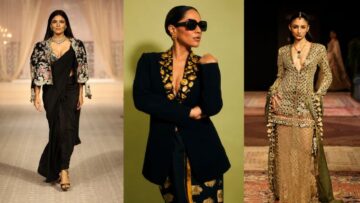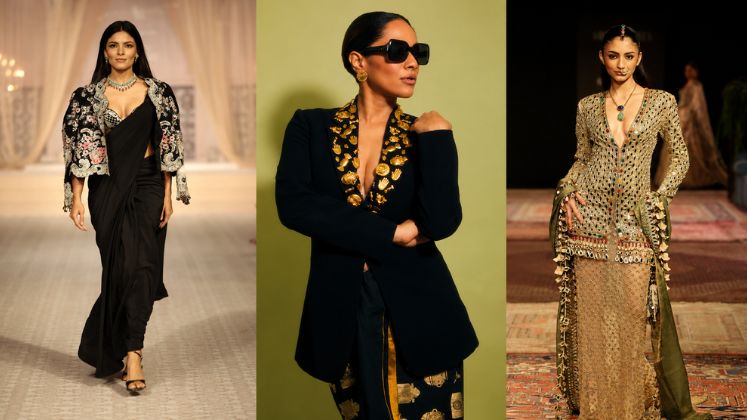
At FDCI’s India Couture Week in New Delhi, the standout silhouette of 2026 was the cocktail blazer. Designers reimagined sharp tailoring as bridalwear, while its rapid trickle-down from couture runways to commercial racks and fast-fashion rails shows how quickly a red-carpet statement can become an everyday wardrobe staple.
The cocktail blazer showed up across various silhouettes,cropped and soft at one end, structured and knee-length at the other worn over sarees, lehengas, or paired with bralettes and textured shorts. Jayanti Reddy styled a black cocktail saree with a Baroque-motif zardozi jacket;
Arpita Mehta showed mirror-worked, shell-tasselled blazers over diaphanous skirts; Falguni Shane Peacock paired a metallic knee-length blazer with feathered denims.
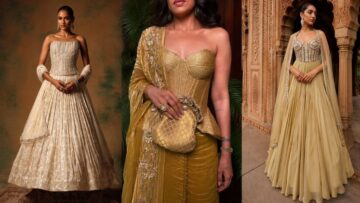
Anamika Khanna added sculptural peplum detailing; JJ Valaya layered a bloom-embroidered blazer over a red saree; and Roseroom Couture by Isha Jajodia matched a gold Chantilly lace saree with a sherwani-style coat.
The designers themselves frame it as more than a trend. Jayanti Reddy calls it a potential heirloom piece; “something that can be styled for the wedding, then worn again in entirely different ways for years to come.” Arpita Mehta is more cautious about the “bridal essential” label but agrees it’s becoming a fixture of wedding-adjacent dressing, useful across the many events that surround a wedding rather than the ceremony itself.
Below the couture tier, the silhouette has already been absorbed into India’s Indo-Western ready-to-wear playbook. Blazer cholis, cropped, fitted jackets in raw silk, brocade or structured fabrics that replace the traditional blouse are emerging as a sharper alternative to the standard three-piece lehenga, often styled with a statement belt for a cinched silhouette.Essentially, it is couture tailoring decompressed for a bridesmaid or cocktail-party budget with less embroidery, greater repeat-wearability and reasonable pricing geared towards the pre-wedding functions circuit.
Indian labels are expanding the category with hand-embellished, statement and contemporary blazers. Masaba’s Heavy Crepe Blazer Set brings a playful yet structured approach, while Kanika Goyal’s Gleam Fold Blazer Set reflects her signature bold, streamlined tailoring. Soup by Sougat Paul adds a handcrafted dimension with pieces such as its Black Velvet Appliqué Embroidered Blazer Set, while Torqadorn’s Slate Grey Embroidered Blazer delivers a sharper, structured take on partywear.
Together, these labels are creating a versatile hybrid that brings the polish of couture tailoring into occasionwear, without the commitment or formality of traditional bridal dressing.
At the mass-market end, the same silhouette shift has evolved into a distinct commercial category rather than a one-off trend. Zara India, for instance, offers dedicated party-ready and sequin-blazer edits, spanning cropped, oversized and elongated cuts in gold, black and embellished finishes, positioning the blazer as evening and festive wear rather than officewear. H&M follows a similar global strategy, placing embellished and sequinned blazers alongside its party-dress offering, although its India assortment currently skews more heavily towards dresses.
The commercial proposition mirrors the couture movement: a structured jacket delivers an instant dressed-up effect without requiring a complete outfit change, translating the grandeur of zardozi and hand embroidery into sequins, synthetic fabrics and accessible price points.
Indian contemporary labels are reinforcing the shift, with Power Sutra offering tailored statement pieces, FableStreet focusing on polished, structured eveningwear, and Tahvo & Elle bringing metallic finishes and party-ready silhouettes to major fashion platforms. Van Heusen and FabAlley further broaden the category with sleek solid and metallic single-breasted styles that transition seamlessly from dinner to party dressing.
These brands illustrate how the cocktail blazer is evolving from an occasion-specific statement into a scalable, repeat-wear category, bridging couture-inspired design with accessible festive retail. Its presence across three price tiers within a single wedding season also highlights the speed at which Indian couture ideas now filter into the mass wardrobe, driven by a wedding market where pre- and post-function dressing has emerged as a distinct commercial opportunity alongside bridal wear.