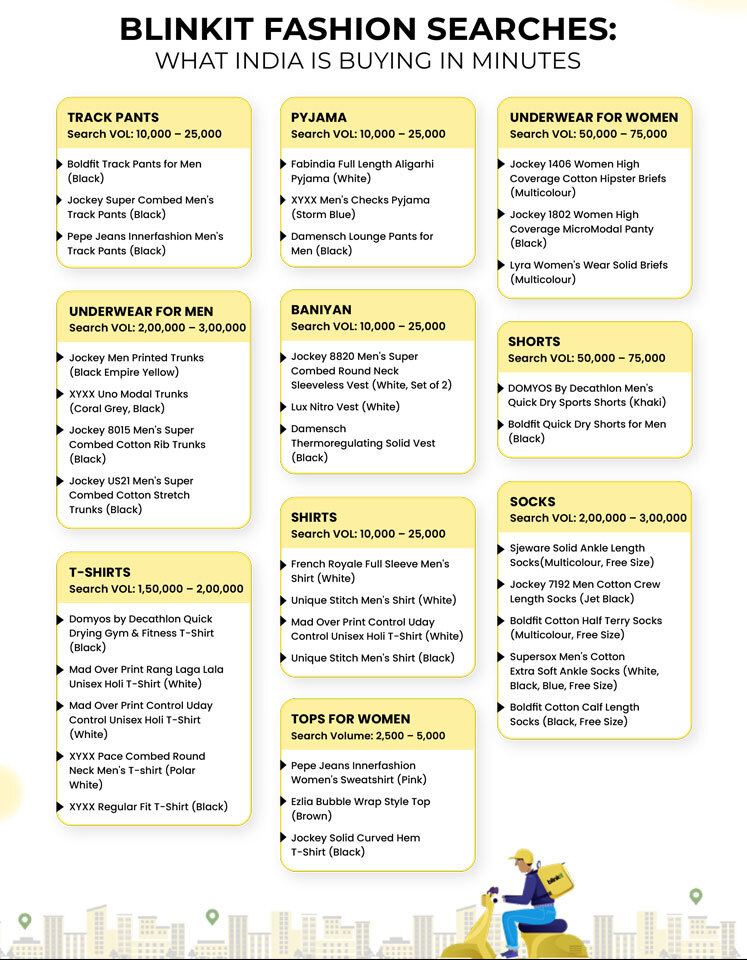
Q-commerce is fast emerging as a juggernaut, fuelled by a growing base of consumers who value speed above all. Today, it is India’s fastest-growing retail format, reaching 33 million monthly users across 150+ cities. By 2030, it is expected to command 10% of branded retail sales.
India’s q-commerce market is estimated to have reached around ₹64,000 crore (US $6.93 billion) in FY25, growing at a brisk 142% CAGR (compound annual growth rate) between FY22 and FY25, according to market analytics firm CareEdge.
No wonder the advertising spends on platforms like Blinkit, Zepto and Swiggy Instamart are rising sharply as companies compete for visibility in an increasingly crowded digital shelf. In fact, advertising has become an important revenue stream for quick commerce platforms.
Eternal-owned Blinkit, which has nearly 50% share of the q-commerce pie, surpassed ₹400 crore (US $43.33 million) ad revenue in FY24 and reportedly reached ₹1,000 crore (US $108 million) last year.
Zepto, which holds a market share in the high 20s, is also seeing strong growth in advertising. The company’s ad business is currently estimated to generate around ₹1,000 crore in revenue annually. Swiggy, which holds approximately 23–25%, is likewise looking to increase the share of advertising in its total income.
For brands, the opportunity is massive. Q-commerce users are often highintent shoppers looking to solve an immediate need, which means the right product appearing at the right moment can translate into instant sales. As a result, marketing budgets on q-commerce are expanding, turning these platforms into one of the newest battlegrounds for digital advertising.
Inside the Economics of Q-Commerce Advertising
Q-commerce platforms offer a range of advertising options, starting from basic visibility tools. At the entry level, brands typically pay a platform fee to get listed, which varies across platforms and is often credited back as ad spend.
As brands scale on these platforms, premium advertising options start to open up.
This usually follows a mixed model that includes homepage banners, category spotlights, hero slots, and priority listings. These placements are typically priced for a fixed duration, such as a day or a week.
Some visibility formats, especially sponsored listings, run on a performance-based model such as Cost Per Click (CPC) or Cost Per View (CPV), where brands pay based on the number of clicks or impressions generated.
Promotional campaigns may also include discount-related costs where brands and platforms share the value of the discount, along with campaign activation fees and additional margin support during major sale events.
Certain high-visibility positions, such as top row placements, bestseller shelves or trending product rows, often have tiered pricing based on traffic levels, category competition and seasonal demand.
Moreover, q-commerce platforms often offer bundled visibility packages that combine several placements at negotiated rates, especially during peak periods.
Brands can also choose additional promotional tools such as in-app notifications, platform social media mentions, enhanced brand store pages or product sampling, which together help increase visibility and drive conversions on quick commerce apps.
The total charges a brand pays to the platform can reach up to 40 to 45% of the product price when multiple fees are combined. These costs typically include commission on product sales, inwarding fees for warehouse intake, fulfilment fees for delivery, and storage or ageing fees for unsold inventory.
Despite the steep cost, brands report good Return on Ad Spend (ROAS) because of quick cart conversions.
According to Datum Intelligence, advertising on q-commerce platforms delivers conversion rates of around 3-8% for D2C brands. In comparison, marketplaces such as Amazon and Flipkart typically deliver returns of about 5-8% on ad spend, while platforms like Google and Meta usually generate lower returns of around 1.5-3%. Industry sources also say that the ROAS on q-commerce platforms can be two to three times higher than that of Meta or Google.
Brands’ approach to q-commerce differs strategically from other digital advertising platforms. While channels like Meta and online marketplaces focus on discovery and scale, q-commerce is needbased, driven by purchase intent for essential products. As a result, brand investments in this space are more targeted and performance-focused, aimed at ensuring visibility at the point of purchase rather than driving broad awareness or top-of-the-funnel demand.
Another significant advantage is the smoother and more predictable payment cycles. For startups, especially, steady cash flow is critical. Q-commerce platforms often offer structured, timely settlements, which help maintain operational stability while scaling.

“Compared to conventional e-commerce or physical retail, q-commerce offers a different kind of return on investment. The value lies in speed, convenience, and brand visibility at the point of purchase, even if margins may vary. It is a strategic channel focused on meeting immediate consumer demand rather than purely driving margins,” said Ravi Kukreja, Founder, playR, a sports and lifestyle brand.
Brands Dial Up Q-Commerce Ad Spend

High conversions and strong returns are prompting brands to ramp up ad spending on q-commerce platforms. “Our overall spending on q-commerce has increased; however, this growth has been directly proportional to the rise in sales on these platforms. In our case, core essentials and replenishment-driven products such as innerwear basics, multipacks, accessories, and everyday comfortwear, generate the highest ROI,” said Tanvi Yadav, E-commerce Head, XYXX Apparels, a men’s innerwear brand.
She added, “Initially, we didn’t invest in ads and relied purely on organic listing performance, since category competition was low. Unlike Meta or Marketplaces, where competition is high, and brands spend heavily on topfunnel. Q-commerce is a high-intent channel where we primarily spend only on conversion. We started investing once the competition increased, and more brands entered the category.”
As of now, Blinkit accounts for 77% of the brands’ total q-commerce sales, followed by Zepto (15%) and Instamart (8%).

Similarly, Kavya Sethi, Co-Founder, Jisora, a Jaipur-originated D2C womenswear brand, stated, “Our visibility and advertising budget for q-commerce has increased over the past year. We currently allocate around 10% of our digital advertising budget to q-commerce platforms,
ensuring steady visibility in fast turnover, high-intent spaces. In our experience, everyday-wear categories particularly coords and tops deliver the highest return from visibility spend on q-commerce.”
The brand sells a range of products including ethnic wear, office wear, co-ord sets, loungewear, dresses, and tops and tunics. At present, these platforms make up 3% of the brand’s q-commerce sales, with 2% from Blinkit and 1% from Zepto.
The visibility and demand for lifestyle accessories brand Hexafun, which debuted on Blinkit in July 2025, has also grown on the platform. Currently, the brand is not available on any other q-commerce platform.

“Two categories that consistently perform best for us are caps and socks. These are classic last-minute purchases. Additionally, customers often opt for value packs to meet minimum order thresholds or free delivery requirements, which increases average order value while maintaining strong conversion rates,” stated Manali Sanghvi, Co-founder, Hexafun.
She added, “Typically, we pay a fixed fee to the platform for every SKU to be taken live, which is credited to our advertising wallet. For example, a flat fee of ₹25,000 (excluding GST) is reflected as ad credit that we can deploy based on campaign priorities. If we observe a demand spike in a particular month, we optimise by exhausting a larger share of those credits. This flexible structure allows us to align visibility spends with realtime performance trends.”
Currently, Q-commerce accounts for under 10% of the brand’s digital marketing spend.
AD COSTS FOR Q-COMMERCE
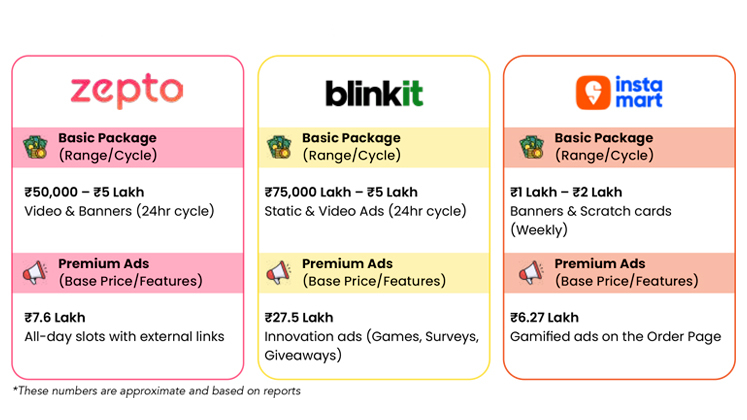
Some players also pointed out that brands have limited access to end consumer data on these platforms.
“Currently, promotions and visibility are largely decided by the q-commerce platforms based on the customer data they collect. The data exposure to the end customers is limited, so brands rely on the platform’s expertise to drive promotions and visibility. The pricing and cost structure is also very tight, so it is important to stay competitive to remain relevant on these platforms,” stressed Ravi Kukreja.
He also noted that products such as basic athleisure training tees, running shorts, joggers, jackets, socks, sippers, jerseys and yoga mats perform well on q-commerce platforms, which is why brands usually list only a curated set of products, as depth matters more than width. playR drives most of its q-commerce sales from Blinkit and Instamart, while Zepto contributes a moderate share.
Ad Spending on Q-Commerce Set to Spike
Looking ahead, advertising spending on quick commerce platforms is expected to grow further.
“The expected rise in spending would be mainly due to the rapid expansion of apparel categories on these platforms. Apparel sales have grown 40–50% year-on-year, partly because the starting base was small. Categories such as innerwear and athleisure would continue to lead this growth,” said Ashmeer Sayyed, Consultant and former CRO, DaMensch, a premium men’s fashion brand.

Hexafun plans to raise its advertising spending on these platforms by around 30% in the next financial year. Jisora expects a 10–15% increase, depending on platform performance and consumer demand. playR also plans to increase its spending by about 25%.
Meanwhile, XYXX Apparels expects its spending to grow in line with sales. “As q-commerce expands, especially in large urban markets, we expect our business on these platforms to grow. Accordingly, visibility investments will increase in line with performance rather than through a disproportionate jump in budgets,” said Tanvi Yadav.
As more brands join these platforms, competition for visibility will intensify, turning q-commerce apps into the next major retail shelf.
However, experts point out that even as brands increase spending on q-commerce, the focus should not be on treating these platforms as discovery channels. Doing so can lead brands into a constant cycle of chasing visibility through higher ad spends.
Instead, q-commerce should be viewed as another touchpoint in the consumer journey, where shoppers come with a clear need and intent to buy quickly.
The real discovery and brand-building, experts say, should happen elsewhere.
To make this work, brands need to strengthen their presence across other channels. This becomes especially important for emerging brands and startups with limited ad-spending power. By upping their social media game, they can ensure that when consumers open a q-commerce app, they actively search for their products rather than discover them by chance.