After the international trade war and inception of COVID-19, China is again in the limelight due to tussle on the issue of Xinjiang cotton boycott with global brands like H&M, Nike and many others. Though the brands raised their concern on this issue long back but it is only recently that the tussle has picked up momentum with the Chinese Government’s campaign against these brands heightening after the US and a few other Western countries imposed fresh sanctions on the country recently.
The sanctions were meant to punish the country for carrying out serious human rights violations against Uighur Muslim minority in Xinjiang. Earlier in January, the Trump administration announced an import ban on all-cotton products from Xinjiang. And even the Biden administration did not attempt to reverse the ban when it came to power earlier this year.
China, which has consistently denied these claims, is now aggressively vocal on this issue and international apparel brands are facing the heat. The Chinese officials warned retailers against ‘politicising economic behaviour’ amidst Western concerns over forced labour in Xinjiang’s cotton industry.
The issue is highly important for China as around 87 per cent of all the material produced in China is made out of cotton obtained in Xinjiang which means one in five cotton garments sold globally contains cotton or yarn from this region.
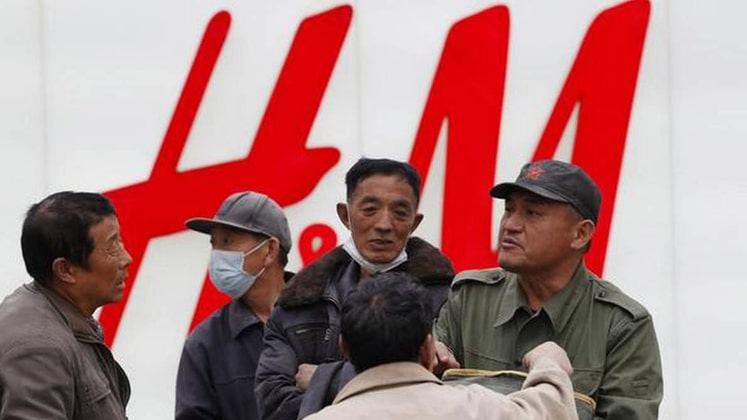
Though apart from H&M, Nike, adidas, Burberry and New Balance also faced criticism on this issue, but it is H&M which faced the maximum heat. The Communist Party of China’s Communist Youth League launched an attack on H&M.
Its products disappeared overnight from major Chinese e-commerce platforms like Alibaba and JD.com, AP reported. The brand’s smartphone app also went missing from app stores soon after.
Landlords have meanwhile closed at least six H&M stores in the lower-tier cities of Urumqi, Yinchuan, Changchun and Lianyungang.
Besides, around 40 high profile Chinese celebrities have cancelled lucrative sponsorship contracts and brand partnerships with a number of foreign-owned clothing brands, including H&M, Nike, New Balance and Uniqlo. These celebrities in China are now running a campaign with the hashtag ‘I support Xinjiang’s cotton’.
On 31 March, H&M finally issued a statement and said that it is working together with its colleagues in China to do everything it can to manage the current challenges and find a way forward. The brand said that it is dedicated to regaining the trust and confidence of its customers, colleagues and business partners in China.
“China is a very important market for us and our long-term commitment to the country remains strong. Having been present there for more than thirty years, we have witnessed remarkable progress within the Chinese textile industry. Being at the forefront of innovation and technology, China will clearly continue to play an important role in further developing the entire industry. We are proud our suppliers are being part of that development and we want to continue contributing to driving progress together with our partners and stakeholders in the country. We want to be a responsible buyer, in China and elsewhere and are now building forward-looking strategies and actively working on the next steps with regard to material sourcing. Together with all relevant stakeholders, we want to collaborate to be part of the solution and jointly build a more sustainable fashion industry,” the statement reads.
The statement has been ‘criticised’ by Global Times, China’s daily tabloid newspaper (The Communist Party mouthpiece) as it reported, “Chinese consumers said they’re not buying a fresh statement that H&M made on Wednesday, with some asserting H&M is a market ‘speculator’, after the company claimed that it was ‘a responsible buyer’ while refusing to apologise or begin to source Xinjiang cotton… The Group may face more stores being shut down in the coming days due to lost consumers.”
China is important for the majority of leading brands like H&M has 502 stores in China, the third-highest after the US and Germany. China contributed 5.2 per cent (US $1.4 billion in sales) of H&M’s total sales in 2020, the fourth-largest market after Germany, the US and the UK.
At the same time, H&M is sourcing from around 380 vendors in China, which are second-highest after Bangladesh.So, the figures make clear that H&M is badly dependent on China be it for sales or sourcing. Almost same is the case with other brands also.
Brand’s ‘U turn’
This is perhaps the first instance in recent years when so many international brands are forced to face heat due to one particular reason in a country. The important issue here is whether brands like Bible which claim to follow compliance in their supply chain will be able to shut their mouth on these violations of human rights in China?
Leading Japanese brand Muji’s stand is also being ‘suspected’ on this issue as Global Times says that after a doubtful reply from the owner of the Muji brand goods store chain said they are ‘deeply concerned’ about ‘forced labour’ reports in China, Muji China told the Global Times exclusively that these comments do not constitute any agreement on specific content or opinion in the reports.
Even in August 2019, Fast Retailing had also said that its brand Uniqlo did not produce any products in Xinjiang, nor did it subcontract the products to local fabric factories or textile factories.
As per media reports, Japanese firm Asics also confirmed that it too plans to continue sourcing cotton from Xinjiang.
Bodies need to be stronger and more impactful
This issue has also shown that sustainable bodies like Better Cotton Initiative (BCI) need to become stronger and more impactful as last October it has announced that it was withdrawing from the Xinjiang region. However, that statement is no longer visible on the website with the BCI, reportedly, claiming that this was because its website had been the target of repeated ‘denial-of-service’ attacks in recent days.
There is a rift between the BCI headquarters in Geneva and the Shanghai branch. The Chinese branch of BCI challenges its headquarters and says it has found no evidence of Xinjiang forced labour.
China-based Anta Sports–which is the world’s third-largest sportswear company – is, reportedly, leaving the BCI so that it can continue sourcing cotton from Xinjiang.The decision of the sportswear giant is also a potential embarrassment to the International Olympic Committee (IOC) as the company is its official uniform supplier.
Experts believe that China knows that any retaliatory sanctions against Western politicians will not work because of the limited reach of its financial institution. Therefore conducting such a campaign against global brands would be a more effective way to send a signal to the Western world.
No doubt, there can’t be a substitute of China, neither as a selling destination nor as a sourcing hub but will brands and organisations continue to tolerate China’s dominance, even at an ethical cost?


 Bharat Tex Special Report 2026