If there is one industry that’s been hit massively by the deadly virus in last 8 months, it’s the apparel industry – and this has been true across the globe. It’s not different in the US either!
It’s not as if the decline for apparel industry started during the pandemic; the fall had started much earlier. In fact, in one of its reports in 2019, McKinsey had warned apparel retailers of sluggishness in their sales in 2020 owing to shoppers becoming more cautious due to threat of trade wars – not to mention the broader macro-economic threat of uncertainty.
However, the pandemic has proved to be the final nail in fast receding apparel industry’s coffin. Poorly hit sales at a time when the pandemic was wrecking the US retail world was followed by slow recovery and a gradual change in consumer behaviour that saw shoppers buying apparels more through e-commerce and less through bricks-and-mortar stores. But a consistent rise in cases all across the US over the last couple of months is keeping the scenario unpredictable for the holiday season as well as the first quarter of 2021.
Back in early September, when Coresight Research held a weekly survey, it was clearly highlighted that 55 per cent of shoppers in the US were avoiding shopping malls; however, in just 2 weeks that percentage went down. In another survey conducted by them very recently, shoppers in the US are gradually returning to stores – and importantly to buy apparels. That’s good to hear! In fact, in the 2 months till 6 October 2020, the survey distinctly brought out 3.7 percentage-point rise in the number of respondents saying that they had recently purchased apparels in a store.
Importantly, this was partially offset by a 1.7 percentage-point fall in the number of people purchasing apparels through digital platform during the same period. As per the estimates of Coresight Research, the consumer spending on apparels, through bricks-and-mortar stores, e-commerce or any other platform, will slump by 13.2 per cent this year.
In fact, the recent consumer spending and retail sales numbers tell us that underlying demand for apparels continue to be very negative. Instead of upward trend path, negative increase in spending has remained at circa 10 per cent in recent months. The depressing underlying demand owes majorly to less than the usual visits to offices or lack of social gatherings.
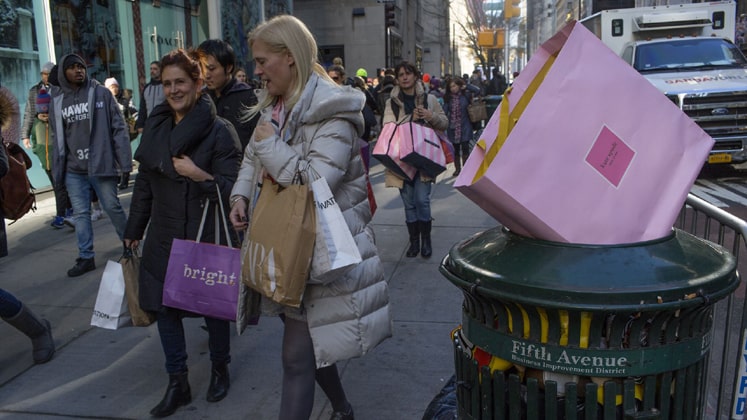
A lot now depends on holiday season, when generally sales of apparels pick up. Again Coresight Research survey says many of the shoppers are planning to start holiday shopping early this year, which may ease the load by the time it is late November and December. Yes, on the whole spending on apparels will fall this year, but the last quarter might just help improve the numbers. Talking about early start to shopping apparels, Jeff Gennette, CEO, Macy’s, said “Holiday demand typically occurs between the goal posts of Thanksgiving and Christmas Day, but I think 2020 is going to be different with demand beginning even earlier.”
In fact, here it is imperative to state that back in May 2020, when coronavirus was at its peak in the US, a survey was conducted by First Insight, which showed that 54 per cent of American shoppers were keen to buy apparels in a store, with 32 per cent expressing their interest to visit stores to purchase shoes. In fact, the survey also showed that millennials felt the safest re-entering the shopping arena – and let’s not forget it was back in May. While 80 per cent of those surveyed said that restricting the number of people within stores would make them feel safe to visit apparel stores, 79 per cent said wearing face masks would make them feel better and safe.
This followed by the recent survey conducted by Coresight Research at least makes it distinct that people want to get back to shopping apparels – especially casualwear or apparels to be gifted. Whatever the choices of apparel products are, a lot is going to depend on the holiday season.
The store-focused apparel specialty retailers will underperform total category spending not only owing to the habit of purchasing more online, but also because of challenges in handling crowd in a bricks-and-mortar stores especially during the holiday season. But the retailers aren’t giving up!
The apparel retailers are enticing the shoppers by starting holiday shopping sales. One saw Walmart increase the inventory of athleisure, loungewear and sleepwear in October to combat the online giant Amazon’s Prime Day. That was not all! Walmart also recently launched a private clothing label ‘Free Assembly’ to win the apparel and fashion customers. Priced in the range of US $ 9 and US $ 45, Free Assembly managed to catch the attention of lots of American shoppers.
Also Read: Walmart’s Free Assembly. Trying hands at apparels yet again!
There are others too to attract the apparel shoppers! If American clothing manufacturer Banana Republic offered 50 per cent discount on most of its apparel products, then clothing chain Old Navy rolled out ‘Giftober’ with half-off on almost everything. Meanwhile, the American market research company The NPD Group has predicted that during the upcoming holidays, sweatshirts, sweatpants and active bottoms or sleepwear may rise to 31 per cent of US apparel spending from 26 per cent in 2019.
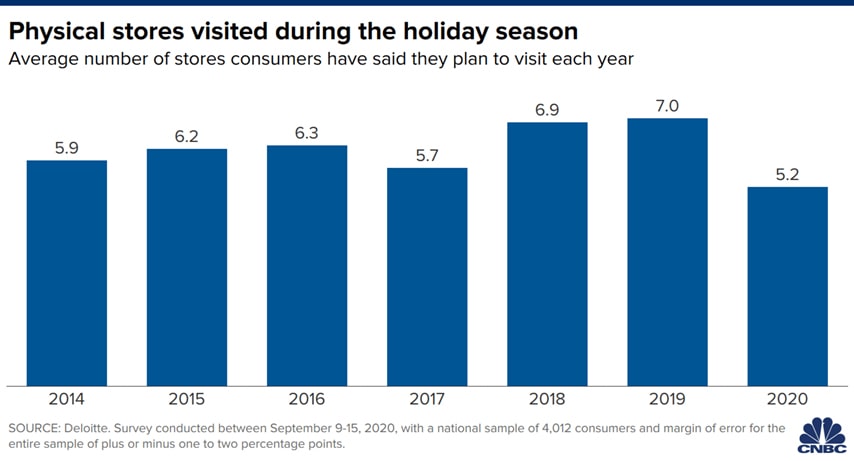
The efforts are there on the part of retailers to lure the shoppers to purchase apparels and consumers too are interested though the response has been sluggish so far. As this piece is being written, Deloitte comes up with a survey which says that financial and public health concerns continue to inhibit holiday shoppers in 2020; they are expected to spend US $ 1,387 per household, which is a 7 per cent slump year-over-year (Y-o-Y). The survey also highlights that 38 per cent respondents plan to spend less this season – a level not seen since the financial crisis. In fact, shoppers intend to visit just 5.2 retail stores on average during the holiday season, which is a big fall from 7.0 last year (see the Deloitte survey chart below).
And it’s not going to be much different in 2021. Now, if one assumes people adapt to the ‘new normal’ world and enter 2021 with better control over the pandemic, the US apparel spending should be strong, but as per the Coresight Research finding, the total apparel spending is in no way going to be anywhere near what it was in 2019 or before the pandemic had hit the apparel and fashion world.
But still being positive, with people gradually adapting to new normal, restrictions may come down a bit, offices may open and there could be a surge in formalwear and partywear. In a survey conducted by The NPD Group recently, 27 per cent of men said they plan to dress more casually after the pandemic, compared to 16 per cent of women who shared the same opinion.
54 per cent said they miss getting dressed up for office and other special events, while 33 per cent aren’t wanting for it at all. Notably, only 23 per cent said they plan to shop for apparels. This division of views distinctly tells all how dresses are going to be in 2021 – an occasion for one and nothing much for others.
Shawn Grain Carter, Professor of Fashion Business Management at Fashion Institute of Technology and Tom Ott, Founder of Retail and Fashion Solutions, substantiate further by stating that pent-up demand could increase clothing sales, as the holidays approach, but after 2020, retailers and brands would be wise enough to cater to the increasing number of shoppers interested in sustainability, including getting their clothes second-hand, or renting them.
Finally, it is the pandemic situation in the country, at the start of 2021, and also the psyche of a consumer at that point of time that will determine where the apparel market is and how much people are keen to buy apparels.
Till then, let’s hope we return to the good old days when dressing up was so much fun and buying apparels was no less than an event.