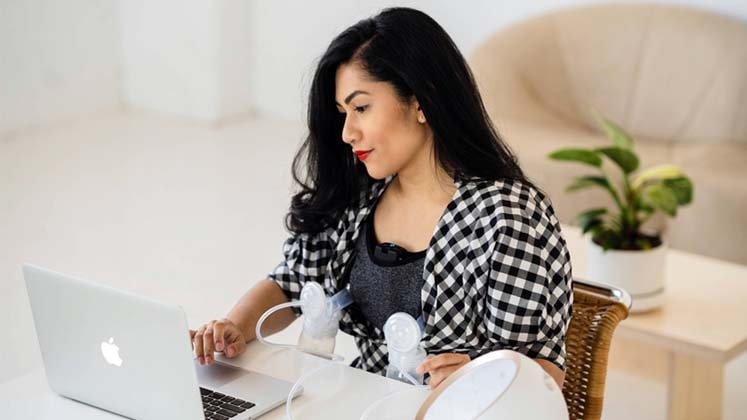
Despite being a natural phenomenon, breastfeeding is not always as easy as it seems. According to research conducted by WHO/Europe, around 80 per cent of mothers and babies experience difficulties with breastfeeding. More than 60 per cent of mothers quit breastfeeding within the first four weeks after the baby’s birth due to a perceived insufficient milk supply. It’s worth noting here that USA and Europe are two of the biggest regions/countries where a huge number of working mothers live! According to the CDC (USA), only 25.6 per cent of infants are exclusively breastfed through 6 months, which is the minimum amount of time the American Academy of Pediatrics recommends.
As new moms go back to work and are away from their babies, they begin to pump and constantly stress and ask themselves if they are producing enough milk! Globally, the main reason for premature weaning is a mother’s fear that her breast milk may not supply sufficient nourishment for her baby. This tempts mothers to bottle feed, adversely affecting their natural lactation cycle, in turn resulting in decreased breast milk. Wearable technology has emerged as a support for these working moms as smart-sensor embedded bras are now targeting to increase breastfeeding rates so that babies get adequate natural milk from their moms.
-
Nextiles Tech expand its sensor-based technology in bras…
Nextiles, the leader in smart fabric technology, has expanded its modular data capture platform by partnering with women’s health brand Lilu to bring the next level of breast pumping technology to new mothers. Both the US-based companies are National Science Foundation (NSF)-backed companies that have joined forces as part of a larger initiative during National Breastfeeding Month to spread awareness of the mental and physical challenges new moms endure.
To help with this mission, the companies are using Lilu’s advanced breast pumping massage bra and integrating Nextiles’ sensor technology to create novel performance data for new mothers and the broader healthcare industry.
According to Nextiles, its patent-protected manufacturing process blends traditional sewing techniques with printed circuit boards to embed flexible sensors directly into fabrics for the new mom uniform – a breastfeeding-friendly bra. Using fabric such as nylon and spandex, the breast pumping bra is said to be designed to be comfortable and is even machine washable for easy cleanup. The bra collects data to provide mothers with insights about their lactation, to help them reach their breastfeeding goals.

The data captured from Lilu’s bra and Nextiles’ custom-embedded circuitry will be powered by Nextiles’ newly launched software development kit (SDK). The software allows Lilu to own and build custom algorithms for the Femtech industry and to empower mothers. Lilu’s user app aims at implementing Nextiles’ SDK to display a plethora of datasets to help moms optimise their breastfeeding and breast pumping routines and maximise their milk production while wearing the hands-free and self-massaging bra.
Having the data provided by the Lilu Bra will provide moms with peace of mind to continue to breastfeed and take control of their pumping.
Commenting on the development, George Sun, Founder and CEO, of Nextiles, averred that, together with Lilu, Nextiles is delivering user-friendly technology to new moms who struggle with breastfeeding, while simultaneously shedding light on the obvious gap in Femtech products…
Funding is a key growth driver for any start-up and both Nextiles and Lilu have got investors which are pumping investment to help them continue their efforts. Lilu is a recipient of an NSF Small Business Innovation Research (SBIR) grant, which is awarded to start-ups with high impact technologies. Nextiles, an NSF Innovation Corps (I-Corps) program participant, will serve as a sub-awardee and license its core technology to Lilu.
-
The EU-funded Presque Smart Bra project boosts the benefits of breastfeeding
A 2020 EU-funded Presque project has aimed to reverse the trend low rate of natural breastfeeding with the smart nursing bra with novel bio-sensors, fluid delivery systems and machine learning to benefit the physical and mental health of mothers and babies.
The project proposed developing a novel wearable device to improve both breastfeeding rates and the detection and monitoring of lactation performance. Lactation is beneficial to mother’s and baby’s long-term health but women often discontinue breastfeeding due to lactation failure. Presque Smart Nursing Bra is a product which supports the natural milk lactation cycle, monitors breast milk flow and delivers supplemental milk while breastfeeding.
The Presque supports the natural lactation cycle by: 1) helping offset any natural milk deficiencies with the onboard supply of either pre-expressed or donated breast milk, or formulated milk for delivery as needed; 2) requiring the engagement of the mother’s nipple by the baby for dispensing supplementary milk, thus stimulating natural milk production, 3) mediating the concerns of the nursing mother by measuring her breast milk amount and milk flow ensuring the mother that her baby is fully nourished, encouraging her self-confidence.
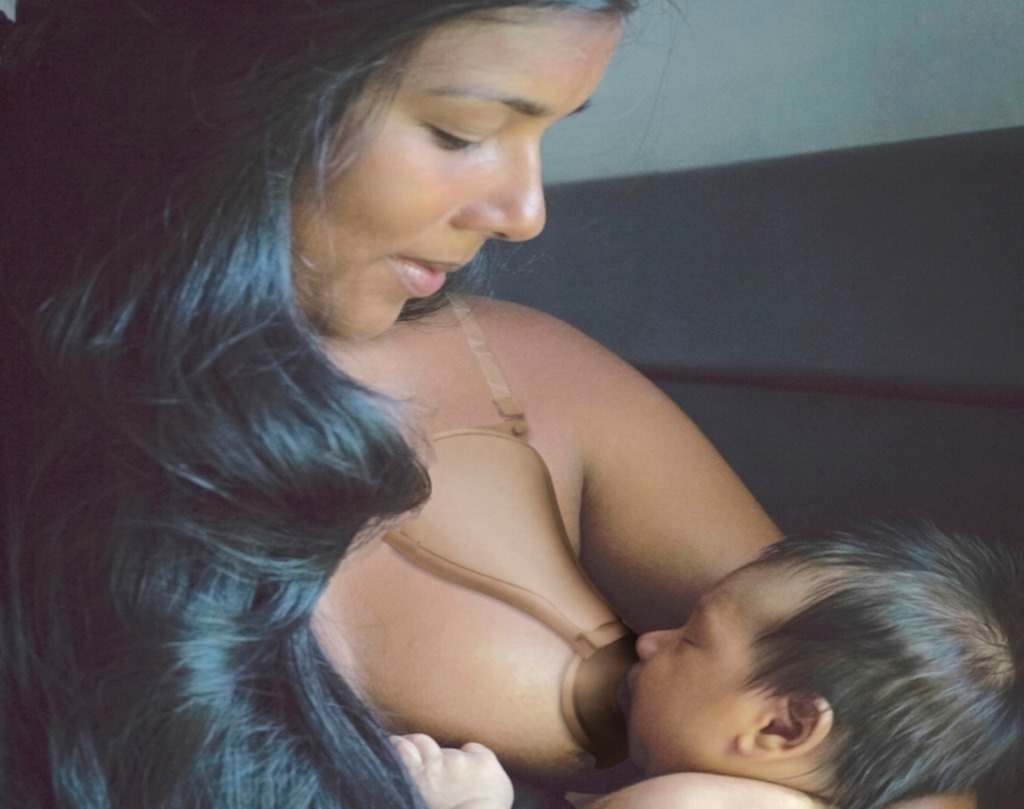
The smart bra Presque permits the dual functions of direct breastfeeding and supplementing without interrupting natural breastfeeding or competing with mother’s milk. The project, when kicked off in 2020, had undergone several testing and monitoring. Smart sensors incorporated into the bra generate valuable monitoring data.
For example, the system can provide information about the baby’s suction power, the flow rate of mother’s natural milk and the required amount of supplemental milk. This data, used individually or in combination, can offer insights about maternal and child behaviour. After introducing a basic proof-of-concept version of the bra, to potential users and healthcare professionals, the team of Presque project conducted anonymous surveys and tests. They found features, price, look and feel, ease of use, source of recommendation, and potentially brand name, were the most important factors impacting purchase decisions. Gathering this information was more difficult in Europe than in the US, as they claim, with fewer mothers familiar with different breastfeeding tools.
The device is protected by 4 issued patents, 10 pending and more in the pipeline, as informed by the team. The Presque system is designed for patentability with a multi-tiered IP strategy to protect the system, the product, components and consumable parts and their fabrication. The device wearability, ease of use, discreet design and automated analysis of breast milk data will significantly increase the rate and duration of breastfeeding which will help decrease the long-term healthcare burden globally. “Moreover, Presque platform proposed in this project will create a new market of smart nursing devices,” shared Presque…