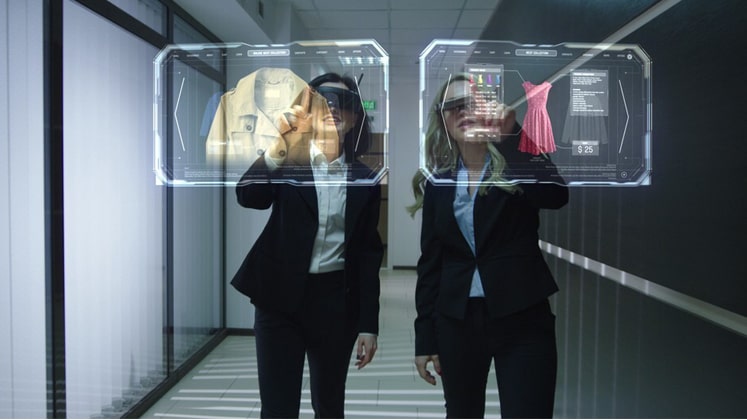
We all wished for a day when everything could be delivered to us at the touch of a button, and in the ’90s and ’00s eagerly waited for the dream to come true. Voila, it seems that the futuristic, imaginative, and prescient technological world that all of us need has arrived – the world of ‘Phygital’. In addition to conventional e-commerce, the globe is now creating a beeline for V-commerce, which is a combination of AR (Augmented Reality) and VR (Virtual Reality) where consumers can save time and energy while accessing the breadth and depth of products. Therefore the companies that continue to embrace technology and refashion are the ones that will outlive in the future.
As per Goldman Sachs, the market for AR and VR in retail will reach US $1.6 billion by 2025. Not only this, a whopping 63 per cent of customers will accept new innovations which will alter how individuals buy, furthermore two-third of internet users are already game for a new realm of V-commerce.
Buying patterns of customers do indicate the shift quite sooner, not to forget that Cart Abandonment is always regarded as the key pain point of the consumption pattern, and category managers spend many hours investigating how to grip the client’s attention span. Did you know a staggering 78 per cent of customers leave their shopping carts (Cart Abandonment) before making a purchase? Something needs to transpire in order to increase these conversion rates, and VR and AR might be the ‘Just solution’. Customers may use virtual reality to interact with items rather than just view them. It brings the shopping experience outside of the store by allowing users to digitally try on things. Customers do spend time on such new exposures which catch their attention in a favourable way.
Director of INHAABIT, Jordan Yim confides “Augmented Reality technology is radically altering industries. The ability to see fashion and beauty goods in real-time highlights how AR can be used to make a shopping experience more engaging and dynamic.” The fashion industry has already begun to recognise that this massive shift to AR and immersive technology is the primary source of sales.
There is absolutely no doubt that AR and VR dramatically alter the shopping experience.Customers may utilise augmented reality to interface with rather than just view them. Retailers could beat genuine prerequisites and give admittance to all product features, bringing more consumers into the sales funnel and increasing conversions. Online retail accounts for 11 per cent of all retail sales. Customers can see, touch and feel the product when they browse in-store. This experience is bulldozed online, which might lead to diminished trust in the product and more frequent returns.
In traditional commerce, although the customer gets to experience the product in real life, the limited number of products reduces the customer’s shopping scale. Factors like colour and size are often a limitation. However, with technologies like AR, we are now able to experience a product in every size and colour from the comfort of our own homes.
“Imagine you’re buying a shoe from an online store. It can be tricky to know how exactly it will look on your feet before making the actual purchase, right? Not anymore. With the help of augmented reality, you can virtually try, spin, move and in some cases customise any shoe or even garments from any angle. Today, customers can have a better idea of the products like the actual size, colour and texture,” told Ugur Yekta Basak, Co-Founder of Turkish tech start-up ART Labs in a fireside chat with Team Apparel Resources sometime back.
In this competitive industry, brand image is critical for survival, and brands that grasp the technology first will be the overall winner for the market and thus AR is a budding outlook to reinforce ‘brand value’ through realistic and immersive storytelling. It is believed these kind of experiences bring a positive magnitude of feelings to the digital platform.
FaceCake Marketing Technologies is one such shining example; they are the pioneer in augmented retail with a customised, cross-device, targeted marketing platform. FaceCake’s innovations in Try-On, which combine patented technologies with intuitive user interfaces, permit consumers to virtually try individual or multiple products on their own images in real-time, while instantly providing pertinent product recommendations; a very similar pathway which is chosen by our homegrown Lenskart . Customers who purchase online using AR, on the other hand, may not only recreate components of the in-store purchasing experience but can also go a step further by experiencing how a product will appear in the real world. That implies bigger margins, better quality and a superb experience for customers.
AR is an exquisite medium for reviving extremely detailed 3D portrayals for the desired items. Images that are visually appealing are essential for marketing things online. Consumers can know precisely how their product will function for them, with their individual demands and space, thanks to 3D representations of the items in AR. After customers have determined which items will work for them, the decision of which product to purchase is an area in which AR may have a huge impact. AR and VR can persuade clients with real-life, rich imagery that propels them to purchase.
As per Ben Houston – Founder of Threekit – “AR will grow so pervasive that it will become an integrated expectation of the purchasing experience. Brands who want to interact with customers now and in the future must invest in technology leveraging V-comm.”
The use of 3D & AR, especially for online shopping, has proven to improve the most important KPIs and success metrics. Pioneer companies and even a considerable number of small-sized companies are now implementing AR features in their business models to benefit from the various advantages that AR can provide such as increased conversion rate, increased app/website traffic, and decreased product returns.
Multinational retailers such as Zara, H&M, Footlocker, Watchbox, ASOS and Uniqlo are already using these technologies completely; not only these companies, BMW, Volvo, Chevrolet, Mazda are also on the bandwagon to attract their customers, However, if we look at Indian retail, we can see that the adoption of these technologies is still in its early stages ,it is making up for lost time rapidly. There are few Indian retailers which are proactively reaching customers with their V-commerce hunch. The companies like Intellify, Techugo, NexGen Innovators, Monkhub Innvoations are few that provide AR & VR services in India.
We may be late adopters, but some Indian brands have begun to explore the technology. Rent it Bae, a luxury rental company, had deployed AI and AR technology in its Delhi retail facades. The arena assisted them in obtaining fundamental facts, such as product pricing and fabric rental charge. CommonFloor, a property listing firm that delivers property tours utilising software that leverages VR, and not to forget Shark Tank’s favourite Experiential Etc, an inventive Ad Tech Agency that is utilising technology to align the enthusiasm, curiosity and demands of enterprises as well as customers are few such brands.
The AR & VR immersive technology has given way to numerous start-ups which are aligned to generate methodologies for such stores which can adopt the technologies. One such Noida-based Digital Jalebi is a promising start-up that delivers interactive experiences and believes immersive technology connects with the audience on a more emotional level. With a focus on spatial interactive installations, they are able to catch the attention span of the Indian customer which is indirectly expanding the ‘let’s explore’ factor among the Indian buyers.
The route must be shortened, and the market needs to be captured sooner. Despite brands’ and customers’ enthusiasm, retailers are still wary of implementing this new technology. The difficulty is in their capacity to adapt to the growth of consumer culture and comprehend this new environment. Nevertheless, to become the future of e-commerce, the V-commerce sector must be evangelised.






 Bharat Tex Special Report 2026