Everyone likes a partner at work or at home, who is responsive, with an icing on the cake of being adaptive. Now, one can expect the same from new age clothing which are turning responsive and adaptive by the day. Though such clothing has existed since the 1990s, they were focused on meeting specific requirements of the military forces, and later to meet the demand in medical applications, but are now widely catering to special requirements in various fields like Sports, Fitness activities, as entertainment sources, with new areas being added regularly.
There is much more to smart textiles than what meets the eye with constant research happening around the world. The category has become so big that now the industry recognises it as ‘Wearable Tech’ which has evolved through addition of ‘smartness’ in the form of hard goods or soft goods. In this series, the focus will be on Electronic Textiles, which is the most dominating and popular sector of textiles within smart textiles.
Categorising smart wearables
Smart wearables are popularly categorised based on their location when in use – Close to the body, On the body and In the body. While smart glasses and smart watches are ‘Close to body’ wearables, Insulin pump patches are ‘On the body’ smart wearables. BoneTag is an example of ‘In the body’ smart wearables which is a universal RFID device, encapsulated in a biocompatible casing of the size of SIM card and placed inside the knee prosthesis. It facilitates communication with surgical orthopaedic implants by connecting them to the scanning device, thus making them smart.
When a wearable product is able to sense parameters around its environment or/and is able to respond to changes occurring in the environment, it is considered to be smart wearable. And if the wearables are prepared out of smart textiles, they are specifically termed as ‘Smart Garments’. The term ‘Smart Textiles’ are commonly used for fabrics that are able to capture and analyse a signal in order to respond in an adapted manner. They can therefore be described as fabrics capable of reacting by themselves by adapting to their environment.
Smartness in textiles can be achieved through intrinsic properties of textiles, applied textile finishes or imparted responsiveness by combining sensing, actuating and communicating activities through conductive textiles often interchanged with ‘E-Textiles’. Intrinsic properties could include usage of phase change materials, shape memory polymers in the wearable ensemble. Applied finishes could include usage of activated carbon, photoluminescent dyes, to name a few.
Early efforts in smart wearables
Oricalco Shirt– a smart shirt, whose long sleeves could roll up with the increase in temperature to beat away the heat, with the help of shape memory polymers was priced at £ 2500. The fabric was woven from fibres of the shape-memory alloy NiTinol (nickel-titanium alloy), interspersed with nylon. Kimberly-Clark came up with a smart diaper made out of laminated textile which is responsive to humidity. When in dry state, moisture absorbing polymer is deformed and as the moisture content rises, the modulus of the material decreases and triggers shape change of the material. It takes desired configuration which can shield against leakage.
Products offered through such intervention majorly cater to smart wearables for comfortable or aesthetic attributes. The functionality in smart wearables like biovital monitoring, position tracking, remote communications, special ability for differently abled individuals are majorly provided by utilising conductive textiles. That might be the reason for the smart wearable sectors for apparel category to be majorly dominated by the products developed out of E-Textiles.
Textiles make smart wearable devices flexible, lighter and friendly, existing next to your skin. Off late, consumers are found to often relate Smart Wearables with Smart Textiles, unlike in the early 19th Century. That might be the reason why the trending search for Smart Wearables and Smart Textiles started merging together around 2009, and they are now clubbed together as a category.
Just how smart is smart?
Functionality of smart textiles includes sensing, actuating, energy supply, energy storage, data processing, communicating and interconnecting. Based on the manner in which a smart wearable system behaves, it can be classified as Passive Smart, Active Smart and Very Smart. Passive smart wearable system is capable of performing sensing functions. Active smart wearable systems are capable of performing sensing as well as actuating functions. They sense the stimulus in an environment and act to it. When a smart wearable system is able to adapt their behaviour based on the changing environment, after sensing and actuation, it is called very smart. A schematic representation of this classification is given below.
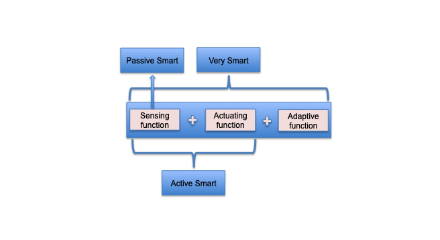
A smart garment having a piezo-resistive sensor just for sensing velocity/temperature/ humidity would be categorised as passive smart textile. An active smart textile could be an ensemble integrated/embedded with piezo-resistive sensor which would sense the environmental temperature and further activate the thermal actuator made up of electro-conductive material, to act as heating element by exploiting electrical resistance of the material. Adding a communication module to this ensemble to enable transmission of temperature data to a computation device enabling trend analysis for further futuristic decision making would make the ensemble a very smart textile wearable.
A smart garment need not have all the functions stated. These functions may be attained through E-textiles or an inherent property of textile structure. STW obtained through electronic textiles can be seen to be evolving through distinctly identifiable generations. 1st generation are the ones, which are formed by inserting electronic components in a textile base, in a manner that they can be removed without the destruction of the textile ensemble. Here the major focus remains to miniaturise the components as much as possible thus making the smart wearable system less bulky and less rigid. The 2nd generation of STW includes products which have at least one electronic component made up of electronic textiles and integrated with the textile base through several material manipulation methods.
The textile based electronic component could be at the level of fibre, yarn or fabric integrated through spinning, weaving, knitting, braiding, embroidery, coating, printing, etc. As the textile based electronic components are integrated in the system, they cannot be removed without destroying the product. Hence, such components need to be resistant to flexing, washing, abrasion, etc. Further, the 3rd generation of STW products are all electronic components ranging from sensors, actuators, made up of electronic textiles. They do not have any electronic components in the form of hard goods. However, they are rare to find and limited to their existence at the proof-of-concept stage.
Some commercial applications
Owlet smart socks are one of the wearables designed for infants and kids up to the weight of 25 kilograms, available in varying sizes and colours. They are embedded with sensors (non-textile) to monitor heart rate, oxygen level and sleep trends. These may be placed under 1st generation STWs. The heart rate and oxygen levels are monitored through pulse oximetry. It has coin size rechargeable batteries which require charging on a daily basis if put for continuous usage. The body vital data measured is transmitted wirelessly to a base station through bluetooth connectivity. This base station may be connected to the cloud through the internet and thus enables connectivity at remote locations and monitoring the baby’s status through the mobile application. This has come as a saviour for parents who are away from their kids for longer duration.
It also enables peaceful sleep at night and is equipped with alarms which the base station device and mobile application plays once the oxygen level declines or heart rate reaches beyond the pre-set range. The schematic diagram below explains the connectivity set up with the smart socks. Sensors in the smart socks are integrated in the socks and cannot be removed. The company specifies that the sensors not be water resistant and thus advises the socks to be hand washed and the sensors not be submerged in water.

Figure: Owlet Smart Socks for infants
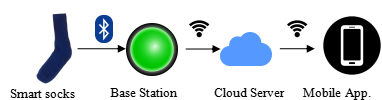
Figure: Schematic representation of functioning of Smart Socks
Levi’s Trucker Commuter Jacket with Jacquard by Google may be classified as 2nd Generation of STW. The fabric in the sleeve portion near the cuff, comprises conductive yarns integrated through weaving (thus the name Jacquard). They enable touch gestures, thus making the control of activities hands free. Tapping and swiping, issues a command for controlling switches in mobile, e.g. playing a song, receiving or disconnecting a call, etc. These are specially designed for bicycle commuters. It has got a non-textile electronic component ‘jacquard tag’ which establishes connectivity of the jacket with the mobile application. The newer version of jacquard tag is also capable of sending alerts through vibration in cuff and glow of light when your hand-held device (mobile phone) is left behind somewhere away from you.

Figure: Levi’s Commuter Trucker jacket with Jacquard by Google
Hexoskin Smart Shirt may be placed in the 3rd Generation STW product class. It comes in different versions for men, women and children. It claims to consist of all textile-based sensors integrated within the garment. It monitors the user’s cardiorespiratory function, sleep and activity through the textile embedded sensors continuously. The communication module has an open API and app which can help visualising the data. The data extraction tool allows extraction with time series for analysis through Machine Learning. This smart garment requires an external power source for which it uses a battery. However, the majority of the sensing and communication is established through textile-based components. A pro-kit for men’s Hexoskin Smart Shirt costs US $ 579.
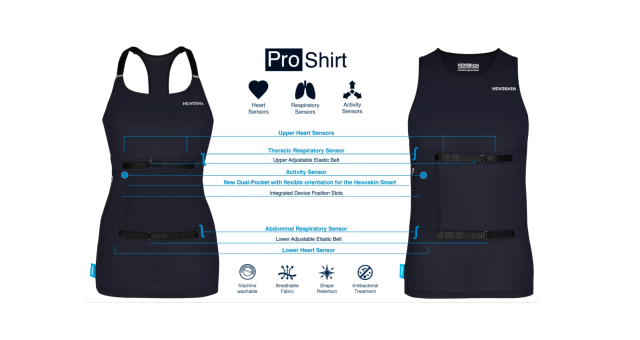
Figure: Hexoskin Smart Shirt
https://atap.google.com/jacquard/products/levi-trucker/
Challenges remain
Smart textiles offer many advantages to the wearer and the industry is moving towards more application of the same, however there are challenges which need to be taken care of to make its use more widespread. Among them, consistent electromechanical performance is a critical challenge. Further, these E-textiles need to be resistant to washing, flexing, abrasion, etc. so that they are more robust, reliable and reproducible. On attainment of the same, popularity and consumption of smart textiles and wearable systems will see a huge increase.
Today, the application of wearables is found ranging from luxury goods to utility goods and from robust environments of military applications to precise environments of medical applications. A smart wearable system is capable of capturing, transmitting and processing the information from every corner of our body parts including eyes, lungs, blood, skin, heart and vascular, brain and emotions, bladder and urine, etc. Clothing is the next after skin, which covers a large part of our body. What best can serve as the base for such wearables if not textiles?





 Bharat Tex Special Report 2026