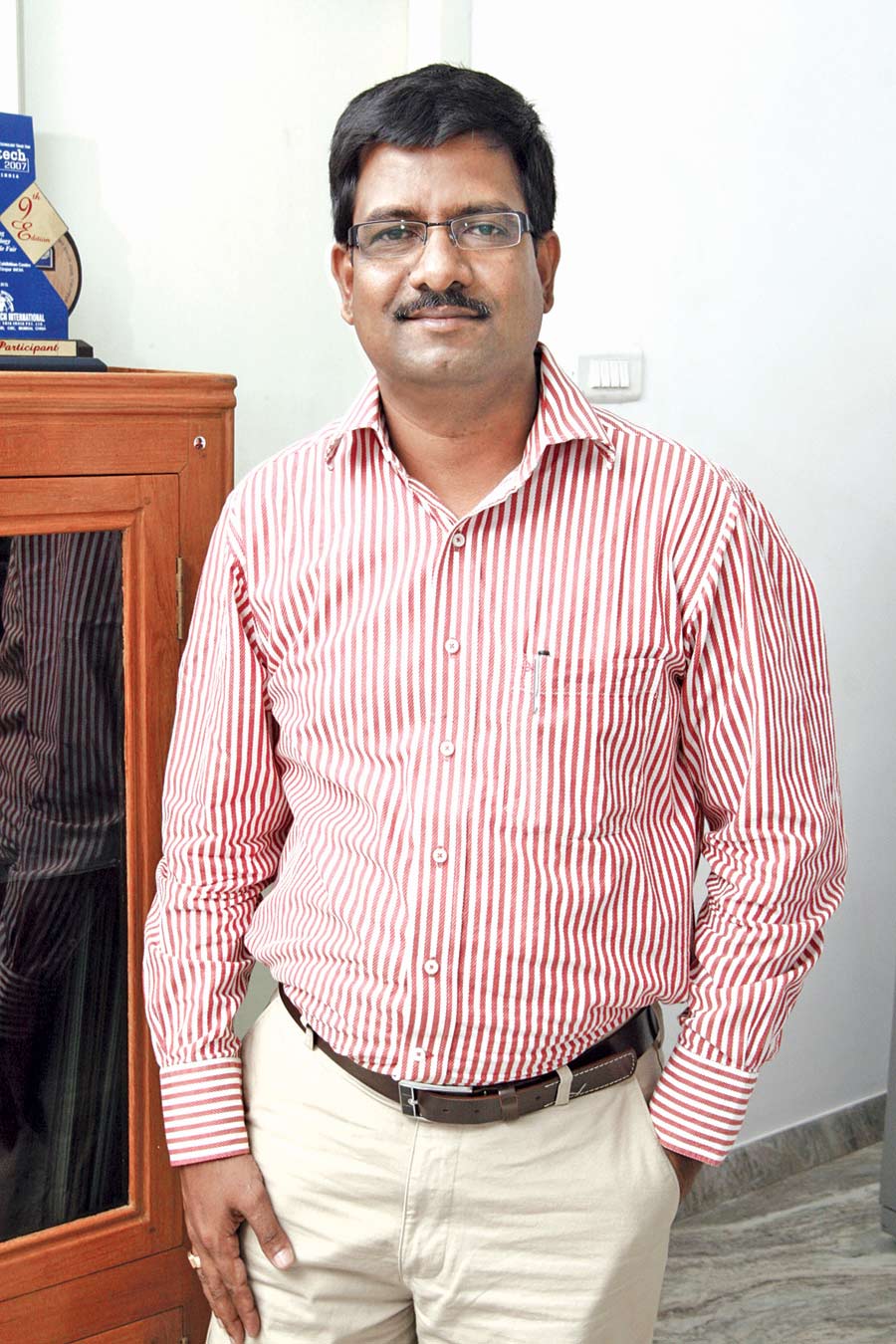
At a time when the industry is searching for ‘solutions’ to improve upon lead times having already worked on quality and productivity, Coimbatore-based Jeevan Infotech claims to have an ERP answer to this. Developed indigenously by professionals who understand the industry and its detailing, its ERP solutions integrate each small process that goes into this dynamic business, right from the raw material procurement to the retail floor management. If required, it could be broken up into customized solutions for individual needs. Team StitchWorld recently met Shanmuga Sundaram, Director, Jeevan Infotech and quizzed on what made ‘Jeevan’ the lifeline of the Textile and Garment Industry.
The type of depth and reach that we can provide is only because of our unmatched and strong background in textiles,” claims Shanmuga Sundaram, Director, Jeevan Infotech. In the last few years, many IT companies have come to India with tall claims of ERP systems that can streamline processes and add value to the system in apparel manufacturing by saving time and money. But none of these companies till today have proven their claim in actual running conditions as most of the exporters are using the modules only in finance and inventory management and not production and planning. “The fact is that they have little or no idea what is the need of the industry in manufacturing. Jeevan has data processing abilities right from the Tally (financials) to the ETON system. Its flexibility is unmatched and can be remodelled for specific needs of quantities, line balancing, T&A, etc.,” says Sundaram with complete confidence.
Sundaram further insists, “A pure customer relationship management in apparel business will not be complete without an on-line ERP system. Time and Quality are the key functional elements of merchandising and we are proud to present you an ultimate web-enabled product “FIT-ERP” that was an outcome of our 10 years of experience in working with Apparel Industry. The CRM module acts as a bridge between the customer and the agent to conduct business in a single window, where every information or status of an order is instantly available to the entire chain of people involved in the job.”
This system facilitates the buyers to closely work with their suppliers and customers in a single data server, where the key information of the order is broadly classified under three heads – material, approvals and works by the application, says Sundaram. The system further flows to the level of recording each inspection done at the supplier site and includes an On-line Billing and dispatching system that would further flow to the level of retrieving Bills Receivable and Bills Payable in a detailed fashion.
Few modules like the HR module in the system have improved system to fit for almost 5 other languages including Tamil, Kannada, French, Bangla and Chinese for basic pay registers and few statutory reports so as to face the minimum resistance in implementation due to the statutory needs of the specific country or State, adds Sundaram.
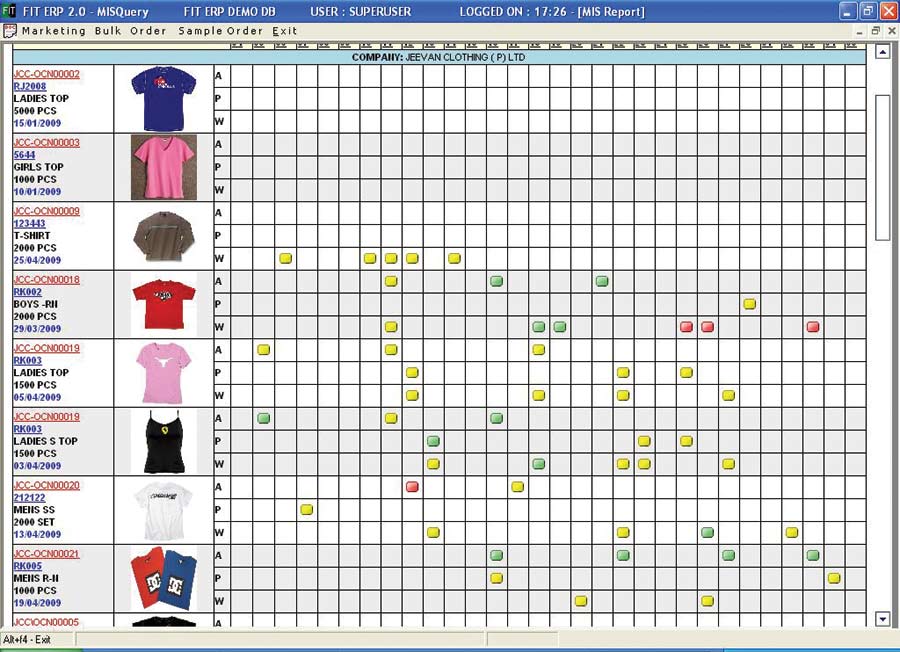
The response of the industry to the integrated ERP solution from Jeevan has been very positive and the company already has more than 80 customers in India and it is now looking for new market in Indonesia, Bangladesh, and Vietnam. “Within the country, Delhi is still not very responsive, but Bombay and Bangalore both have been very good markets, while both Tirupur and Coimbatore have a major share. Especially, Our MIS Query reporting is widely accepted considering the coverage of information in our reports. Our on-line query for instant status is the most used and appreciated by top management of the user companies. Our TNA, Sampling & Floor Management also have got good acceptance from our clients,” mentions Sundaram.
“The response of the industry to our ERP solution has been very positive. With more than 80 customers in India, we are now looking for new markets in Indonesia, Bangladesh, and Vietnam.”
One of the major problem areas as defined by the industry has been the ERP solution implementation, which takes more than 2 years, but Jeevan claims that it takes almost 6-8 months to implement. The reason is simple – there is passion and confidence in the product behind the implementation. “There is different kind of approach that has to be built into the process while implementing the system. Implementation is not just hiring a few IT people. What we do is that we train the real user. The only guarantee we ask from the customer while applying this system is that – at any point of time they will not use any manual documents to make it faster, which means that at the end of the day every single real user should be using the system to run their company and not bypassing them. The executives are trained on how to transform their daily works to the ERP System and on the best practices of the industry incorporated in FIT ERP.”
That is why if the company is really using the ERP system then it is equivalent to implementing any lean management concept because the whole production process is working under a controlled system and no extra cost or manpower is acceptable to the system, which is the purpose of implementing the ‘lean’ management systems. Also, since each person is trained to work in a system any new employee automatically moves into the system after a briefing and in-house training.
So confident is Sundaram of his product that he would like smaller companies to enjoy the benefits so he is currently working on a subscription model. “We are looking at different strategies to attract the market. What we are planning right now is a subscription model. Which means no company needs to buy the software they just subscribe the product on our website on a monthly fees and we manage the process from a centralized system,” says Sundaram. This would require a few days of training and a little readjustment in the factory. “In fact the Logistics & Documentation is the module where we had to do maximum customization due to change of requirement of Packing Slips and Invoices formats from one customer to another. We are still trying to generalize this module to have one version for all our customers.” The modules of the ERP are also addressed to the slowdown when exporters are looking at minimum investment but optimum returns.
Concludes Sundaram, “The entire global market is switching towards automation; the Garment Business is no more an exemption. The entrepreneurs have fully understood that only an Integrated Software Application can help him sustain with a market that expects pace, volume and quality and prove their customer that they are better than their competitors.”



 Bharat Tex Special Report 2026