With a strong history spanning more than 100 years of understanding of the sewing industry, HCA is today one of the largest suppliers of technology for the garment manufacturing sector offering a wide range of industrial machines from the world’s leading manufacturers like Kansai Special, Highlead, ASS, SWF, Strobel, Yuho, Cutex, Grand and the newly re-instated Mauser Spezial Machines (formerly PFAFF), to name a few. Inspired by the founders who strived to provide ‘World Acclaimed Brand, Best Technology and Services’, the company led by Anil Anand, Managing Director is now venturing into manufacturing of ‘automats’ another first for the Indian sewing machine industry…
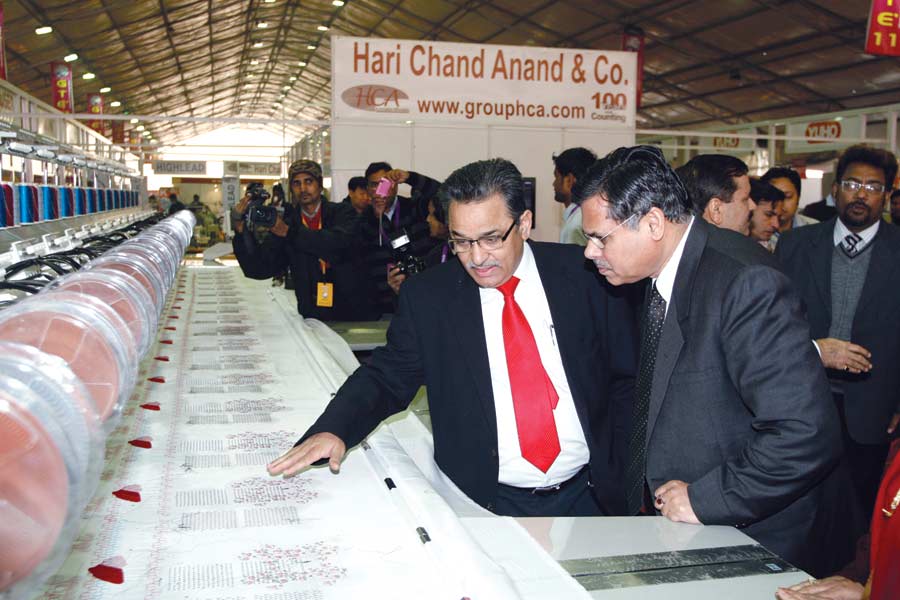
At GTE’11, HCA showcased besides its regular brands some new automated machines from Yuho, Japan. Model “U-3102-E/PS” shirt front creasing machine with presser and Model “U-3101-E/01” cuffs sewing machine with knife were emphasized by the company. While “U-3102-E/PS” model can make 3-fold seam and promises accurate plaid matching without any distortion, “U-3101-E/01” can stitch the left/right cuff simultaneously while trimming the extra fabric, thus saving the pattern cost. 10 other machines of Yuho that were also a part of the automation range are “U-3101E” Automatic Cuff Sewing machine, “U-3101-2” Automatic Placket Creasing & Stitching machine, “U-2706-E/1416” Automatic Knit Pocket Setter, “U-2702-E” Automatic Shirt Sleeve Placket Setter, “U-2710-E” Automatic Top Stitching Yoke Seamer with pleating (for shirts), “U-8410-E” Auto Serger, “U-9608-E” Auto 2 point Narai Dart machine, “U-2910-E” Auto Fly Seamer, “U-3002-E” New Tack Dart Seamer and U-308-E New Narai Breast Dart Seamer.
Anil Anand has been questioning his principals on why machines like bartack and button stitch reach the end-user with a difference of 40% price though the manufacturing cost of both the machines is same. According to him, for all practical applications a bartack machine can be converted into a button stitch machine and vice-versa at a cost of just $ 300. “But today sellers are selling both the machines at a difference of $ 1400. They are charging this difference because the end-user does not have the knowledge of the difference/similarity between the two machines,” argues Anil.
Further, the maintenance cost of automated machines is also very high and brands are charging roughly 50 to 100 times more on the parts. “Most major machine brands around the world are not manufacturing automates/parts, but sourcing them from smaller companies specializing and then assembling them under their own brand name,” says Anil.
Since spares and attachments require machinery and raw material which is not available in India, the cost of manufacturing such items under the current scenario works out to be double or triple the cost of the goods sourced from China, Vietnam, Malaysia and even Taiwan. Also, the custom duty on SKD (Semi Knock Down) goods is much higher than the complete machines hence assembling them in India is of no use.
However, work aids can be made in India and HCA has taken the first step, already making a few of them. “We have completed the hundredth year of serving the industry and if after hundred years I am not able to do justice to myself then I have no right to ask my customers for a price I am not satisfied with. So, I have initiated a manufacturing unit in Bangalore to produce automated machines which should be fully operational by the next year. Through this venture I will be able to offer affordable automates to the industry,” says Anil.
“Automats require thinking and intelligence that makes India a place of right manpower for successfully running such venture. However, it is unfortunate that TUF (technology upgradation fund) scheme cannot be availed for our venture,” adds Anil.
There is a great potential in the technology industry for growth, as both the international and domestic manufacturers are looking to increase scale of production. Having the right technology at the right price is going to be the key for growth.