Sewing machines in general were designed to execute various types of sewing operations, but since the garments were being standardized and made in large volumes it necessitated for specialization of machinery with the use of attachments, thereby making the machines more productive, yet limiting it into performing only specific sewing operations. However, with the industry facing changing fashion trends, new material and new designs, with exclusive set of operations using different threads and stitch types, it has become imperative to have multi-operational machines for greater efficiency. The global fashion drifting towards lower volume per style and similar demands coming from small and medium manufacturers necessitates that machine manufacturers design flexible sewing workstations which give double benefit of extreme production speed with flexibility of using the machine for multiple operations. Team StitchWorld discusses few examples of flexible sewing workstations available.
Flexible sewing machines have become an ideal alternative for manufacturers working with a variety of styles. Flexible workstations are specialized workstations which are capable of doing more than one operation, just by changing a few parts. Even though they sound just like an automated machine, they are much more. All automated workstations are not flexible by definition; however, end-user demand forces the machine developers to incorporate flexibility within workstations. For instance, a specialized fly felling workstation makes only flies, but when the same workstation can sew wing pocket in trouser or sew pocket facing to pocket bag, then it becomes a flexible workstation. Such flexibility is achieved through change of jigs, and/or change of settings.

Any sewing operation consists of three distinctive steps: The first is the load or pick up of components to be sewn and placed below presser foot; the second step is the actual sewing of the components; and the third step is unload or dispose of the sewn component. Maximum workstations are designed to mechanize the 2nd and 3rd step while the first step remains manual. Generally, start and stop of the machine is either sensor driven or actuator driven; while the sewing is going on, the component is continuously being aligned or guided automatically either by edge guides or by jigs. The dispose of stage is fitted with large or small part stacker, where parts are nicely stacked one on top of the other so that the feeding for the next operation becomes more organized.
[bleft]Brands like Duerkopp Adler, Juki and Vibemac offer flexible workstations whereby a simple change of part enables the users to apply the machine for multiple operations.[/bleft]
Brands like Duerkopp Adler, Juki and Vibemac offer flexible workstations whereby a simple change of part enables the user to apply the machine for multiple operations. We have kept the pattern tacking machines out of this analysis as the pattern tacking machines are not actually workstations, but rather are cycle sewing machines and meant for sewing different patterns of sewing operations.
Vibemac came into existence in 1980 as a Singer support centre, but since the very beginning they started to produce machines and accessories under its own brand. Carlo Guerreschi, the founder of the company, chose to manufacture machines particularly for denim jeans market, sensing the potential of this sector. Vibemac embodies the Italian perfection in sewing machines.
Performs embroidery on the pocket, sews labels, patches, velcro, flaps, makes darts and pleats in trousers
Being equipped with an automatic load-unload system that increases productivity by 25%, 1010V4 allows even an unqualified operator to manage three machines simultaneously. Apart from embroidering the pocket, this DCT (Double Colour Technology, which allows to sew with 2 threads in different colours and thickness in one sewing cycle) machine can stitch pockets in a single or double colour, attach labels, patches, velcro, flaps and makes darts and pleats. The 1010V4 is equipped with the Mitsubishi direct drive motor PLK-G, with 2 needle lockstitch (V4 model)/1 needle lockstitch (V4M model), shuttle hook and thread trimmer. The machine has maximum sewing speed of 2800 RPM (single colour), 2500 RPM (double colour).Thanks to its split needle bars it is possible to switch automatically from one needle to another and, therefore, change the sewing pattern.
Performs embroidery on back pocket, makes darts and pleats, also runs flap stitch along with making “J” seam on the front fly
The 1010V4F1 (double needle) or the 1010V4F1M (single needle) are two automatic programmable units that make “J” seam on the front fly part on jeans, casual trousers and workwear. These machines give a total freedom of style and custom-made “J” patterns for any request at no extra costs for additional jigs. It can perform back pocket embroidery, make darts and pleats, and run flap stitch. Thanks to the loader and the stacker devices, the unit can achieve an incredible production rate with no need for a skilled operator.

Sewing of back yoke and back rise parts, inseam and out seam, top stitch operation in trouser
The 2261HP is a reverse-arm lap felling unit with 3 needle chainstitch for double lap sewing on jeans, casual trousers, work clothes and denim clothes in general. This machine is particularly suitable to stitch back yoke and back rise parts, in and out seams and top stitch operations. After sewing, the puller device guides the sewn parts to the chain cutter device, and finally to unloading. The dynamic presser foot control (DCP system) in the machine avoids the skipped stitches even on the thickest seat parts.
The 2262HP is a “sister” unit of the already famous 2261HP. It is strong, fast and precise and guarantees the consistency of stitching length even on the thickest parts. The 2262HP is a reverse lap feed of the arm unit suitable for all the double waistband operations on jeans, casual and working pants, including shirts. This unit is particularly suitable for sewing back yoke and rise, inseams and out seams, in addition to the top stitch operations.
Sewing of waistband to trouser, also performs lockstitch, chainstitch
3022WB406 is an automatic unit for waistband application on jeans, casual trousers and denim jackets with the “continuous waistband” working method which involves a special folding system. The unit cuts the fabric and automatically leaves open the seaming according to the needs of operator. The machine comes in wide range of models with various configurations and distance between the needles.
[bleft]Flexible workstations are specialized machines which are capable of doing more than one operation only by changing a few parts. Even though they sound just like an automated machine, they are in fact much more and hence have a better return on investment.[/bleft]
Sewing patch pockets, apply labels, sew darts and pleats in trouser, performs embroidery on back pockets, and even sews patch cargo pockets
The 2516V4DCT is a double needle lockstitch machine equipped with the Mitsubishi PLK-G head with shuttle hook and thread trimmer. This first double colour pocket setter by Vibemac is able to sew with 2 threads in different colours in one sewing cycle. The unit can perform a variety of operations such as attach pockets of any shape (round, square, with zip, asymmetric pockets), attach labels and flaps, make darts and pleats, embroider back pockets and sew patch cargo pockets. The patented load-unload system in the machine gives a full choice of pocket designs. The cost of moulds for the machine is the cheapest worldwide since they can be produced locally; otherwise Vibemac offers to supply it within 7 days.
The purpose is to give an idea to trouser manufacturers how they can maximize their productivity while retaining their flexibility.
The German leader in sewing machines, Duerkopp Adler exemplifies the ultimate sophistication in sewing solutions. It offers engineered workstations for manufacturing of trousers and shirts with an objective to perfect the automation of sewing process, and at the same time guaranteeing maximum degree of flexible applications.
[bleft]Vibemac specializes in sewing solutions for bottom manufacturing, and all their solutions increase the productivity keeping in mind the flexibility required to keep up with the dynamic market requirements.[/bleft]
Sewing left and right flies in trouser and attach wing pockets in front trouser
This Duerkopp Adler 2111-5 sewing unit sews the left and right fly pieces of a trouser; in addition, the unit can attach and notch wing pockets to front trousers too. One only has to load the work pieces and all further steps are executed automatically, thus increasing productivity. Even less experienced users can achieve excellent sewing results due to the easy operation. The machine can sew approximately 2000 left or right fly pieces in 480 minutes (1000 trousers l/r flies).
Sewing darts and waist pleats in trousers and skirts
743-121 (double chainstitch) is a compact sewing unit which can produce both darts and waist pleats, and the appealing part is that only the templates are required to be changed for sewing darts or sewing waist pleats. The sewing unit processes all fabrics with a consistent high quality, in very short cycle times. The fully overlapped working method of the machine enables an extremely high output of approximately 7500 seams in 480 minutes.
[bleft]Duerkopp Adler presently has the finest line of German sewing innovations and that too for a wide variety of complex products like formal trousers and all kinds of jackets, with focus always on deskilling critical operations.[/bleft]
Sewing side seam, inseam in trouser, jacket or skirt lining seams
Sewing unit 1281-5-1 has been designed for closing seams like trousers side seams and inseams, jacket or skirt lining seams. The machine is equipped with a preparation table with mouse and reverse device and its flexible adjustable guide rail allows a quick adaptation to different seam contours and an overlapped working method.
The machine can produce approximately 900 – 1100 pairs of trousers side seams in 480 minutes, 1000 – 1200 pairs of trousers inseams in 480 minutes and 600 complete trousers (4 seams) in 480 minutes.
The Japanese sewing machine giant, Juki is synonymous with industrial sewing machines in India, with probably the widest product range for manufacturing apparel, shoe, luggage, and automotive products.
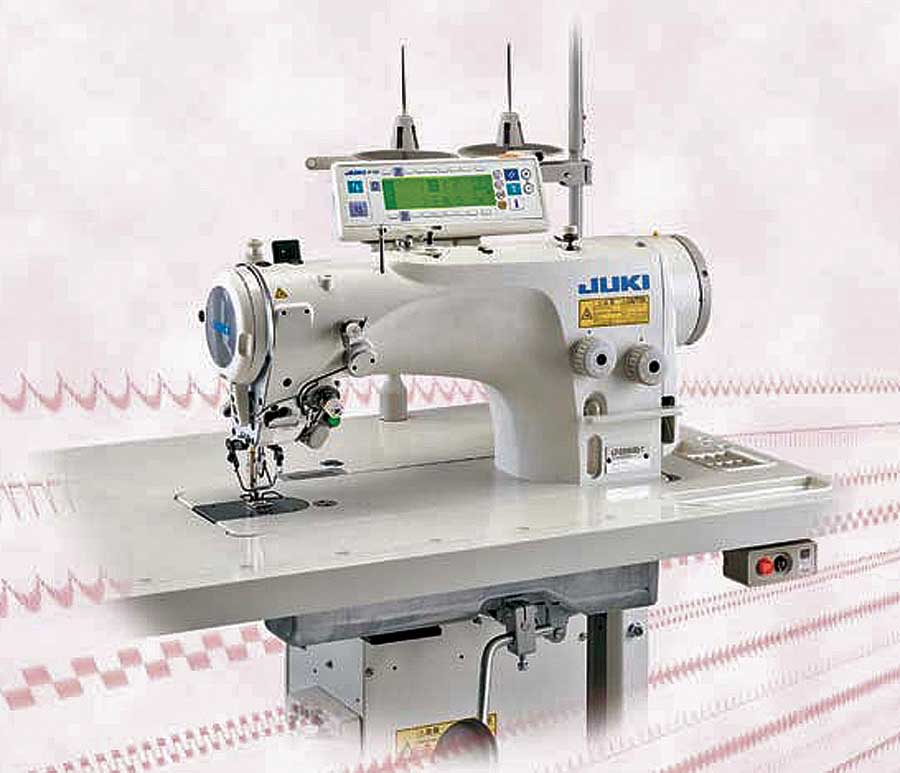
Sewing handles to bags and pouches, also attaches belts and parts of shoes and sewing air bags
AMS-224ENHS6030 is a computer controlled cycle machine which comes with the promise of higher productivity. The machine performs various kinds of stitching in various sewing applications such as attaching handles to bags and pouches, attaching belts, sewing many small parts at a time, attaching parts to shoes and sewing air bags. The accuracy of the feed is remarkably improved as the position of the feed can be checked during sewing by means of the encoder-controlled X-Y drive stepping motor. The machine is equipped with a large-sized liquid crystal touch panel that supports USB.
Performs 8 types and 14 patterns of zigzag stitching, T-shape stitching, covering stitching and condensation stitching, sewing topstitch in welt pockets, sewing labels and collar
[bleft]Japanese pioneer Juki has a wide variety of sewing machines capable of doing multiple operations on multiple products from apparel, shoe, luggage, and automotive products, while ensuring flexibility, quality and productivity of operations.[/bleft]
In addition to the conventional 8 types and 14 patterns of zigzag stitching, LZ-2290A-SR-7-WB performs T-shape and covering stitching, thereby increasing its sewing capability to 14 types and 20 patterns. Furthermore, the machine can perform condensation stitching (for reverse feed stitching) at a high speed thereby dramatically increasing the operating rate of the facility.
For men’s garments, the machine is used in top stitching for welt pockets, sewing collar and labels. For ladies’ garments, it can perform pattern stitching for the collars and front bodies of jackets and blouses. In addition, original patterns can be created using the custom pattern feature, enabling the machine to be utilized for a broader range of uses.

Sewing materials of different curves, run stitch on sleeves, critical seams of skirt panel and pin tucks
The AE-200A edge control seamer is configured with JUKI’s unique sensor and manipulator-control mechanism allowing inexperienced operators to join materials with different curves with great finesses, matching the finished seam quality of highly skilled operators. The sewing machine enables control of shirring and stretching of materials on a section-by-section basis by dividing the sewing length into ten different sections at the maximum. The sewing machine is able to produce beautiful and equally-spaced pin tucks by installing the pin tuck device (40088621).
The sewing machine is applicable of doing many different processes such as sewing the centre of the back and joining the sides of garment bodies of men’s and ladies jackets and ladies skirts.