Trends in Sewing machine technology is clearly two prong today; while traditional leaders in technology – the Japanese and German brands – are busy educating the customers with environment and operator-friendly features, conserving energy, reducing noise and vibration levels, whilst being more flexible, efficient and producing improved quality. On the other hand the Chinese brands are offering direct drive and dry head at economical prices.
The developments in technology are driven by market needs and demand for new features, constantly challenging the manufacturers to invest in R&D. One example of market-driven need is the requirement of time saving devices aiming to reduce non value added time in sewing that made headlines in 2011. Technology which was introduced to address this need include the extremely short thread length by under bed trimmer and coreless bobbin hook by Duerkopp Adler. 2011 saw another low key but highly innovative development, the x-feed system by typical that may change the way world understands low tension sewing specially for difficult to sew fabrics.
Productivity and quality remained the evergreen focus, thus there have been re-launching of labour saving devices, some introduced a decade ego, by original equipment manufacturers of Japanese and German brands as well as Chinese brands. The re-launch of features like transparent throat plate in overlock, Yamato hemming and error-proofing devices like Pegasus stitchlock is probably an indication for things likely to come.
While the basic kinematics – a basic branch of classical mechanics that describes the motion of bodies (object) and systems (group of objects) without consideration of the forces that cause the motion – of sewing machine remains almost the same, developments are mainly in driving and controlling the kinematics. Direct drive motors and dry head machines are already commonly available but with fewer parts to rotate. Machines fitted with direct drive motors tend to be quieter; and with less moving parts, so there are fewer parts prone to failure. Power is not wasted in friction from a belt chain or gearbox. High torque can be produced at a low RPM (revolutions per minute); high torque and low inertia enable faster positioning times on permanent magnet synchronous servo drives. Dry head sewing mechanism eliminated concerns of oil contamination from the needle bar and the needle thread take-up, achieving high productivity and clean sewing over a broad application range.
Improvements in electronic controls over kinematics reduces power consumption whilst increasing productivity and flexibility and enables ever finer adjustments, whether in cutting with automatic buttonhole machines, for example, or setting sewing thread tension. Electronics are also used for reducing machine set-up times when changing design and sewing specification during production. In case of cyclic machines like button sew, pattern tacking and button hole, the controls are programmed and can be saved, transferred and reproduced using any storage medium.
The above directions of developments are impacting trends that are going to dominate the future of sewing and include:
One machine for all fabric types!
Traditionally all sewing machines are classified into three categories: light-duty, medium-duty and heavy-duty and sometime ‘extra heavy’. The categorization is based on GSM of fabric; lighter the GSM of fabric, light duty machine to be used and so on. However, most factories making fashion garment (unlike a shirt or trouser specialised factory) used to buy medium duty to remain flexible in use of fabrics, so that they can use either light or heavy material in same machine without major quality and operational hurdle. We already have machines with adjustments to use with various fabric types, thereby offering enormous flexibility to users like the Kansai Special RX-9803 Series Cylinder Bed Flat Lock Machine for Bottom Hemming and Vetron from Xi’an Typical. Flexibility in conventional sewing machine use is also seen widening their use into the decoration field. Be it sequential and programmable sequin sewn designs, different effects achieved by multi-needle chainstitch machines, multi-colour and multi-stitch type overlock and flat lock machines, three-hole or six-hole button sewing and many more.
Self-Healing Sewing machine!
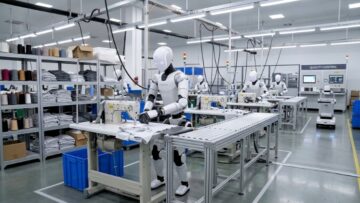
Machine downtime is one of the most notorious reasons behind lower efficiency. Nowadays machines are made with less number of movable parts, more of modular platform, interchangeable parts, and replaceable components aiming to make the machine in running condition in quickest possible time during a breakdown. Common platform sewing machine development (M-Type from Duerkopp Adler and Vetron from Typical) will enable use of exchangeable common parts between different machine types and thereby breaking the age-old tradition of specialised machine engineers for special machines. (Traditionally for lockstitch and overlocks mechanics at basic level is enough, however for buttonhole/buttonsew/bartack/special machine there are different mechanics). Fewer moving parts also reduced failure rate, ease of repair and lesser downtime like AMF-Reece eyelet buttonhole machine. Touch screen based easy diagnostic module are common for highly automated workstation. Very soon we will see self-healing sewing machine which will repair itself after breakdown!
Seam Welding will Replace Needle-Thread Sewing!
Although ultrasound seam welding technology is there for quite some time, it was restricted to non-apparel and/or performance outerwear. A precondition of welding fabric parts together is the presence of a thermoplastic material, either within the fabric itself, as with synthetic materials, or by the use of a bonding tape between the two fabric layers, feed into the seam as it is sealed together, as required by natural fibres. However with improvement in technology and wider acceptance of fabric type more and more product categories are being made using ultrasound welding technology. This method of construction has many advantages for certain types of garments and PFAFF has the most popular series of welding machines. It is water and chemical proof as the main fabric, bacteria and pathogen resistant and therefore is of great interest for military, medical, outdoor, sports and undergarments and technical uses. The ultrasonic process channels high frequency vibrations which cause a rapid heat build-up at the material contact point. The process is very versatile as a machine can be programmed to seam, cut, slit, trim, tack, emboss, or cut and seal simultaneously. Coming years will see more and more garments and other sewn products being manufactured by welding as opposed to sewing.
Bobbin Changing is Passe!
Automatic bobbin changers (ABC) were developed way back in 1990’s. All the effort to popularize ABCs was unsuccessful because of high cost and exclusivity attached to it. Except multi head computerized embroidery machine other use of ABCs were discontinued gradually. However, recently there is a renewed interest about ABCs in pattern sewing, moving head sewing and automated workstations, Juki’s AVP-875A for automatic pocket setter for jeans is equipped with an auto-bobbin changer. Probably the proven success of data transfer across sewing machine and use of stand-up module with higher machine to operator ratio has necessitated the justification of ABC to maximize needle running time. As a supplement to Lean philosophy or probably being promoted by Lean protagonist as removal of non-values adding activity ABC is expected to come back with a bang.
Moving Head Sewing to Replace Moving Hand of Operator!
Jig sewing technique is common for profile sewing of components over the decades. However over the years manual jig sewing technique is giving way to computerized pattern tacking machines. Use of pattern tacking machine for small area profile sewing (e.g. Velcro attach, cross tack, etc.) or moving head sewing machines for large area profile sewing (patch pocket attach, car airbag sewing, etc.) are becoming common for consistent quality and improved production over time. These are gaining momentum as an alternative to deskilling of the operations, which otherwise require skilled operators. The SPS/HT- 10050A Series from SunStar and the Programmable rotating head sewing machines from Rodella Automatic Machines, are some of the most popular ones. Manoeuvring of fabric component to be sewn requires skill component; with sewing operators becoming scarce commodity if machine takes over the skill component in future who complains!