Projecting an embossed appearance, flock printing is used in many ways to impersonate varieties of velvet and velour textures on 2-D surfaces like cottons and nets. Inspired by the velvet appliqué and intricate pattern formations, minuscule fibre particles are deposited onto the surface to produce grassy texture in decorative patterns. Adorning a piece of textile with this “print-art” has been gaining the spotlight now, season after season, but owing to its recurrent but irregular aspect, not many service providers look at it as a business growth opportunity. However, with increasing applications of flocking on sportswear, T-shirts, wallpapers, gift/jewellery boxes, and upholstery and escalating prevalence on the runways, this elevated furry print, available in multi-colour patterns is predicted to continue in trend not only for its aesthetic appeal but also functional reasons including insulation, slip-and-grip friction, and low reflectivity…
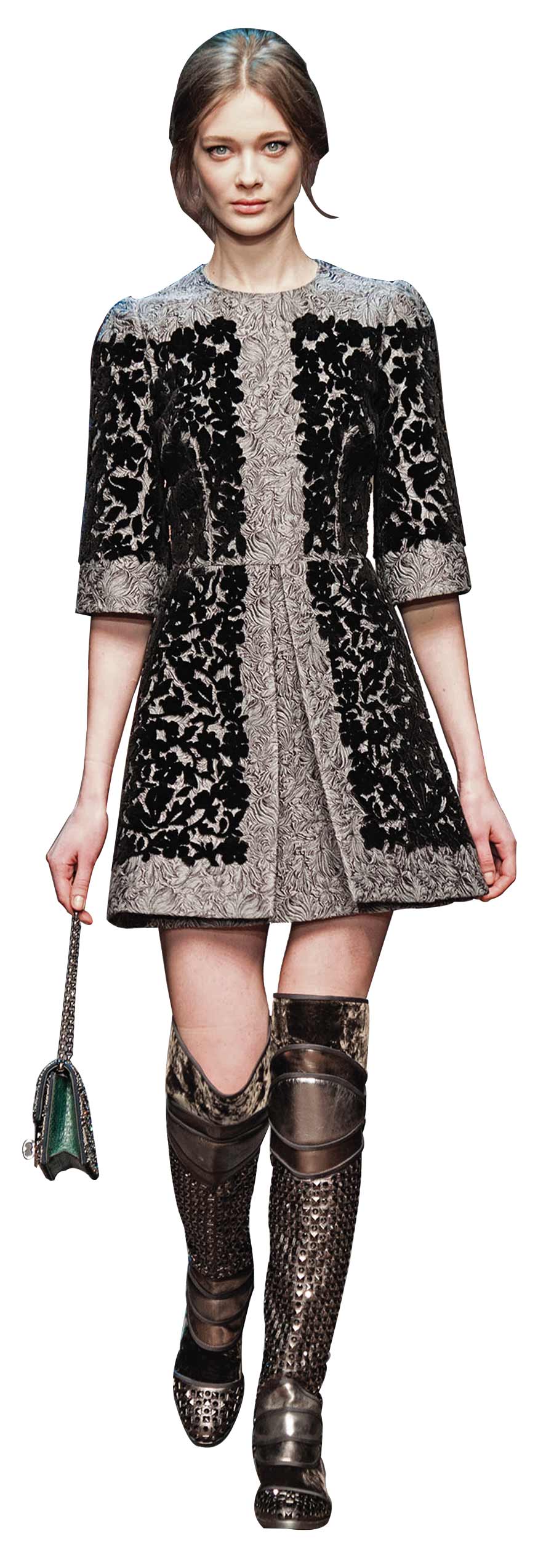
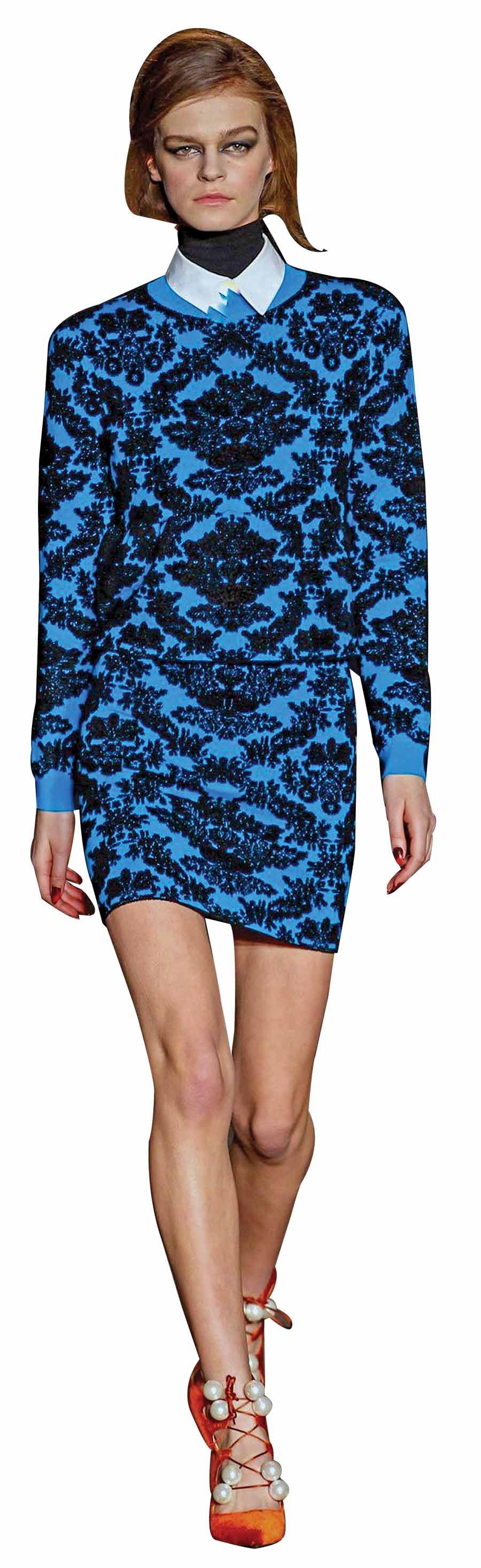
The rising popularity of flock prints and their in-built quality to provide 3-D and tactile dimension to any garment, or accessory, made them a collection staple on the A/W’14-15 runways, both in India and on international ramps, as an imperative surfacing technique. Nida Mahmood, Designer, informing us about this growing trend said, “We have done flock printing as a very important texture detail applying flocked butties on hand-woven striped fabrics. An interesting play of intricate medallion patterns with simpler polka dot patterns can be noticed.” Other designers on the international runways displayed their varied interpretations of this trend on the ramp illustrated in numerous possibilities. Antonio Marras in his Menswear collection experimented with heavy flocking with different pile heights in ombre effect. Aquilano Rimondi, Derek Lam and Dolce and Gabbana presented an amalgamation of profound floral motifs on delicate brocades. House of Holand showcased all-over damask patterns in low pile whereas Jason Wu created an illusion of brasso with his patterned flocking on sheers.
Today, flock printing can be explored through variety of methods like electrostatic printing, beater bar/gravity, spraying and transfers and is also suitable to be printed on all fabric types. Short microfilament fibres of nylon, rayon, viscose and polyester, are applied directly onto the substrate that has been previously coated with an adhesive. The lengths of fibres vary in thickness and length according to the design which also co-determines the appearance of the flocked product. Thin fibres produce a soft velvety surface, whereas thicker fibres give a more bristle-like surface. Flocked cotton gives a texture in various forms and colours, creating an illusion and sense of touch, reminiscent of laser cut velvet appliqué and embroidery stitches.
The multi-faceted flocking process can be carried out on an automated flock printing machine as well as with the help of a hand-held electronic device. Flock Sur India, manufacturers and exporters of flock printed fabrics is currently working with many exporters using the technique for their collections. “We are making use of vibration, electrostatic and automated machineries for producing flocked fabrics. For creating placement prints, logos and chest prints, electrostatic method is always the best suited and most viable one. Flocking material is sprayed using an air compressor, reservoir, and spray gun similar to spraying paint and finishing method is similar to a thin felt coating, as most of the fibres get stuck to the adhesive at 90 degrees to the fabric,” informs Harveer Singh, Purchase Manager, Flock Sur India.
With many automated machines being available in the market, the platform to do innovative experiments has widened. Now available in variety of applications like, one colour flock, two colour flock, multi-colour flock going up to 16 colours, this printing technique has provided a completely new edge to the design abilities and applications. Innovative designs like cover up methods, iris flock and flock on flock, which facilitate the process of bringing out shaded, ombre and multi-colour effects in one application gives out various options to do one design differently. K. Muthusamy, Proprietor, Sindhu Tex Prints/Marvel Flock Printer, manufacturer and exporter of flocked fabrics, informs, “As of today, flock printing in one colour, 2 colours, multi-colour going up to 8 colours and flock on flock are very popular on various types of fabrics like cotton, polyester, silks, be it solid or printed.”
[bleft]Flock printing is not a regular job, yet the demand is almost always there. The demand has witnessed a gradual increase compared to last few years. Nylon amongst other short filament fibres is the most demanded flock fibre on account of its better quality and shiny properties. [/bleft]
Flocking Techniques and its Commercial Viability…
Even though flocking is a decorative value addition technique cheaper than embroidery, laser cutting and appliqué, still not many exporters are in favour of installing machines for flocking in their in-house setup, owing to the installation expenses and its recurring but irregular nature on the fashion front. Pawan Kapoor, Director, Creative Print Perfections, a screen printing job-worker with a capacity of about 12-15,000 pieces per day reasons, “Flock printing is not a regular job, yet the demand is almost always there. For instance, till last 3 months there were no such orders for flock printing, but now suddenly there are a lot of orders in the pipeline. Flock printing doesn’t have a particular season and can come and go anytime, this is the biggest reason why exporters get their flock printing programmes job-worked and not done in-house.”
The demand has witnessed a gradual increase compared to last few years. Nylon amongst other short filament fibres is the most demanded flock fibre on account of its better quality and shiny properties. Viscose flock is mostly used in the domestic market because of its cheaper cost, but the flock tends to flatten after a few washes. The output may look soft and fragile but is actually quite durable and does not fade. Flock retains its colours and sticks on to the fabric throughout a life of regular washing at 40°C. Jay Prakash Tosniwal, Director, Gujarat Flotex Pvt. Ltd., manufacturer and exporter of flock printed fabrics with two lines of fully automated machines of roll to roll flocking, affirms, “The quality of the flock depends on the kind of flock and adhesive used. By using a good quality flock and adhesive, very good washing fastness, rub fastness and colour fastness can be achieved. This technique is quite durable as compared to foam and other similar value adding printing techniques.”The diameter of the individual flock strand is only a few thousandths of a centimetre, and ranges in length from 0.25 – 5 mm. Adhesives that capture the fibres must have the same flexibility and resistance to wear as the substrate. The process uses special equipment that electrically charges the flock particles causing them to stand-up. The application is both durable and permanent.
[bleft]Now available in variety of applications like, one colour flock, two colour flock, multi-colour flock going up to 16 colours, this printing technique has provided a completely new edge to the design abilities and applications.[/bleft]
With all the properties of this technique working towards its growth, India has seen a great increase in demand in the last six months and the market is all set to boom in the next 2-3 years. Job workers like Appu Velvet are planning to set up a new plant for flock printing and textile machine manufacturers are innovating and offering varieties of flock printing machines to give a helping hand to job-workers, thus enhancing their business opportunities. Companies like A.T.E. and Cheran Machines offer heat transfer presses and digital fusing machines designed for flocking through transfer paper techniques. Many hand-held electrostatic flocking machines, flock cutting machines and flock dyeing machines are offered by Chinese manufacturers and suppliers like Jiangsu Xintu Machinery Co. Ltd., Dongguan Lihan Machinery Co. Ltd. and Taiwan Key Cheng Printing Machinery Co. Ltd.