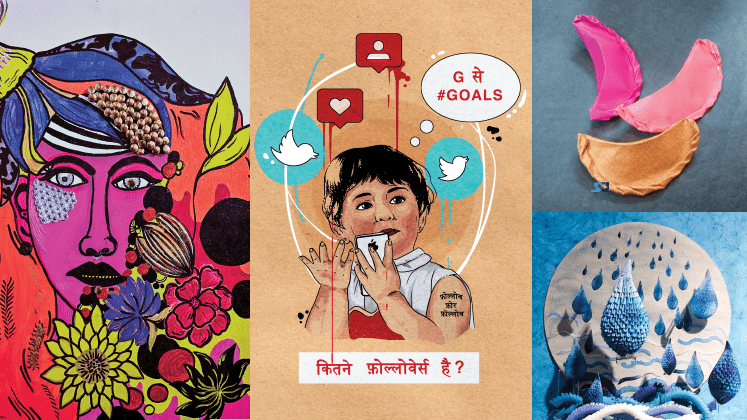
Nitya Bellani illustrator a knitwear graduate from NIFT, New Delhi, Nitya ventured into the hyped space of digital art during her tenure at college, where she realised that she is not meant for the garment space. With immense support from her faculties, Nitya was able to hone her skills and today, her artworks are creating quite a spur on Instagram.
AR: What drives your creative process?
NB: Initially all my artworks were inspired by my personal experiences. I used to portray what I used to feel, it was all about emotions for me. Even till now, when I create something, it’s not about what kind of audience I’m targeting, it’s more about myself, and my take on a particular topic.
AR: From knitwear to digital art – what made you take the plunge?
NB: I realised during my four years at NIFT, how much I hate garments and how much I love graphics. But I won’t say that those four years went in waste as they made me realise what I really wanted to do. I realised that I was most comfortable with Photoshop as a design software. Now that I’m done with college, I’m aiming for my masters in Graphic Designing.
Graphic design has lay outing, branding and it’s something I enjoy as well. I want to explore more of that space but at the same time I’m not going to leave illustration. That’s very personal to me and I’m going to practise it all my life.
AR: Describe the mediums that you use and your signature style?
NB: In a very informal way, I sketch every day with a basic marker that I use. I love creating animated characters and I do a lot of cartoons – they come naturally to me. I even like to play with my stroke lines and I feel that the digital medium, specifically Photoshop, works really well for me.
I have a very flowy aesthetic; there’s a little imperfection in my work which I really like. If everything would be perfect, then how will you differentiate? So, even though my artworks are done digitally, I like to finish them in a way that when you look at them, they look like a painting.
A lot of people come up to me enquiring about the medium it is, and I say – ‘it’s looking like a painting but it’s been done on Photoshop – nothing is painted – it’s all printed! I say it’s a JPEG!’
AR: What’s the story behind calling your work ‘It’s a JPEG’?
NB: It’s because all the photos that people click, all the memories people have, are in JPEG format; so in a way I want to capture what people feel through my art. That’s what I initially began with and that’s my ideation behind the name ‘It’s a JPEG’.
AR: How can emerging artists expose themselves more on the art front and how can they update their skills and knowledge?
NB: Social media is a great platform for people like us and for someone who has no contacts in the industry. I don’t know people in this industry – I come from a business family, so interacting with artists online really helps.
Secondly, there are open calls for artists nowadays to participate in exhibitions and shows. You can just open Google and search for keywords like Artist Delhi and so many entries come up. So I think opportunities are there but effort is needed to search for them.
I also feel that there should be more independent shows for independent artists, and galleries wanting to showcase independent artists. There should also be more efforts for the artistic community, such as singers, rappers, artists, dancers, painters, etc., coming together on one singular platform to showcase their art. Such platforms are great to interact and collaborate with people.
Shachi Jain origami artist homemaker-turned artist, Shachi is a mother of two who prioritised her family until her kids got into engineering, to really give flight to her dreams. Interested in crafts since a very young age, Shachi quickly developed origami as her forte, and started practising origami tessellations as an art form. She creates art using only one sheet of paper without cutting it, solely by manipulating its edges, and incorporating various folding techniques.
AR: How did you get introduced to the craft? What led you to practise this full-time?
SJ: I have always been interested in paper, it has always fascinated me. I found passion in the art of paper folding – popularly known as origami. My journey started nearly six years ago and hasn’t stopped since then. It’s a constant learning process which makes one challenge their skill sets on an everyday basis.
AR: What is the methodology that you use for your tessellations?
SJ: I use varied paper folding techniques to create crease pattern tessellations. In this, one has to follow a particular pattern and create it by folding only, you don’t cut paper or use any glue. The shape of the paper can be manipulated using origami folds while starting out – we can cut a hexagon or any other basic shape. This is a new age art. You can make anything with origami.
AR: Many aspiring and emerging artists who wish to get into the art field in India, hold themselves back keeping in mind the curtailed exposure Indian artists get or the way the art field is considered as a career opportunity. What would your advice be to such people?
SJ: If you have a passion for something, you should keep on doing it. If you don’t want to pursue it 100 per cent, you can start slow along with your education, or fulltime job or business on one side. I wouldn’t say leave everything, and pursue art because art is a field that takes time for one to get established in; so until then, if financial security is your goal, pursue other things side by side and keep honing and practising and participating in your artistic pursuits.
AR: What is something that you wish you had known earlier, while starting out, that would’ve helped you, which can even help other artists who are just starting out?
SJ: I would say exposure is a big aspect. I could’ve displayed my work much earlier at a younger age, but because of certain responsibilities, I couldn’t showcase my work properly. One should keep doing whatever they love, and take advantage of various platforms that provide exposure in order to get their art noticed.
RD woodcut painter Jabalpur-based woodcut painting artist RD, credits his practice to his aunt, eminent artist Meenakshi Dubey. An ancient style of print making, woodcut paintings are extremely rare with only a small population of people actually practising it in the present day. Depending upon the size of the paper,one artwork can take anywhere between 2 weeks to 3 months to complete.
AR: Explain your art form. What all tools do you use to get your art out and what is the process?
RD: The main USP of this art work is printing. The tools required for woodcut paintings are mainly the wood block from which prints have to be taken and a variety of other tools used for carving.
The shelf life of the paper is 100, 200 or maybe 500 years if preserved properly. The ink which is used remains intact throughout and won’t be shredded out.
Precision is crucial in this type of work. If we displace the paper by even .5, the entire painting gets spoiled. It takes a lot of time, labour and patience to complete.
Starting from light shade to dark shade, we put the ink or colour with the help of a rubber roller on to the wood, place the paper on to the wood, rub it and press rigorously so that the colours get transferred into that paper or canvas.
The first colour used earlier on the woodblock is then scrapped off creating a sort of grove. Then we take the second colour, put the colour with the help of roller on to the woodblock so that the groovy part that had previously been scrapped does not attract any colour.
Then again, we place the paper on to the woodblock, rub it, press it and take a print on that paper. And likewise for third colour, fourth colour, we just keep putting colour, scraping it out, taking a print. The last part is outlines, for which we just put black colour on to the woodblock and place the paper on to it to get the outline.
AR: How do you describe the art space in India? What do you think are the drawbacks?
RD: I think that the Government needs to support Indian artists – they should get more recognition and should be able to sell artwork. Right now, the Government isn’t putting in major efforts to promote Indian art and artists, as a result of which the craft is dying out.
AR: What would your advice to the young aspiring artists looking to enter in the field who might be holding themselves back keeping in mind the opportunities that artists have in India?
RD: There are so many opportunities available nowadays, but how to grab them totally depends upon the person. Younger artists need to know how to get out there to display their work.
Aspiring artists shouldn’t get dismayed because it takes longer to establish oneself in this industry. If they showcase their work in a gallery for the first time or second time, they start thinking that their artwork should be sold, but this isn’t the right approach. They have to try repeatedly and definitely one day they’ll be able to make a mark with their art and garner clients.
Megha Sawhney contemporary artist Part-time writer and part-time artist, Megha has been interested in art since she was a kid. Hailing from a small town called Rudrapur, in Uttarakhand, she moved to Delhi for a degree in English Hons., which opened up a world of opportunities for her and made her follow her passion.
AR: What inspires you?
MS: I personally enjoy creating artwork around women, and social issues surrounding them, because I myself come from a conservative family, and growing up in small town, I had many suppressed feelings. My art speaks about feminism or the rights for women or how suppressed women are and how they’re trying to break out, which I communicate via rebellious means of expression.
AR: What all mediums do you use?
MS: Acrylics, because they are bold compared to water colours. I like making my artworks crafty and you can see many materials easily found in a daily household such as aluminium foil, bulletin pins, wire, etc. It’s a mix of a lot of things.
For now, my base is mostly acrylic and I am looking to experiment with different mediums because art cannot be restrictive. My basic idea is to make art decodable by a layman because as an appreciator of art, I know art, but for a layman they cannot understand abstract very well.
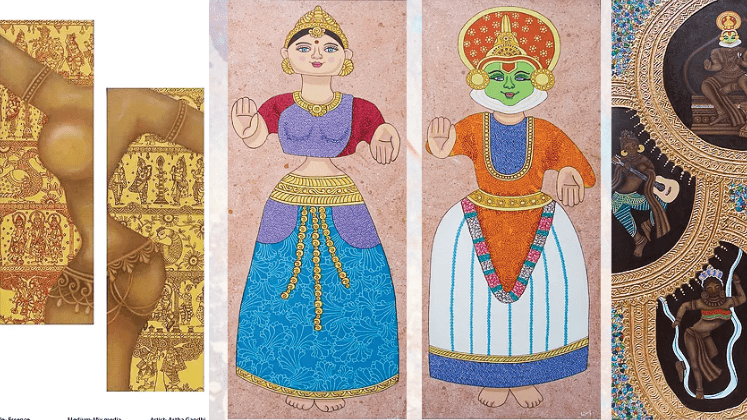
Astha Gandhi Indian fork artist A bachelor in Fine Arts from Jamia, Astha is a freelance painter and muralist who works with Indian fork art themes that can be relevant today. Having worked in the past on mural projects with established teams such as ‘Delhi Street Art’ and ‘Rockstar Artist’, Astha also does solos, commissioned work and exhibitions.
AR: How would you describe the art scene in India?
MS: Ruined! I don’t know about the larger struggle but according to me, coming from a small town, I don’t see many opportunities available. People are not ready to pay. I feel that it’s still growing and we are not far from the destination since many emerging artists are trying to make an impact which can lead to many millennials taking it up as a full-time job.
AR: What changes do you think can be implemented to further the art scene in India?
MS: I think we really need to provide newcomers like me, with opportunities instead of only focusing on people who have access to galleries and who have contacts in the field, because new comers don’t have that privilege.
People from smaller villages, have to leave their families and make contacts to get work. Artists can’t just keep paying for galleries and investing whilst getting nothing in return. I think that’s the thing that people need to approach and broaden their horizon when it comes to understanding art if they want to admire it.
I think people need to move a little beyond the small group of people they already know who are big names in the industry because there’s no point buying a painting for crores on one side, whilst on the other, an artist is dying just because they don’t have access.
AR: How did you start out?
MS: In my third year of college, I took part in a contest hosted by the Literature Magazine and my work was selected for the cover page. We weren’t given a theme, so I went all out and created a badass woman and that’s when I saw people appreciating my work since it didn’t fall under the conventional art bracket. This pushed me to an extent where I mailed the publisher supplying books for our college.
Today, eight of my books are already out and people in my college are using books with my cover.
AR: How would you describe your style?
AG: I merge Indian art forms with contemporary themes that is a fusion of contemporary and Indian fork form. I work with oil and acrylic but I prefer acrylic over varied basis. I have painted on clothes and walls and recently discovered that wood, because of its texture, is as great a medium to paint on, as well.
AR: What do you think the art scene in India is like?How can it be made better?
AG: I have seen a lot of potential that we need to work on because as a struggling artist, I myself feel that somehow we are not getting the correct opportunities that are required. India is still very far behind when it comes to the world art scene. We really need to work together as a community rather than pushing the newcomers down further.

 Bharat Tex Special Report 2026