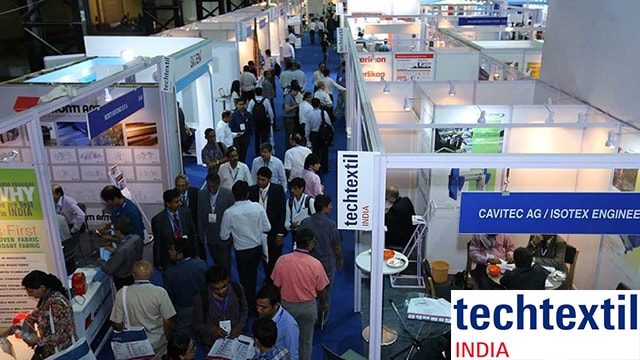
Messe Frankfurt, known for experimenting with its events to add more value for its visitors, included Texprocess for the first time to its already successful Techtextil India show. The 6th edition of the event was an amalgamation of technology and technical fabrics for the textile value chain. In addition, the State of Telangana highlighted its textile policies encouraging investors to consider the state for future expansions.
The three-day textile fair hosted over 175 companies from India, Austria, Belarus, China, France, Germany, Italy, Korea, Spain, Belgium and Switzerland. A prime highlight of the fair was an exclusive telecast of the 56th edition of Dornbirn Man-Made Fibers Congress 2017, besides various seminars on technology and technical textiles that were lapped up by the visitors. The first day saw a host of dignitaries at the inauguration ceremony, emphasizing the importance of the event. Michael Janecke, Director, Brand Management, Technical Textiles & Textile Processing, Messe Frankfurt Exhibition; Dr Jurgen Morhard, Consul General, Consulate General of Federal Republic of Germany in Mumbai; and Elgar Straub, MD, Textile Care, Fabric and Leather Technologies, VDMA (The Mechanical Engineering Industry Association), Germany; Pramod Khosla, Chairman, Indian Technical Textile Association (ITTA) & CMD, Khosla Profil Pvt. Ltd. and Dr Anoop Rakshit, ED, ITTA, were also among those present.
As the Official Partner State for the event, the Government of Telangana was aggressively promoting its textile policies and networking with potential investors at the fair. The Department of Handloom and Textiles is currently working to strengthen the textile and apparel industry, and has launched many incentive-based programmes in areas such as capital support, power tariff and land price to attract investors. The Kakatiya Integrated Mega Textile Park is one of the key focus areas presented by the state at the 6th edition.
Techtextil has many new offerings…
Along with Indian textile giants like Reliance, Arvind, RSWM and Welspun, many Chinese and European companies displayed/discussed a variety of products in the technical textile segment. Among one of the first textile mills to enter into the technical segment 20 years ago, RSWM is constantly innovating, moving far ahead from its first flame retardant fabric to protective clothing and special fabrics with performance properties like anti-static, water retardant, heat proof and comfort. “RSWM is known for its innovation, but unfortunately the concept of safety is not well-known and applied in the country. Specialized fabrics are still to find wide use in India, though they are in great demand in other countries,” said Ajay Sharma, Sr. General Manager, New Product Development, RSWM.
Arvind Advanced Materials, a division of the Arvind group, is an ISO 9001: 2008 certified manufacturing facility producing high performance protective and industrial fabrics. At the event, the company was displaying specialized products for personal protection such as flame retardant, anti-ballistic, climate protection and also for industrial applications such as filtration, belting, coating, outdoor and drying, etc. “Our fabrics are produced with world-class technology and know-how based on a strong foundation of knowledge, research and market needs in collaboration with Japanese expertise,” said Satyapriya Dash, Technical Advisor, Arvind Limited.
A large chunk of visitors were the uniform manufacturers and traders who were very much keen to see how they can add value to their uniforms through new fabrics on display. It was also a good sign that not only the top players, but also the medium-level companies are now exploring technical textiles, and that too in various segments.
The Reliance group was showcasing many offerings in technical applications including its polyester high tenacity yarns. The company is the first in the country to introduce these polyester yarns with wide applications. Meanwhile, the Advanced Textile division of Welspun was offering its new Welicide, spunlace for delicate touch and 3D swipe for hard wiping needs. Both the companies saw many visitors, mostly looking to add new dimensions to their businesses. “I have been visiting Techtextil India since its 3 Editions, looking for products in technical textiles and non-wovens, I have interacted with several potential exhibitors and discovered many new products in various segments,” shared Shalin Kaushikbhai, Director, Premjyot Fabrics Ltd.
Apart from the teams of some big players like Kewal Kiran Clothing Limited (KKCL), Karam Industries, Raymond Apparels, Sri Shanmugavel Mills and various fabric mills from Surat, the show witnessed visitation from many small and medium-level garment manufacturers from across the country and most of them were curious to see and understand the technical textile industry. Some of them were disappointed to see that there were limited Indian yarn and fabric companies at the show. Many also felt that there should have been more players showcasing fabrics for the garmenting segment.
A large chunk of visitors were uniforms manufacturers and traders who were very much keen to see how they can add value in their uniforms through new fabrics on display. Srinivas G, Director of Lance Innovations, Hyderabad explored products for uniforms, specific to pharma factories. Few buying houses and some overseas professionals also visited the fair like Arvind Gupta, President Director, PT. Lotus Indah Textile Industries, Indonesia and Palaniswamy Raj, Rajan, Chairman & CEO, Softwear Automation to understand the market and how India is progressing in the segment.
It is a good sign that not only top players, but also medium-level companies are now exploring technical textiles and that too in various segments. While some of the medium-level players are already observing good growth in their existing textiles business with the use of technical textiles, few are looking to bring in some changes in their existing infrastructure to offer products which have better margins compared to routine offerings. Among them, Sudarshan Chandak, Director of Amarnath Dyeing & Bleaching Works, Kolkata, dyeing 20 tonnes of fabric per day, was at the fair searching for new opportunities. “Currently we are not into technical textile but we have realized that this is the future direction we are thinking to venture into. Our planning is at the initial stage, but we are seriously thinking about it,” said Chandak.

Having 45 Sulzer looms, Uchit Shah, Director, Optimum Silk Mills informed, “We are comparatively new in the technical textile segment. We have developed 20s PV by 20s PV plain fabrics, processed it for water repellence, so that it can be used for interlining of fire retardant suites. The development has turned out to be successful for us as we have noticed high return on the same, compared to our regular suiting/shirting fabric. So, we are exploring more of technical textiles and researching how we can develop more such products.” The company also has some enquiries for fire-retardant fabric for the Indian military, as well. “We do not need to make many changes in our existing unit, but just need to add few technologies and modify existing machines to produce different products of technical textiles,” he further added.
Some technologically advanced solutions launched and demonstrated include…
• Arselon, a flame-resistant, high-temperature resistant fibre that will not melt, drip, or support combustion in air by OJSC Svetlogorsk Khimvolokno
• Arselon, a flame-resistant, high-temperature resistant fibre that will not melt, drip, or support combustion in air by OJSC Svetlogorsk Khimvolokno
• Mehgies Airtex magic FR duo, a digital print fabric with textile texture, lending a natural radiance by Low & Bonar
• The Loom Travclean (LTC), automatic travelling cleaner for weaving machines by Luwa India
• Meta Aramid Fabric for gloves, replacement to carcinogenic (cancer causing) asbestos in the industry by Tex & Twist
• Evereco Polyurethane Reactive (PUR), 100% solid content/ organotin-free and toxic-free substance that is Excellent Hydrolysis & Heat resistant
• PREMIUMCUT ELC, a single-ply CNC cutting machine at the Mehala booth
Prayosha Tex, Surat, currently producing 5 lakh metres of grey fabric per month for womenswear, half of which is exported to Afghanistan, Africa and Europe, is planning to diversify. Shubham Italia, Director of the company, is currently exploring opportunities in nonwoven fabric, glass fibre yarns and mono fabrics segment, especially for carpets and arrow space engineering. “I have noticed growing demand for carpets, but when I approached some carpet manufacturers, they were not able to give the carpet which can be used again and again. I am exploring a particular fabric that can make it possible for a carpet to be used many times with the same feel and get it easily washed,” informed Shubham. The company is also planning to start a dyeing mill.
Get-well is another company from Mumbai that recently entered into hospital garments (woven as well as nonwoven). Deven Doshi of the company informed that the company is adding more machines to increase capacities. “We are targeting domestic as well as overseas markets for our products. We have observed that medical textiles in India and African region are under penetrated, so our target is to garb a share in this heavy potential market,” reasons Doshi. Anil U. Kharate of Reddcolt Enterprises, Aurangabad, informed that the business in non-traditional fabric is going good and apart from banana fibres, the company is also into industrial chemicals and bagasse supplies.
Texprocess gets lukewarm response…
The newly introduced Texprocess segment saw technology market leaders such as IIGM, Tukatech, Mehala Machines Ltd., Turel Sales Corporation, GA Morgan Dynamics Pvt. Ltd., Bierrebi, Optitex, Lectra give live demos at their booths. The participants of the segment were displaying for the technical textile industry for the first time. “India’s diverse markets are rightly positioned to manufacture, consume and export non-traditional textile products. Non-apparel related products have varied applications and these industry related products need different technologies, compared to the traditional methods of manufacturing. Going forward, these segments of business have potential to surpass the requirement of traditional textile and leather products. IIGM’s participation in Techtextil India offers detailed insights into some of these technologies,” said Pavan Kapoor, Managing Director, IIGM.
Though there are many technology fairs happening in India, companies decided to participate on the basis of the brand value of Texprocess. “We have not been participating at technology fairs for some time now, but being a part of the first Texprocess in India was important, so we are here only to mark our presence and support quality exhibitions,” said BT Nagesh, MD & India Subsidiary Head – Lectra. Elgar Straub, MD, Textile Care, Fabric and Leather Technologies, VDMA was confident that the event would continue in future, but maybe with some changes. “Companies in India are preparing for the future and Texprocess is being visualized as the platform to bring in the change. We will analyse the feedback and see what more needs to be done in the next edition,” said Staub.
As a new feature of the Techtextil India, the section was an attraction for many visitors from apparel industry as many cutting room solution providers and top machines companies were presenting their latest offerings. Mehala Machines was the only company actually demonstrating the cutting machine and the PREMIUMCUT ELC, a single-ply CNC cutting machine at their booth, was a major attraction. “We have displayed technologies that go well with the technical textile segment and people showed great interest in the displays. How much of the interest will translate into business, is to be seen,” said a pragmatic Bharath Subramaniam, Director, Mehala Machines India.
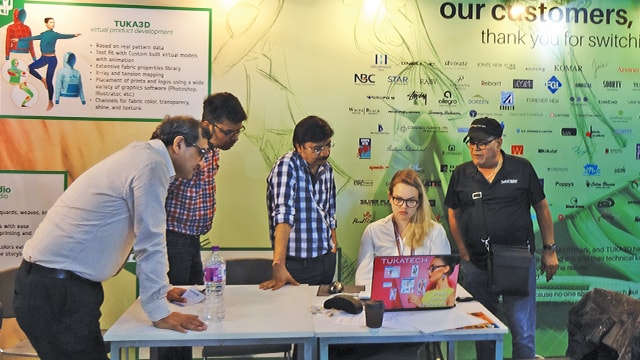
Though the Tukatech stall drew many people including Dinesh Jain, Director KKCL, Ram Sareen of Tukatech was disappointed at the turnout and felt that much was left to desire. “The major turnout was for the technical textile segment and the Texprocess pavilion was only a curiosity element,” said Sareen. Similar views were expressed by many other players in the Texprocess pavilion.
Yet, many visitors were happy to see the technologies. Anju Shetty, Strategic Product Initiatives and Mukesh Kaura, Manager of Raymond Apparels were looking for disruptive technology and were content finding some of them at the fair. Rahul Dudhane, CEO & Partner, Noble Technical Nonwovens, Kolhapur, which is into needle punch felts, thermal bonded waddings, spunbond fabrics etc, wishes to enter into garmenting and hence, he interacted with many exhibitors at Texprocess. Raj Fabrics, Udumalpet (Tirupur) is also planning to enter garmenting and so also is his partner N. Ponnuraj. They both took keen interest in exploring the Texprocess section of the event. Many players were offering innovative or industrial yarns, fibres and were searching how technology could help them in their business.