One of the largest exhibitors at the event was Reliance Industries Ltd. which showed its staple and filament fibres. Heading the list in the staple section is Recron Green Gold, the greenest fibre in the world for knits and wovens used by all the big brands. Available in raw white or 45 pre-coloured fibres, its primary purpose is to lower the dependency on natural resources and increase sustainability. The fibre is certified with Global Recycle Standard.
Recron’s other offerings Recrobulk is advanced staple fibre good for hosiery and scarves, while Supermicro is of 0.6 denier, which can spin up to 140 counts and is considered the finest fibre available in the world. Besides this Recron LP is a low pill tow for high-end worsted suitings, PV/PC blended suitings, socks and upholstery fabrics. Other best sellers are Recron Feel Fresh with anti-microbial properties, Recron FR flame retardant and Recron UV for ultraviolet protection.
For Reliance, innovations are important so on the filament side the company has Recron in eleven types of “Fancyy” like MCX, Linen, Sapan, Slub, Lnlyk, Sparkle, Mélange Vxxx, Salsa, CTS Diamond and Worstlene, which are ideal for suiting, shirting, dress materials, furnishings, bottomwear, and knits. Reliance buyers look for three points – lustre, slub and function – and this has helped the company achieve a ten-fold increase in volume to support the fashion industry. The company also pays attention to the carbon foot print mapping for lowest pollution.
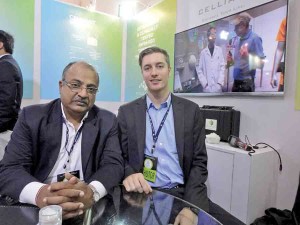
Murugan Thenicondar, GM-Sales, Lenzing is very excited about the expansion plans of Lenzing. “We have an expansion programme from 2014-2015 when there will be the first new plant in Austria, followed by a second in USA and a third in China. There are plans for a plant in India too. Lenzing is the only company in the world, which has cellulose as the core business,” says Thenicondar. Lenzing makes all the three generation fibres namely Viscose, Modal and Tencel and creates the technology to build the fibre too. The combination of Lenzing and Accordis Technology in USA and UK is aiding in making dry spinning technology for Tencel. “The market for commodity fibre is under pressure. Modal is oversold and Tencel will be oversold by end 2014. Buyers want better retail pull, which we can offer,” says Thenicondar. Modal and Tencel both botanic fibres are ideal for bed linen, garments, workwear, home furnishings and automobile applications.
Vinay Phadtare, Assistant Manager, Supply Chain Management Processing, Birla Cellulose revealed its new variety called Spunshades which is eco-friendly and sustainable with colour fastness and safe even for babies with Oeko-Tex 100 certification. It is dope dyed fibre manufactured in colours and is ready to be woven or knitted. “We have our own business development technical team to support the buyers from fibre to fashion stage. This is a new business initiative to guide in supply chain department,” states Phadtare. Plants are in Gujarat, Madhya Pradesh and Karnataka and one more will be added in Ankleshwar. The company makes viscose, modal and excel fibres with a production of 1000 tonnes per day which will go up to 1200-1300 tonnes per day. Phadtare is optimistic about business in 2014, “Since cotton cultivation is decreasing these fibres will replace it, so business will grow,” adds Phadtare.
The most exciting launch at the Fibers and Yarns 2014 Expo was by Stuti Exports. Celliant, the new fibre with technology that converts body heat into infrared light turning wasted energy into a renewable power source that increases blood circulation and improves overall well-being and which truly was a crowd-puller. “The core of the fibre has minerals to make the body produce energy. This is very important for dailywear as well as effective sleepwear. This is a life-long process, has no allergic reactions to skin and is not diminished by washing,” informs Trenton Rae Horinek, Business Development of Celliant, a USA based company. The infrared light created by the fibre penetrates deep into the tissue to increase circulation oxygen and blood flow. A pair of socks with Celliant fibre proves reduction in swelling and fights fatigue. The use of the Celliant fibre will be identified by a hang tag or branding on the product. Introduced in 2008 in USA, Celliant is best for activewear and bedding as it gives good blood circulation and relaxation.
[bleft]The 9th edition of the Fibers and Yarns 2014 Expo held in Mumbai recently was an eagerly awaited event with over 55 exhibitors showing their latest products for the coming season. The various stalls were crowded with visitors interested in the innovative developments in the fibres and yarns segments that will drive the fashion industry in the future. Tecoya Infotech, organisers to the event were happy with the good footfall that was seen over the three-day event, Meher Castelino unveils some of the new developments shown at the event.[/bleft]
In Europe it is doing very well for bedding, in Korea for outerwear and in Australia for underwear. “In Australia, Jockey had Celliant in its underwear and it was sold out in days! Brands like Adidas and Puma have already used it,” adds Horinek. “We are introducing Celliant in India and the response has been very good from major fashion players in the suiting, shirting, innerwear and bed linen segments. It is a premium product but with a lot of health benefits,” informs Pradeep Roongta, MD, Stuti Exports.
Cotton Council International was present to highlight the wonderful properties of cotton. “We are here to promote cotton as a consistent supply. The buyers want constant quality but technical parameters have to be good. USA and Australia have come together since 2013 for responsible cotton sourcing and nearly 150 brands and manufacturers are on board,” informs Peush Narang, Representative India and Sri Lanka, Cotton Council International. Nearly one third of the world’s consumption is cotton while two-thirds of the cotton consumption is in India. For Indians, cotton is still a favoured fabric.
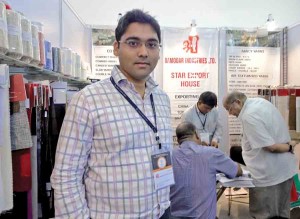
The focus at Damodar Industries Ltd. was on a variety of fancy yarns. The Damodar Group, is a leading manufacturer and exporter of cotton polyester and polyester blended value added yarns in India. Specialists in manufacturing linen and silk like yarns, the company exports 60 per cent of its production to 26 countries including China, Brazil, Korea, Bangladesh, Turkey, Europe, etc. while 40 per cent is sold in the domestic market. “We produce knits in poly and viscose linen as linen is our predominant product. Buyers want linen for men’s and women’s wear as well as suiting, shirting and knits,” informs Aditya Biyani of Damodar Industries. With a unit in Silvasa in Daman, Biyani is very happy about 2014 being a good year for business.

Winsome Knitwear manufactures and exports premium quality raw white compact organic and eco-friendly yarns to more than 70 countries around the world. The company’s business is from yarn to garments and it is also the biggest producer of flat knitted garments. Started in 1952 the company’s turnover is US $ 100 million. Licensees for the Italian men’s knitwear brand Portobello, the company is the first and largest producer of cotton Mélange yarn in India with 25 tonnes per day. Making cotton viscose, Modal, acrylic yarns, the company also has the Old Berry knitwear in-house brand. The production for knitwear is one lakh pieces per month with the unit in Mohali. Garments are also in cashmere and silk and the company has a woolmark license. Exporting to Marks & Spencer, British Home Stores, Shibu, John Louis, the company is organically as well as BCI approved. “The domestic market is very good while exports may not be that good. We supply garments to Celio, Wills Lifestyle, Benetton, Pantaloon, Colors under their label. Business is good and one can grow if one starts an in-house label,” informs Hitesh Manuja, Manager, Winsome Knitwear.

Sri Balavigna Yarns is well known in the industry for sourcing yarns from domestic as well as international markets. Agents and manufacturers of grey fabrics, the company plans expansion for 2014. “We will be expanding our weaving and plant to start a bed linen unit as well as home textiles. 2014 is showing good signs slowly and we have been experiencing a 15 per cent growth each year,” says S Krishnamoorthy, Administrative Director, Sri Balavigna Yarns. The company sources yarns from all over India from over 31 associates.
With 25 manufacturing units in five states including Himachal Pradesh, Punjab and Madhya Pradesh, Vardhman Textiles Ltd. exports 25 per cent of its production and supplies cotton yarn for weaving and knitting to top companies like Raymond, Arvind, Mafatlal, Morarjee, Welspun, Madura and Mandhana. “The company’s specialty is slub yarns, which is in the fashionable fancy segment on display. These yarns are specially engineered to a specific pattern of mass length and frequency,” informs Vijay Puniyani, Sr Vice President – Marketing, Vardhman Textiles Ltd. adding that the year 2014-2015 will be a very fruitful year for the company as business is picking.

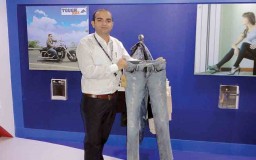
The display by Invista was large and spacious with visitors interested in the company’s latest Lycra T 400 polyester based fibre application which requires no spinning but can be taken to the loom to make fabrics. It is 100 per cent chlorine resistant, comfortable with good moisture management. Tough Max is the fabric from Lycra T 400. “The other product is Dual FX which is a mix of T 400 and Lycra fibre ideal for women’s bottomwear. Its stretch is more than 35 per cent,” informs Munish Verma, Technical and Market Development, Invista Sales and Service India Pvt. Ltd. According to Verma, buyers are looking for stretch with a good recovery, durability and light weight. Lycra T 400 has super stretch recovery and comfort for denims and ideal for knits and wovens. Lycra T 400 Black Fibre is perfect for dark colours like indigo black for denim jeans, jackets, separates, trousers, skirts, suiting, knit tops. In addition on display was XFIT Lycra, the popular Cool Max brand for active sportswear, Thermolite Fleece for lightweight warmth for outdoor activities and Lycra Sport Energy and Lycra Sport Beauty for high performance garments.
[bleft]Heading the list in the staple section was Recron Green Gold, the greenest fibre in the world for knits and wovens used by all the big brands. Available in raw white or 45 pre-coloured fibres, its primary purpose is to lower the dependency on natural resources and increase sustainability.[/bleft]
Tirupati Yarns launched its Solucell filament yarn ideal for towels. The company is an agent for Solucell, which is a Chinese product newly developed and displayed for the first time in India. Very popular in USA for towels and T-shirts, it has zero shrinkage and is very cost-effective besides being biodegradable. “Solucell is soluble in alkali, and is an innovative filament yarn providing the world with a solution of easy dissolution and eco-friendly processing. It is an ideal to substitute PVA for the production of zero twist towels,” informs S V Shetye, Technical Advisor, Tirupati Yarns. “Being a filament yarn, Solucell can be used to produce core yarn, which acts like the normal cotton yarn in the fabric production. After dissolving, Solucell disappears and creates a real hollow as the core of the yarn,” says Rahul Lohiya, Export Executive, Tirupati Yarns.
From Indorama Industries Ltd. comes INVIYA, the new freedom fibre. Made in the company’s plant in Himachal Pradesh, the company produces the advanced spandex fibre under the brand name INVIYA with its new series INVIYA I-300 for wider application. The plant started production on March 25, 2012 with special technology and in December 2013 INVIYA I-300 was introduced. “INVIYA I-300 is a high tenacity product with improved stretch, recovery, heat resistance and durability. It can stretch up to six times its original length,” informs Sunil S Murkute, DSM – CTS, Indorama Industries Ltd. The company is the first producer of spandex in India and has a turnover of Rs. 200 crore. INVIYA can be used for polyester or nylon circular knit fabrics, while INVIYA I-300 is suitable for core spinning applications. Nearly all texturisers are the customers of INVIYA. About 14 tonnes per day is produced and with the demand being very high, another plant will be setup in 2015. About 25 per cent of the production is for exports with INVIYA having 50 per cent of the domestic market share already.