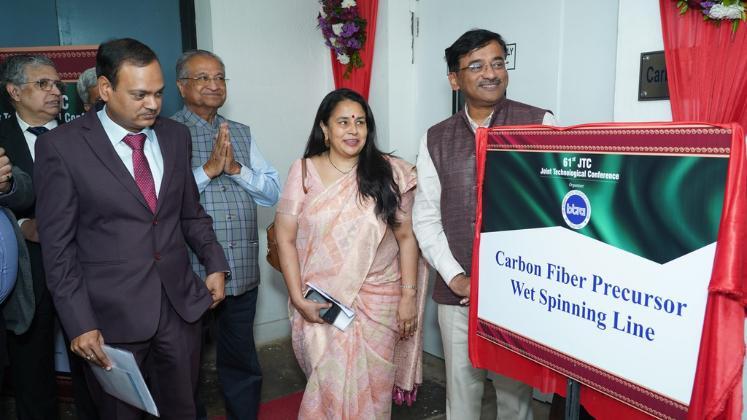
India’s inaugural Carbon Fibre Precursor state-of-the-art Line, with a capacity of 4000 filaments, has been successfully installed within BTRA’s High Performance Fibre Lab. This significant milestone was unveiled during the 61st JTC – Joint Textile Conference, hosted by the Bombay Textile Research Association (BTRA) in collaboration with Ahmedabad Textile Industry’s Research Association (ATIRA), Northern India Textile Research Association (NITRA), and South India Textile Research Association (SITRA).
Amidst industry veterans in attendance, Narendra M Dalmia, CEO/Director of Strata Geosystems, emphasised the evolution of Textile Research Associations into global benchmarks, particularly within the technical textiles realm. Dalmia urged industry players to engage with TRAs to actively contribute to the advancement of technical textiles.
Textile Commissioner of India, Roop Rashi, underscored the pivotal support offered by the Government of India to both industry and TRAs, especially in navigating market challenges, supply chain intricacies, and the overall ecosystem. Rashi encouraged industry stakeholders to proffer suggestions during such conferences, aiming to collectively address challenges within the textiles value chain.
Notably, the precursor, the raw material used in crafting carbon fibre, predominantly consists of polyacrylonitrile (PAN), constituting about 90 per cent of carbon fibre production. The remaining 10 per cent comprises rayon or petroleum pitch. Typically sized at 5 and 8 μm in diameter, carbon fibre filaments are amalgamated into tows containing 5000–12000 filaments, commonly known as ’12 K filaments’ (containing 12000 filaments). Stabilizing the precursor fibres significantly impacts the production of durable carbon fibres during the subsequent carbonization process. BTRA’s latest line in the Fibre Lab stands poised to play a pivotal role in India’s journey towards achieving its technical textile mission.