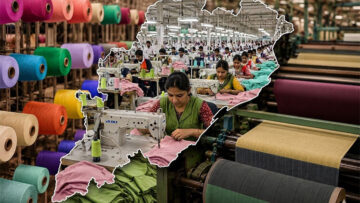
Even as the Indian apparel manufacturers struggle to come to terms with the rapidly declining orders, this trend has had a domino effect on the machine manufacturers too. To deal with this new challenge, many technology producers have taken upon themselves to educate the industry on alternative means to increase their profits by concentrating on areas such as increasing efficiency and productivity, automising maximum operations and controlling wastage.
Brother International recently held a 4-day workshop in Delhi on ‘Improving Production Management’. The objective of the programme, organized in association with Association of Overseas Technical Scholarship (AOTS), Japan, was to train the participants in correct machine handling so as to ensure the production of a higher quality product. This would subsequently result in not only higher efficiency of the operator but also a reduction in repair and rejection, thus cutting of production cost.
The event, inaugurated by Vijay Mathur, Deputy Secretary of AEPC, had participants from not only India but also from Nepal. Mathur said, “In the post-quota scenario of shrinking profit margins manufacturers are looking for new ways to improve the existing production system through product enhancement training programmes. One option could be to control defective manufacturing, which ultimately reduces production cost by minimizing repairing room expenditure. AEPC has stepped up its initiative in providing better trained work force to the industry. We already have 41 training centres and are planning to increase the number to 100 by year 2010.”
India is fast moving towards value-added products for the high fashion market. Therefore, cost balancing is vital to maximise profits. – Masahiro Isobe, Director and GM, Brother International India
Yasumi Suzuki, GM New Delhi, AOTS said, “AOTS offers training programmes worldwide for enhancement of technical skills to achieve better production management in order to improve quality and productivity in different industries. The objective of this workshop is to offer a personalized training opportunity to the participating companies to upgrade their regular training programmes and to expose them to a higher level of specialized guidance.” AOTS also carries out distance learning programmes for interested companies using methods such as Video Conferencing, Web-based Training, and providing study material.
Talking exclusively to StitchWorld of the present condition of the Indian manufacturer, Masahiro Isobe, Director and GM, Brother International India, said, “The industry no longer has the advantage of cheap labour; overhead costs for the management is also steadily increasing. As a result, the country is facing stiff competition from Sri Lanka and Bangladesh who offer lower production cost and cheap labour. But the brighter side is the fact that these countries do only bulk orders. India, however, is fast moving towards value-added products for the high fashion market. Therefore, cost balancing is vital to maximise profits. Another need of the hour is to focus upon line balancing which can be partly obtained through upgrading operator skills. Other advantages that you get out of this are easier management of the labour to derive higher efficiencies, and better quality of the stitched product.”
Talking about the company’s future plans, Isobe shared, “Brother has a strong history of giving new technologies to the sewing machine industry. In the past, we have successfully produced the world’s first direct drive machine, and dry head machines. Other than looking towards further improving these technologies, our primary focus will be on further improving the energy efficiency of our machines.”