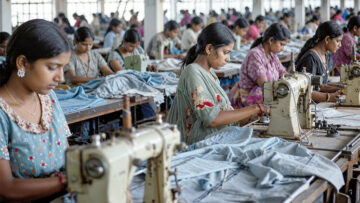
Two reports in the last one month on the garment industry have painted a very negative picture… while the first one ‘Tailor Made Lives’ by People’s Union for Democratic Rights (PUDR) claims that workers are shoddily treated at factories leading to repeated unrest; the second one by the NGO, Save the Children – ‘The Hidden Workforce’ – claims that there are 8,044 children (in the age group of 6-18 years) working in the garment industry in Delhi alone.
These two reports and the subsequent calls I got from the industry on our analysis of the first report, makes me wonder if we as an industry are really compliant, or as the NGOs claim, it is all a farce to get business… I sincerely believe that the industry is doing its bit for the workers and is categorically cautious of child labour in any form. I have yet to find a company which has child labour, but I may have reservations on issues of hygiene.
No one can deny that much has changed over the past two decades, but it is also true that the concept of complete compliance is still to reach the last and smallest of exporters. These exporters are generally working for boutique stores, shop owners, wholesalers and importers who in turn are not yet so clued into compliance, but more worried about price and quality. NGOs do not understand the dynamics of the industry to make a distinction between, manufacturer exporters, boutique manufacturers and domestic manufacturers… their sweeping statements taint the whole industry.
Only recently, I was talking to some smaller exporters and they showed keen interest in upgrading their factories, not only technologically, but also in terms of better working conditions for their operators… The change is happening, but it needs the support of all stakeholders, including civil society and NGOs.
But the fact remains that reports brought out by the NGOs are lopsided and rarely present views from the industry side or even make concrete suggestions for resolving the situation. In the latest report on child labour, the report clearly states that there are no children in the organized garment companies… We all know that young children are found either in home worker situations or at backyard handwork centres running in thickly populated localities where access is only through an agent, who collects the work from the factories and distributes the same to such ‘workshops’.
Time and again this issue has been discussed at different forums and big agendas are made out, but no results are forthcoming; in fact it would not be wrong to say that even the people who participate in such debates are never given a feedback on their suggestions by the organizers of the roundtable!
Taking part in such roundtables has become a ‘fad’ for NGOs and you will see almost the same set of people over and over again, strangely with the same viewpoints intermingling and then moving on to the next forum. Where is the action plan? How many times is the industry invited to participate at such forums to express their problems or share their experiences.
Isolated meetings and finger pointing reports are not going to get results; results will come where there is a synergy of thought and a collective effort to find solutions.
When the factory of Orient Craft was targeted by angry workers recently and my team rang up to know what happened and why…, the response was telling…, “I wish I knew.” NGOs have to understand that exporters too are worried about the situation, after all their business, property and reputation is at stake.
A detailed investigation and honest attempt needs to be made by a neutral party to analyze what is ‘wrong’ why is the labour angry, why are children still in the supply chain, why are companies working with best of brands/retailers targeted by NGOs for non-compliance, why are smaller companies finding it difficult to be compliant…, there are so many questions that need an answer.
The last time I had voiced my concern on the negative attitude of the NGOs, Dr Kebschull the Chairman of the IGEP Foundation in Gurgaon, and a known personality in the ‘compliance and sustainable’ circles, as he is also the India representative of the Business Social Compliance Initiative (BSCI) which is part of the European Foreign Trade Association in Brussels, come personally to my office to congratulate me on the editorial.
He was very vocal in his concern of the ‘irresponsible’ way the NGOs were reporting to international social organizations that controlled most of the NGOs through funding. In India since 1987, Dr Kebschull is not new to the scenario and he feels strongly that the Indian industry is being misrepresented at international forums.
I agree completely with him, though many things still need to change, the industry is willing and together the change can happen. A better understanding between the workers, factory management, buyers and NGOs need to be created… maybe we need a stronger industry association which can take a lead in this direction!




 Bharat Tex Special Report 2026