Forgot your password?Just enter your username or account associated email address below and we will mail you a password reset link.Sorry, login failed. Incorrect email, and/or password.
As winding is not necessary in open-end spinning, a yarn clearer is often not applied. Hence, periodic yarn faults can badly affect the final product with effects like Moiré. To detect these faults during open-end spinning process, a yarn clearer of type 3N1 and 1N1 has been developed by Loepfe, which uses an optical sensing technology. The optical sensing technology is non-sensitive against changing humidity and any other changes in environmental conditions which could possibly affect the sensor.
The Loepfe’s optical yarn clearers cover open-end yarn counts from Nec 3 to Nec 60 at a maximum spinning speed up to 400 m/min with one sensing head. The type 3N1 offers an additional detector for foreign matter and a triboelectric sensor for detection of synthetic foreign matter, as compared to type 1N1. A large touch screen displays all the production and quality related data analyzed by the central unit.
After refining it for over four years at Zurich’s Functional Materials Laboratory, a team of Swiss scientists, led by Wendelin Stark and Philipp Stoessel have invented a technique to create a wool-like fibre using the leftover parts from meat-processing plants, which transforms animal-rendered gelatine into fibres that have wool-like qualities like softness and thermal insulation.
The leftovers are dissolved in water, precipitated with an organic solvent, and then extruded. This material is then ejected through the syringe and allowed to harden into a gelatine form, which are then stretched and dried on a proprietary machine and are ready to be spun in a few hours. It is said to have a comparatively smaller carbon footprint than some synthetic, petroleum-based alternatives.
With effect from 1 April 2015, new requirements will be applicable for the certification of environmentally friendly and socially responsible production facilities in accordance with STeP by OEKO-TEX®. The limits for parameters PFOA, PFOs, Nonylphenol (AP), Octylphenol (AP), Nonylphenolethoxylate (APEO) and Octylphenolethoxylate (APEO) have been revised to 50 µg/l, 10 µg/l, 0.1 µg/l, 0.3 µg/l, 1 µg/l and 1 µg/l respectively. A string of amendments has been brought about in areas of compliance of employees with ethically correct behavior, Social responsibility, banned processes, production waste and chemical management. Further, STeP standard can now also be applied to production companies for accessory parts for textile manufacture with immediate effect.
Loepfe, a Swiss manufacturer of optical yarn clearers for automatic winding machines recently unveiled WEFTMASTER® FALCON-i. Developed to monitor an individual thread for finest knots, fluff, filamentation, smallest thick places or even capillary breaks, Loepfe’s newly developed FALCON-i sensor is installed before or after a weft feeder. The thread can be monitored by using sensitivity levels, to be set manually or automatically. Automatic mode determines the sensitivity level itself. The sensor is insensitive to vibrations which can be extremely disturbing, especially with laser measuring devices, and which could cause false stops. When contamination is severe, the sensor can also be installed upside down which allows most reliable and constant monitoring. The thread is guided virtually contact-free through the optical measuring field by yarn guides before and after the sensor and a stop is triggered for defined faults. The color of the thread to be monitored also has no influence on measurement reliability. It is therefore possible to monitor the latest high-tech materials without problems with FALCON-i. Monofilaments, multifilaments, conductive materials as well as spun yarns in any material composition can be processed. The housing of the sensor is made from shielding material so that any existing static or electromagnetic fields will not affect measurement reliability. The FALCON-i sensor is microprocessor-controlled and therefore provides many options for connection to evaluation modules.
High-technology instrument manufacturer Uster Group has developed Uster Jossi Metal Shield to help spinning mills safeguard both capital investments and profitable production of quality yarn. In a spinning mill, metal piece such as screws, nuts, and pieces of wire or metallic bale strapping that might find their way into the cotton in various manners. By this yarn protection process a daily average of 10 to 20 metal pieces is taken out, but the figure can sometimes reach up to 50. A key feature of the Uster Jossi Metal Shield, known as Speedsense, which not only detects the metal piece but, at the same time, measure its mass and speed. Based on this, the opening time of the diverter is adapted, in a range from 0.2 to 3 seconds. According to the manufacturer, the Uster Jossi Metal Shield typically brings a cost reduction of more than US $ 7,000 per year.
Global fabric production has gone up by 1.3 per cent year-on-year in Q3 of 2014 because of improved output in Asia and Europe, the International Textile Manufacturers Federation (ITMF) said in its ‘State of Trade Report Q3/2014’. In Asia, fabric output increased by 2 per cent year-on-year in Q3/2014, while it increased by 2.9 per cent in Europe. On quarter-on-quarter basis, world fabric stocks increased by 1.4 per cent, with all regions supporting this development. Stocks in Europe increased 4.8 per cent followed by gains of 4 per cent in South America, 0.4 per cent in North America and 0.2 per cent in Asia
Rieter, a producer of textile machinery and supplier of systems for short-staple fibre spinning, is set to optimize the utilization of its existing capacity, improve product margins, reduce structural costs and expand its product and service offerings, particularly in parts and components. Based in Winterthur Switzerland, the company develops and manufactures systems, machinery and technology components used to convert natural and manmade fibres and their blends into yarns. With 18 manufacturing locations in 10 countries, the company employs a global workforce of some 4, 800 people.
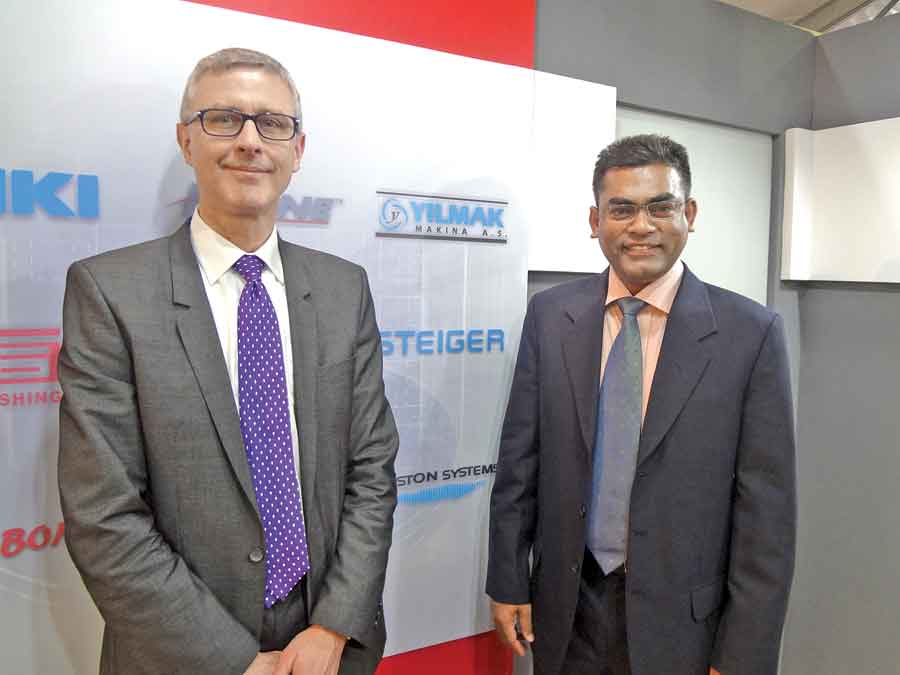
Gianni Zamarco, Sales Division, Steiger with M. A. Saleque, Managing Director, Uni Asia Associates Ltd.
Steiger with more than 50 years of experience is recognized internationally for manufacturing high-technology flat knitting machines. Banking upon the wide array of knit and purl combinations to intarsia and cable patterns possible with their machines, Gianni Zamarco, from the Sales Division of the parent company Cixing, representing the company at the fair, was positive of the potential of its machines in the country due to the major shift of sweater order from China to the country.
Operating in the country since 2006, Steiger owes the success of the company to their agents Uni Asia Associates Ltd., headed by M. A. Saleque, Managing Director of the company, with whom they were able to setup a robust after-sales service and technical support team. “Apart from after-sales service, spare part availability and technical support, we also conduct training through our Switzerland-based main office and the headquarters in China,” explained Gianni Zamarco.
The USP of the company is its intarsia machine, which the company claim’s is way better than the ones offered by its competitors, as it has motorised feeders ensuring top quality sweaters. Highlight of the company’s showcase at the fair was the New Aries 3.130, which is acknowledged for its 32, individually programmable motorised yarn carriers. Along with its smaller dimensions and shorter carriage, the machine offers 40% increase in productivity as well as virtually unlimited knitting possibilities. The speed and the direction of the 32 yarn carrier can be controlled independently allowing users to simply control or move several yarn-carriers simultaneously. As the machines are programmable and adjust automatically in their working position, the carriage does not need to move on the sideline of the needle-bed for colour changes. The carriers can be moved forward or backwards along the axis of a knitting feeder providing improved intarsia, tucking and plating.
Datacolor’s Viewport enables colour quality analyses under multiple lights using colour-calibrated image capture technology
Switzerland based Datacolor, specialist in colour management systems, will showcase a first of its kind Datacolor Viewport in ITME this year. It has been specifically designed to meet the needs of product quality control operators and colour analysts as it captures colour-accurate product images of fabrics. Viewport’s software enables remote visualization and colour evaluation for a wide range of products under multiple lights, thus eliminating the need to send physical samples and risking human error while assessing colour and providing the ease of approval and archiving.
Through Viewport you can share data instantly, in a secure manner from anywhere in the globe via cloud-based repositories, which gives users immediate access to colour-accurate fabric images. “Eliminating the need to ship physical samples is a significant benefit to both the supplier and buyer in the supply chain,” said Eric Alho, Product Marketing Manager, Datacolor.
Datacolor Viewport uses new calorimetric method for quantifying colour differences in multi-colour samples. It is based on a patent-pending technology that now makes it possible to accurately and efficiently control colour quality for any type of fabric, vis-à-vis prints/patterns, heather, lace, denim, towels, wall covering and a variety of multi-colour products.
Other than Datacolor Viewport, the company will also showcase its full product line of colour management solutions to the garment and textile industry, as well as to global retailers and brands at the exhibition.
Sustainable denim from Karl Mayer based on Clariant’s ‘Advanced Denim’ dyeing process
Making denim processing more sustainable has been a pressing need in the textile industry for some years and the Swiss-based chemical company Clariant, with its recently launched innovative advanced denim dyeing process, has been able to meet these demands.
Based on Clariant’s ‘Advanced Denim’ dyeing process, machine builder Karl Mayer’s Indig-O-Matic System is now able to offer superior efficiency, flexibility and sustainable denim for weavers. This new system is extremely efficient and reduces the number of boxes used in conventional dyeing from 12 to one.
Karl Mayer, one of the leading manufacturers of warp preparation, has also generated other environmental and ecological benefits for the production of the ubiquitous, always-in-fashion fabric. These include a massive 92% reduction in water consumption with minimal generation of wastewater, energy savings of up to 30% and up to 87% less cotton waste compared with conventional slasher dyeing processes.
During the denim production, the warp yarns are dyed separately before being woven, contributing to the unique and feel and look of the fabric. Karl Mayer’s modular Indig-O-Matic yarn preparation system is also geared towards the continuing market demands for smaller runs and rapid reaction to changing fashions in denim industry, ensuring the warp yarns are totally ready for subsequent processing.
The system is characterized by the machine manufacturer’s Vario Double modular dyeing machine which can be used for conventional, nitrogen or reactor dyeing, followed by a steamer. The yarns are then passed through a quick oxidization unit and a wash trough. The Kamcos control system and a fully automated chemical dispensing and measuring system are featured to ensure all processes are flexible, fully reproducible and highly accurate. Beam changing between the separate processes is also fully automatic.
“The Pad/Sizing Ox and Indig-O-Matic are two technologies setting the trend in the textile sector,” said Rainer Roesch, Head of Marketing & Application Development of Business Unit Textile Chemicals at Clariant. “This is a partnership which has got the chemistry and machinery just right in terms of efficiency, flexibility and ecological performance,” he added.
The Advanced Denim concept, designed to work using a mill’s existing equipment, was based on Clariant’s Denim-Ox process, which incorporates its Diresul® RDT dyes. It has been further refined by Clariant’s Pad/Sizing Ox innovation, which uses the same dyes and the recently patented sizing agent Arkofil® DEN-FIX and provides a rich variety of colors and shades and is suited to the various forms of weaving and finishing denim. In combination with the company’s full range of Diresul® RDT sulphur dyes, including non-indigo based Diresul® RDT Indicolors, Advanced Denim offers unique effects, improved fastness, better reproducibility of shades and easy application for more precise results.
Partner with India's Premier Fashion Business Platform
Position your brand at the centre of the apparel industry by
partnering with Apparel Sourcing Week — where BRANDS,
MANUFACTURERS, RETAILERS and
TECHNOLOGY PROVIDERS come together to shape the future
of fashion sourcing.