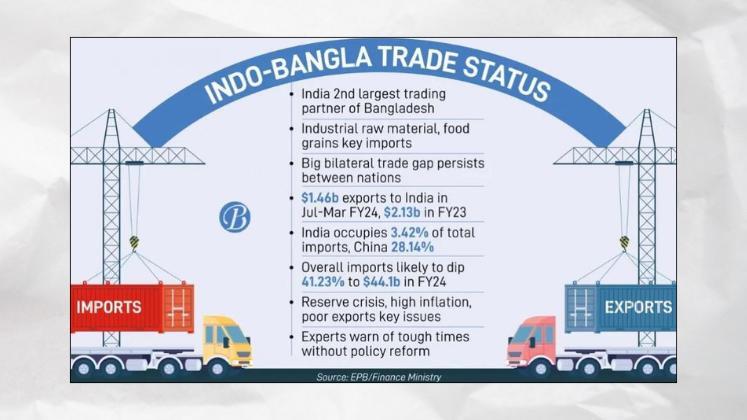
In FY ’22, Bangladesh imported commodities worth US $ 15.18 billion from its neighbour, India; however, in FY ’23, that amount fell to US $ 10.02 billion, primarily as a result of import restrictions put in place by the central bank to stop the steadily declining foreign exchange reserves.
This trend is continued in the Finance Ministry’s draft budget for FY ’25, which projects that imports from India would fall even further to US $ 5.92 billion in FY ’24.
Bangladesh received US $ 1.46 billion in merchandise export revenue from India in the first three quarters of this fiscal year, representing a 3.27 per cent annual rise. A total of US $ 2.13 billion was earned in FY ’23, based on data from the Export Promotion Bureau (EPB).
Economists and industry insiders say Bangladesh usually imports refined petroleum, food grain and textile materials, especially cotton and yarn, from India. The country meets nearly 70 per cent of Bangladesh’s wheat demand and most of the imported onions and rice.
According to the central bank’s most recent data, Bangladesh’s import payments fell by 15.42 per cent year over year from July to March of FY ’24. Another aspect is the recent transition by several local enterprises to imports from China.
Besides, most businesses in Bangladesh are navigating troubled waters because of power and energy shortages, high inflation, and fewer export orders due to global economic headwinds.
As Bangladesh’s key imports of materials from India are industrial raw materials and capital goods, these factors contributed significantly to the reduction in overall imports from India.
According to the central bank data, during the July-March period of FY ’24, RMG raw material declined by 9.1 per cent, other intermediate goods declined by 20.2 per cent, capital machinery declined by 23.7 per cent.
As to the draft budget by the Finance Ministry, India’s market share in Bangladesh is expected to be 13.42 per cent in FY ’24, while China’s market share is expected to be 28.14 per cent.
It is anticipated that imports from China will amount to US $ 12.55 billion at this time, down from US $ 21.12 billion and US $ 24.26 billion in FY ’23 and FY ’22, respectively.
In comparison to FY ’23’s US $ 75.06 billion, Bangladesh’s total import values are expected to drop by 41.23 per cent to US $ 44.1 billion in FY ’24.
Bangladesh fell into a forex reserve shortage at the end of 2022, and the central bank took a stronger position on imports to keep the reserves healthy. The monetary authority increased the LC margin for almost all goods by up to 100 per cent, except essential commodities.
The aim of this action is to deter the opening of new LCs for the import of expensive goods.





 Bharat Tex Special Report 2026