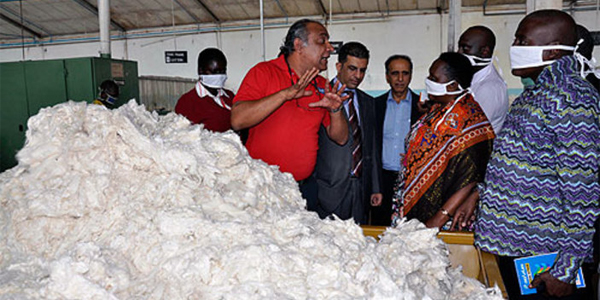
All efforts to bring about a positive change in Uganda’s textile industry has so far failed, owing to the inordinate delay in enforcing the national textile policy.
In what may seem as a reiteration, the Southern Range Nyanza or Nytil, the leading textile manufacturer in the country, has urged the government to expedite the process for implementation of the textile policy, so that its local industry can be rescued from the undue competition created due to the influx of imported clothes, particularly the second-hand ones.
In spite of the repeated promises and promotions relating to the national textile policy, little has been done by the government for its enforcement. The policy was originally formulated in 2009; it was debated and passed, but is yet to be implemented. Meanwhile, the Uganda’s textile industry is already incurring losses of about Ush500 billion ($149.4 million) annually, in the form of exports of unprocessed cotton.
Meanwhile, statistics also show that about 80 per cent of textile products consumed in the country are imported, most of which are mivumba or second-hand clothes. “If the textile policy is enforced, we will increase our employment. All we are asking for is a level playing field because we are here for a long term. We should be protected from cheap imported clothes. This impacts on our production,” says Nytil general manager Vinay Kumar.
Uganda reportedly exports 90 per cent of its cotton as lint (primary form), as value addition continues to elude the industry, thanks to the delay in enforcing the textile policy.
“We have already invested approximately $5 million (about Shs16.7b) in our work. Approximately $2 million (about Shs6.6b) of this will be used in purchasing modern facilities before the close of the year. Actually some of this is already being shipped in,” he adds.
According to Samuel Senkungu, director in charge of the department of Trade, Industry and Cooperatives, Ministry of Trade, it is the lack of funds that is standing in way of the policy being implemented.
Meanwhile, Uganda Manufacturers Association manager policy and advocacy, Lawrence Oketcho, promises, “Engagement with government departments, agencies and ministries is under way, with the main agenda being enforcement of the aforementioned policies.”
Uganda used to produce 254,000 bales of cotton annually, each weighing 185kg, about a decade ago.