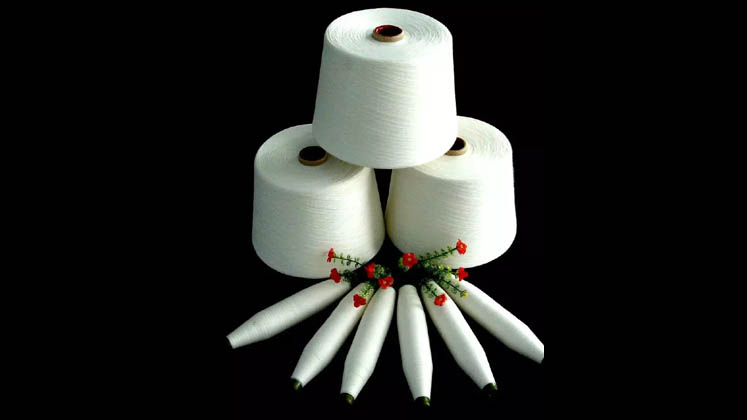
Textiles industry has urged the textile ministry that the domestic polyester spun yarn (PSY) manufacturers be given level playing field.
Sanjay Garg, President Northern India Textile Mills’ Association (NITMA) with a delegation met UP Singh, Textile Secretary and pleaded him to levy anti-dumping duty (ADD) on PSY at the rate of 5 per cent due to the fact that polyester staple fibre is not included in the FTA which is cleared at full duty rate of 5 per cent whereas PSY imports are cleared at zero duty under ASEAN FTA from Indonesia and Vietnam and sought level playing field for the domestic industry.
He stated that in the presence of this anomaly, domestic mills have no chance to compete with the imported goods. Imports are doubling every year since 2015 from 486 tonnes/month to 5,109 tonnes per month in 2020/2021.
Notably, the current market share of imports has reached 25 per cent of the total domestic consumption. In a matter of 1-2 years, it will significantly and thereafter completely wipe out the domestic polyester spinning industry.
He opined that alternatively, removal of basic custom duty on polyester staple fibre or its inclusion in the ASEAN FTA would also give a level playing field to the domestic industry. As both these options would take a long time to materialise, he appealed to the Textile Secretary that the anti-dumping be imposed till such time the FTA is modified to include polyester staple fibre or till such time that the basic custom duty on polyester staple fibre is removed.
It is worth mentioning here that the Directorate General of Trade Remedies, after 18 months of elaborate investigations, has already recommended the imposition of duty on the same.
NITMA President advocated that domestic manufacturers do not require any undue protection or advantage over the imports but only thing that is needed is a level playing field.
In order to protect the domestic industry and to create a level playing field , the rate of duty on input raw material and finished goods need to be the same ,which is currently not the case hence early imposition of the ADD is required. This move is necessary to not only revive the domestic spun yarn industry, but also to save and protect the domestic industry thereby encouraging ‘Make in India’.





 Bharat Tex Special Report 2026