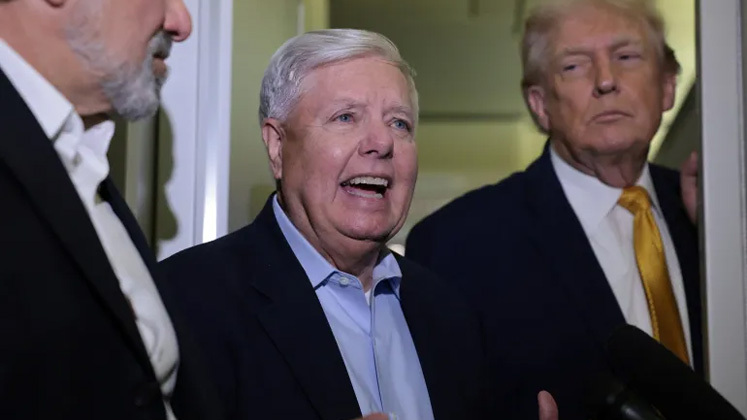
US President Donald Trump has signalled his approval of a bipartisan sanctions bill that could authorise punitive measures against countries that continue to purchase Russian oil, including major trading partners such as India, China and Brazil, Republican Senator Lindsey Graham has said.
Senator Graham described the proposed legislation, co-authored with Democratic Senator Richard Blumenthal, as empowering the US President to impose tariffs of up to 500% on nations deemed to be supporting Moscow’s energy revenues. The measure is intended to exert severe economic pressure on Russia as the Trump administration continues diplomatic efforts to secure an end to the conflict sparked by Russia’s invasion of Ukraine.
Graham told reporters that he had met President Trump at the White House, during which the President extended his support to the bill, which has been under development for several months. A White House official also confirmed the President’s backing in comments to the Associated Press.
In his statement, Senator Graham suggested that the timing of the bill was appropriate given ongoing diplomatic developments, arguing that Ukraine was making concessions towards peace while the Russian leadership continued operations resulting in civilian casualties. He also indicated that the Senate could hold a vote on the legislation as early as next week, though the schedule remains uncertain. The chamber is expected to take up consideration of a scaled-back government funding package, which proposes adjustments pending passage by the House of Representatives.
India is already subject to steep tariffs totalling 50% on a wide range of its exports to the United States — a combination of baseline, reciprocal and punitive duties — which has already hit the textile and clothing industry hard. The United States continues to be India’s largest export market for textiles and apparel, accounting for nearly 29% of total exports worth US $ 37.7 billion in 2024–25.
Buyers in the US market have slashed orders, with some segments experiencing declines of up to 70% and manufacturers reporting that production has been halted amid worsening cost competitiveness. The tariffs are widely seen as eroding India’s price advantage relative to competitors such as Bangladesh, Vietnam and Cambodia, and have contributed to squeezed cash flows and extended payment cycles for small and medium-sized garment exporters.
India’s textiles and garments industry has urged the government to introduce a range of fiscal and policy measures — including tax concessions for new units, depreciation allowances, interest subvention, and rationalisation of key schemes — to mitigate the impact of US import tariffs.
India’s exports of technical textile goods declined marginally by 1.2% in dollar terms during April–October 2025 compared with the same period a year earlier, largely due to tariffs imposed by the United States. Textile exporters in major clusters have been forced to cut working days as fresh orders from the US have dried up.