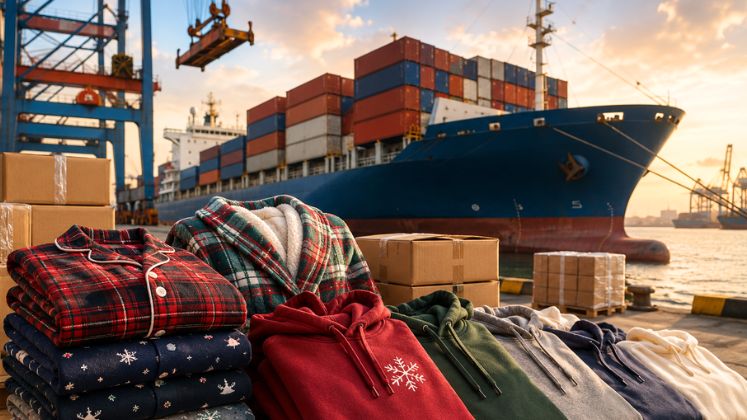
Orders for Christmas-related goods from key markets in the United States and Europe have declined by 10%–15% this year as exporters grapple with global economic uncertainty, elevated raw material costs, higher freight charges and supply-chain disruptions linked to the ongoing West Asia crisis.
Despite the slowdown, Indian exporters remain cautiously optimistic as enquiries continue to come in, with expectations that additional orders could be finalised in June. Exporters typically secure a significant share of holiday-season orders during this period.
India’s exports of Christmas-themed articles rose 1.2% year-on-year to US $121.4 million in FY ’26, compared to US $119.9 million in FY ’25. Exports stood at US $111.2 million in FY ’24. The United States remained the largest destination for Indian Christmas goods, accounting for 63.5% of exports at US $77 million, followed by Germany at US $8.7 million and the United Kingdom at US $7.1 million.
A Mumbai-based exporter of manmade textiles stated that while Christmas-related orders were continuing to arrive, the pace was weaker than last year, adding that orders for home textiles and ready-made garments were down by 10%–15% compared to the previous year.
TT Limited Managing Director Sanjay K Jain said cotton textile orders had been impacted by rising input costs. He noted that cotton yarn prices had increased by 30%, packaging material costs by 50%, and dyes by 30%–40%. He further stated that the West Asia crisis had disrupted business sentiment and slowed consumption.
The Textile Export Promotion Council Chairman Vijaykumar Agarwal said overseas buyers were concerned that consumers could curb discretionary spending and prioritise essential purchases due to constrained household budgets.
Agarwal added that spring and summer apparel orders were currently being placed for deliveries scheduled between September and November. He also noted that demand for bedsheets had remained stable, although concerns persisted over a 30%–40% increase in yarn and polyester prices.
Exporters further indicated that production had been affected by gas shortages and rising freight costs.
Apparel Export Promotion Council Chairman A Sakthivel said June and July were traditionally lean months for orders, although exporters continued to receive business during the remainder of the year. Sakthivel also noted that while fuel and shipping costs were rising, exporters viewed the situation as temporary and were discussing cost-sharing arrangements with buyers.
Exporters said demand in the United States remained subdued, while higher operational costs were making it increasingly difficult to fulfil orders competitively.
A Mumbai-based cotton textile exporter said buyers in the UK and the European Union were adopting a wait-and-watch approach as they awaited progress on trade agreements with India.
The exporter added that Indian suppliers were now attempting to negotiate better pricing in the US market due to the lower tariff burden. The exporter also observed that Christmas orders from the European Union had slowed, although there remained potential for demand to improve in June.