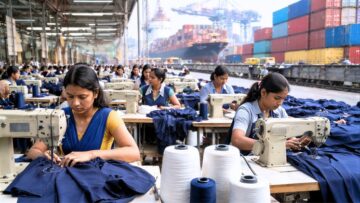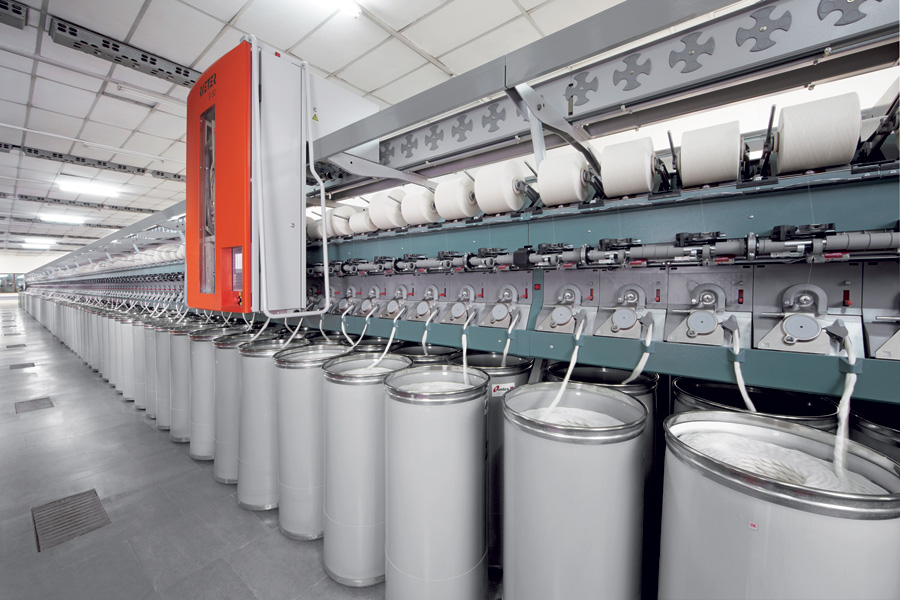
Once considered as the nerve centre for the textile industry with big names like Vardhman, Oswal, Nahar and Trident, based in the city, Ludhiana had a thriving business in both cotton and acrylic yarn; however now the city is losing its sheen with many of the top mills looking for greener pastures in other States like Gujarat, Maharashtra and Madhya Pradesh. As spindle capacities of the country increase manifolds, Punjab spinners are finding new ways to remain competitive. Team Apparel Online recently met top spinners in Ludhiana to check ground realities…
According to industry watchers, about 3.5 million spindles are held by Ludhiana-based companies which accounts for approximately 8% of the total installed spindle capacity of the country. The product offering includes 100% cotton, 100% acrylic, core spun, organic, slub and cotton blends with viscose, polyester, wool and acrylic. While a majority of the spinners in Ludhiana are into basic commodity yarn, off late more and more are going in for specialized yarn, particularly mélange and cotton blends, but the numbers are still small. The focus on specialized finishes is also with very few companies, but one factor that is consistent, is the quality of products, which is obvious from the fact that at an average 70% of the total produce of the mills is going for exports. Many of the companies have one lakh spindles and above, and those who do not, are investing to achieve that benchmark.
Increasing focus on R&D for differential blends…
Today, India holds top position in spinning with modernized mills and incentives to further increase capacities… but the critical question experts are asking is whether we are growing too fast or creating an oversupply that is detrimental to viable growth. Surprisingly, though the industry agrees that there is current excess of supply, most of them feel that there is no reason to stop expansions, and less than one lakh spindles is now considered as a small capacity. Most feel that the solution to remain competitive lies elsewhere. Rajiv Garg, MD, Garg Acrylics Ltd. recalls how a difficult phase came in 2008 as well when they had just 1.5 lakh spindles. “To beat the competition we converted our two units into mélange yarn, some into slub, but now we are much more prepared, having increased our volumes in a number of products. We are into acrylics, polyester, polyester cotton, cotton mélange, slub yarns, dyed yarns, double yarns, acro wool, blends, all types of blended yarns,” says Rajiv.
More R&D is certainly a focus area, and companies like Ganga Acrowools Ltd. have made innovation their growth engine. “We were the first company to drive acrylic into India in 1974-75 and today in terms of capacity we are the second largest in India for Acrylic and Acrylic worsted yarns, but in exports we are the largest. The only simple tagline and philosophy we have been following is ‘experience, expert and innovation’. The key to success these days is innovation, you have to keep doing something different in the market, each year we come up with something interesting in our product range and that is where the customers’ expectations are,” says Amit Thapar, Commercial President, Ganga Acrowools Ltd. The latest offering from the company is a pre-designed hand knitting yarn that automatically creates a design when knitted. Creating awareness for the product, the company is promoting the same online through Snapdeal. Hand knitting yarn has major market in Europe.
However, Ludhiana-based Bhandari Textiles, a vertically integrated company from knitting onwards feels that there is still a lack of product development especially in the Ludhiana belt and for specialized yarns companies either go to the south or import from other Asian countries. “Most spinners still think of mélange and cotton-viscose blends as specialized products, but in reality these have now become commodity. We cannot compete with Vietnam or Bangladesh if that is all we use in our products, Indian spinners need to work on fresh blends that will support product development along the textile chain,” argues Nitin Bhandari, Director, Bhandari Textiles.
Forward integration on the rise…
Better integration of the supply chain for enhanced value is supported by many of the spinners. In fact, Ajay Gupta, MD, Supreme Tex Mart Ltd. is very vocal on the need to strengthen the textile chain to better absorb the increasing capacities rather than curbing growth. “My estimate is that currently there must be around 15% excess supply, which is not really too much, but does impact the profitability; to counter our dependency on exports and global scenario, we have to forward integrate and add capacities at the fabric and garmenting stages. This will not only create demand for yarn, but also add value to the textile chain at the front end,” reasons Ajay.
Falling on forward integration for balanced operations, S.T. Cottex, which started its journey as a cotton spinner, has enhanced its business to include acrylic, polyester and cotton blends, besides moving into knitted fabric. “It is important to keep a pulse on how the market is moving and regularly enhance the portfolio of the company. Going forward processing is the next growth strategy with plans in place to invest in a modern processing unit both for yarns and knitted fabric,” shares Nitin Sondhi, Executive Director, S.T. Cottex Exports. With immense emphasis on quality, the company has not only invested in the best of manufacturing technology, but has also installed contamination detector equipment in the blow room and autoconers besides latest quality control instruments.
Fresh investments being made by most players…
Interestingly, while the traditional players like Vardhman, Nahar, Trident to name a few, continue to remain in the big league and continue to expand capacities, many new players have consistently built capacities in the last decade even as middle level and small players have perished because of the uncertainties that have plagued the industry over the years. “The yarn business is essentially a commodity business and those companies that have failed to upgrade and give quality as per the current standards have either sold out to new players or just closed shop,” says Abhishek Ahuja, Director, Ahuja Cotspin, a company which is among the group of new spinners in the city, having set up mills in 2011-12, when spinning was at the peak of its glory. “It is not as if we are new to the industry, but we were basically traders and though the market has dipped, we still see huge potential in spinning and going forward major investments are in the pipeline,” adds Abhishek.
Though Punjab-based spinners are disappointed with the policies of the State, it has not stopped them from making investments; albeit in other States. Garg Acrylics, which expanded from the steel industry to textiles in the year 2000, has since grown considerably to command three-and-a-half lakh spindles today, the company has immediate intention to increase capacities in Gujarat, as they are confident that spinning is the right business to be in. “Yarn is primarily a fast paced commodity product and though there are cyclic movements with alternating good and bad periods, overall it is a profitable business for those who have control on quality and can sell even when demand is low,” says Rajiv.
In fact, the industry is very upbeat that the investments made in technology are not only rewarding, but also very timely. “In commodity products, it is the survival of the fittest. If I compare my unit 1 with unit 13, I can actually see direct cost of production lower by 15% because of technology,” shares Rajiv. The positive stance of the industry, despite the current global slowdown and the failure of the domestic market to support increased capacity with an average 70% of produce of most spinners going into exports is encouraging. Yet, there are voices of caution. “It would be suicidal for spinners to continue expanding till the China situation becomes clearer,” concludes Vivek Verma, MD, Square Corporation, adding that new markets have to be developed and mechanisms put in place wherein yarn is consumed to a larger extent in the country.
Setbacks to the industry….
Throwing light on the factors that have brought on a slump in the yarn market, Vivek Verma, MD, Square Corporation, a Ludhiana-based yarn supplier with global presence and tie-ups with many leading mills across the country says, “The biggest setup has been the withdrawal of demand from China, which till last year was consuming around 40% of the exported yarn from India.” In April 2014, China terminated its three-year-old cotton procurement policy, shifting to a direct subsidy based policy from FY 2014-15 which would improve domestic availability of cotton at market rates to the mills in China, thereby reducing the dependence on imported cotton. This move has served a major blow to the Indian spinning industry, which had significantly increased capacities to meet rising demand for Indian yarn since 2011. According to official records the number of spindles increased from 46 million to over 48 million in just three years with exports growing from 752 million kg to 1,313 million kg during the same period.
There is unanimity on the fact that spurt in demand from China was the biggest motivator to build-up huge capacities in the last few years. To India’s advantage, the capacity build up was complemented by a shift in focus to finer counts and better productivity, making Indian spinners more competitive then nations like Pakistan. “Even as Chinese mills were losing interest in spinning as it is a high energy consuming industry, spinners in India were quick to pick up the trend and invest on latest machines offering not only better quality, but also competitive pricing, drawing attention of the Chinese companies and taking exports to the country from 75,348 tonnes in 2011 to 5,68,876.80 tonnes in 2013, which translates into 2,370.32 full container loads per month from just 313.95 container loads earlier,” says Vivek.
KSM Spinning Mills, which made the switch from being a trader to a spinner in 2005, is very critical of the way investments have been made in this sector. “Capacities have been added very aggressively in Ludhiana with heavy investments from the bank, which is not the right way to grow. To survive your own investment from internal resources should be in the range of at least 50%. The small players especially have suffered a lot, because they have taken huge loans and do not have the financial strength to counter the losses and also repay the loans. In 2012 what happened was that bigger the capacities, bigger were the losses, because they were sourcing that much of cotton and the stocks just halved in the prices,” shares Sarish Mittal, Director, KSM Spinning Mills Ltd.
Kaur Sain Spinners, who switched to spinning from trading in the early years of the new millennium, feels that Ludhiana is losing its shine as a textile base. Batting for the survival of the spinning industry in the State Ajay Mittal, Director, Kaur Sain Spinners Ltd. says, “One of the major drawbacks of Ludhiana is that it’s a landlocked State, if we need to export, we need to send goods to Gujarat, which means extra cost, more Government subsidy would have helped. Secondly, in last 5-10 years other States have been offering very good initiatives, today I cannot compete with my counterpart in Maharashtra, MP or Gujarat, as my cost of production is higher by Rs. 10-15 per kg, which is a big amount in yarn, that is why entrepreneurs are moving out and most of the new units coming up are not in Punjab.” Some of the factors that make Punjab uncompetitive today include 6% VAT, Rs. 15 per unit for power and relatively high wages of workforce.
[tabs_container style=”style2″ maincolor=”#000000″ overcolor=”#dd9933″]
[tab title=”1) Square Corporation marketing Indian spinners with aplomb… “]
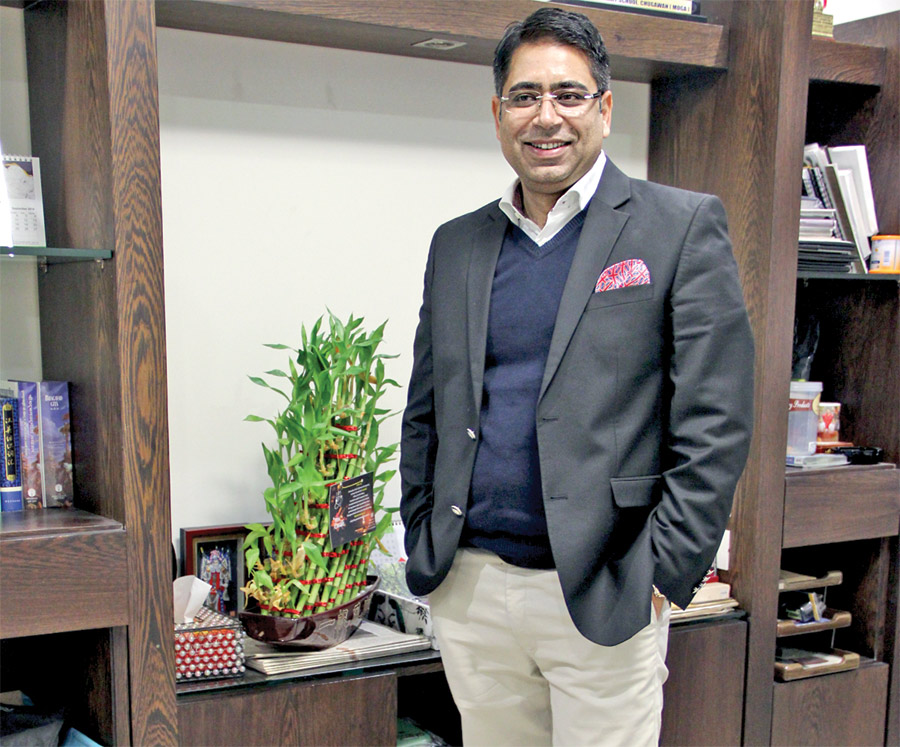
Backed by a strong global team, Square Corporations exported 3,380 containers (40 feet) of yarn to global destinations to clock a turnover of US $ 236 million in 2013, the goal for 2014 was to be one of the largest yarn sourcing company in India and keeping that aim in mind, the company opened new branch offices in Bangladesh, Egypt and Turkey. “Our presence in multiple markets across the globe gives us opportunity and advantage of feeling the pulse of the markets and hence our forecast of markets, based on our inputs from various markets, is generally correct,” says Vivek Verma, Managing Director, Square Corporation. The company has its own offices in three countries and partner offices in five others.
Admitting that processed yarn is not the strength of India, Vivek opines that going forward spinners should continue to upgrade while operating within their core product – cotton. “We cannot compete with China on polyester and it will take years to even come close to them but with our inherent strengths in cotton from farming onwards, we can be world leaders in this segment,” reasons Vivek. He also cautions that with growing capacities in Bangladesh and China putting a hold on imports from India, creating value is also very important. “There has been an increase in the value-added yarn being offered, but it is a very small segment of the export basket.
Working with many reputed and committed spinning companies across the country, Square Corporation is not only a mediator of buyer and supplier of yarns, but also takes on the role of quality controller and inspection agency to ensure that all the products that are imported match standards as per requirement. “We consider ourselves facilitators and partners in trade and keep a keen eye on global scenario to apprise them of the situation so that they can take informed decisions,” concludes Vivek.[/tab]
[tab title=”2) Ahuja Cotspin new entrant with fast growth projectile”]

The ACL Group has been in the textile business since 1970s under the name of Ganga Knit, involved in garmenting and later in trading of yarn. In 2000, the group along with yarn trading started manufacturing of knitted grey and dyed fabric. In 2010, the group came into open-end spinning with the establishment of Ahuja Cotspin Ltd. (ACL) and now into ring spinning in 2014. With base in Ludhiana, the ring spinning unit has 28,800 spindles making variety of products like carded, combed, compact, eli-twist and doubles from count range of 8s to 34s for both knitting and weaving needs. Its open-end unit has 2,880 rotors producing count range from 5s-24s with CSP of 1500-2000. The Group is focusing on different markets world-wide with its vast range of products. Concentrating on both commodity and value-added yarns, the company is now venturing products into the towel industry, denim industry and industrial fabric segment, and are currently making some trials. “In the towel industry, forward integration is a natural progression. But towel’s is not our strength, we want to stick to spinning, fabric and garmenting only. Our main focus is towards value-added products and our main strength is our quality,” informs Abhishek Ahuja, Director, ACL. The group’s current turnover is Rs. 450 crore (US $ 74.99 million).[/tab]
[tab title=”3) Garg Acrylics Ltd. growing on capacity and processing strength”]

With three-and-a-half lakh spindles and an annual turnover of Rs. 1,500 crore (US $ 250 million), Garg Acrylics is a strong player in the Ludhiana market. An integrated player, the company also has a garmenting division manufacturing 30,000 pieces per day and a dyeing unit with a capacity of 30 tonnes per day. Interestingly, the company does not offer greige yarns and is considered as a leader in dyed yarn whether it is 100% cotton, acrylic, polyester, mélange, organic, viscose, cotton blend or any other blend combination.
The company is very confident that spinning from India is going to be a major export category and going forward Garg Acrylics plans to add 2 lakh more spindles in the next two years, but not in Punjab. “My basic aim is to become a 1 million and above spindle company by 2020, but the expansions will be either in Gujarat or Madhya Pradesh because of policy paralysis which Punjab spinners are facing. Once we achieve those scales our turnover should touch Rs. 7,000 crore (US $ 1,166.66 million),” says a very upbeat Rajiv Garg, MD, Garg Acrylics Ltd.
Currently, the company has a strong global presence, exporting to countries like Bangladesh, China, Egypt, Honduras, Tunisia and USA, to name a few destinations. “When you enter into the international market, first you need is range; second is shipment; and third is quantity. Today, if you don’t have quantity, you will not get business; so if you have to enter a certain bracket, you have to increase your size,” concludes Rajiv.
[/tab]
[tab title=”4) KSM Spinning Mills Ltd. looking to enter technical textile segment”]
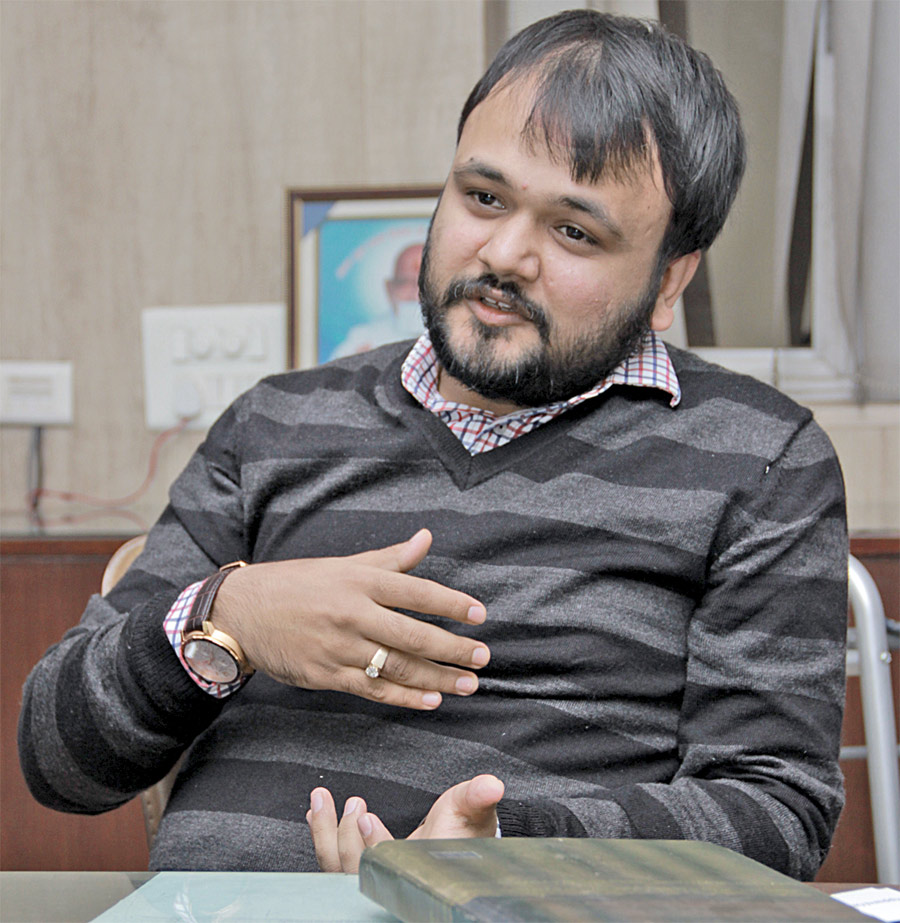
Many forward-looking spinners in Ludhiana like KSM, which have been doing only greige yarn are venturing into processing of value-added yarns and also garments such as T-shirts and sweaters. The company has invested Rs. 200 crore (US $ 33.33 million) to enhance its spindle capacity to the current one lakh spindles, of which 60% is for cotton, 15-20% is for blended and the rest is flexible depending on market demand. “Now we will focus on more specialized yarns like compact yarn and value-added yarn for technical textiles. This is possible because all our machines are fully automized,” informs Sarish Mittal, Director, KSM Spinning Mills Ltd.
After 25 years of successful trading of yarn, KSM Spinning Mills was set up in 2005, with 8,000 spindles for spinning cotton, now the company is producing 50 metric tonnes of cotton yarn daily. Exporting 70% of its capacity, Sarish believes that the global market is the growth driver. “Capacities have increased, so we have to look at the global market. Selling in the domestic market is more difficult, as it is unorganized, but in exports you can sell 80 containers in a day provided you have a good agent,” avers Sarish.
The company’s turnover touched Rs. 209 crore (US $ 34.83 million) in 2013-14 and is expected to reach Rs. 275 crore (US $ 45.83 million) this fiscal. “March 2016 onwards will be a landmark for us, as we will be crossing the Rs. 500 crore (US $ 83.33 million) milestone,” concludes Sarish confidently. [/tab]
[tab title=”5) S.T. Cottex Exports focusing on providing quality and quantity to the commodity market”]
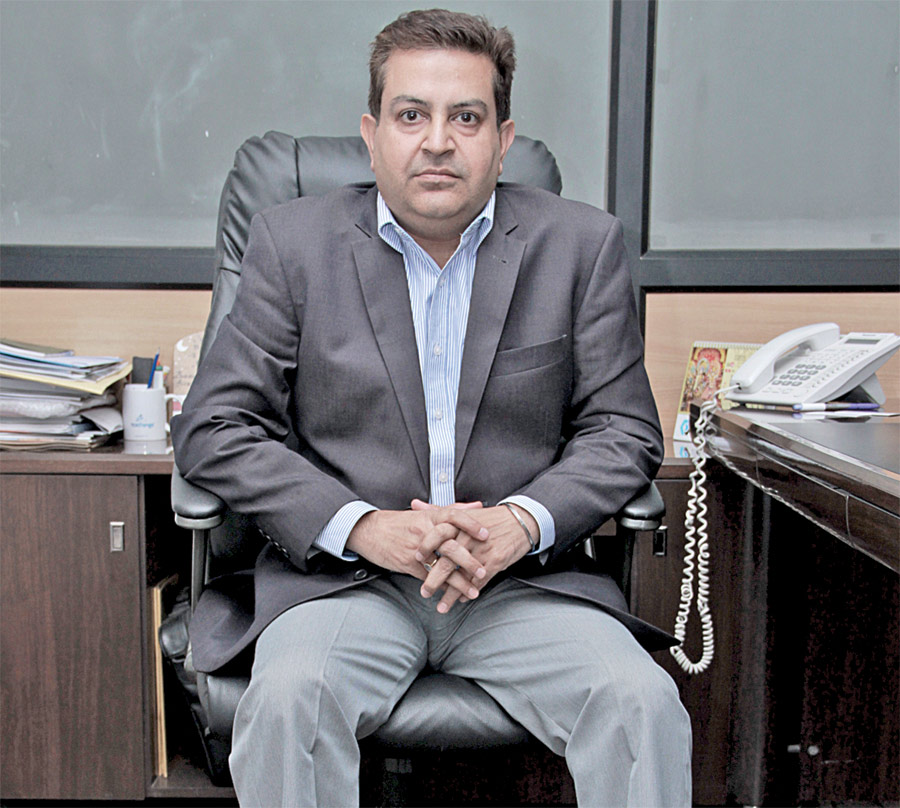
Counted among the big players in commodity yarn, S.T. Cottex with a turnover exceeding Rs. 1,200 crore (US $ 200 million), has an installed capacity of 1,75,000 spindles and 6,000 rotors to produce cotton, acrylic, polyester and blended yarn. The company prides its focus on quality for which it has made investment not only on spinning technology, but also testing procedures. An ISO 9001:2006 certified company, the quality parameters are between 5-10%, as per Uster standards. “Since we deal in a basic product, the differentiator is our quality and timely delivery, which is at par to international norms,” says Nitin Sondhi, Executive Director S.T. Cottex.
The range at S.T. Cottex includes 100% cotton raw white yarns combed, in count range Ne 20s – 40s, both single as well as ‘TFO’ double yarns, ‘COMPACT’ yarns, OPENEND yarns in count range of Ne 6s – 23s, 100% Acrylic yarns (Nm 2/32) and 100% polyester spun yarn, in counts Ne 24s and Ne 30s. Key markets abroad for the company are Indonesia, Singapore, South Korea, Malaysia, Taiwan, China, and Vietnam to name some, besides a domestic presence in major garmenting hubs of India.
[/tab]
[tab title=”6) Supreme Tex Mart Ltd. completely integrated for value”]
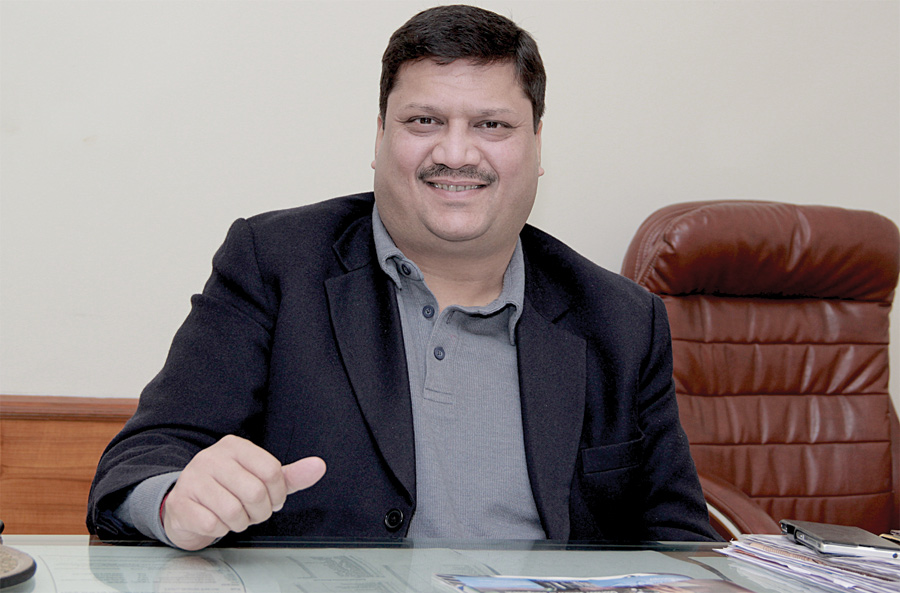
While many of the spinners in Ludhiana are happy growing in the segment with no intention to move beyond their comfort zone, Supreme Tex Mart Ltd. has moved up the value chain right up to garmenting and is very vocal on the need to create internal demands to combat issues that plague the spinning industry. The biggest strength of the company, according to its Managing Director, Ajay Gupta, is its processing infrastructure which he claims is among the best in the region.
Dyeing 35 tonnes per day, the company has opened its facility to other companies, using only around 10% of the capacity in-house. “With the setup that we have and the quality offered, many companies are willing to wait even up to 45 days rather than getting the processing done elsewhere,” says Ajay with pride. The range of dyeing options includes fibre, yarn (both package & cabinet dyeing), fabric and garment. In terms of material base, the range is vast – 100% Cotton, Polyester/Cotton Blends, Cotton/Wool, Cotton/Viscose, Acrylic/Cotton and 100% acrylic. Besides dyeing various specialized finishes as per buyer requirement is also offered.
Following a Total Quality Management (TQM) and zero defect policy, products from this US $ 75 million-textile giant are of high quality standards for niche market segments. While the fabric produced is for buyers like H&M, the knitted garments (both circular and flat knit) are going to brands like Reebok, Adidas, Quicksilver, Gymboree and Brice.
[/tab]
[tab title=”7) Innovation driving growth at Ganga Acrowools Ltd.”]
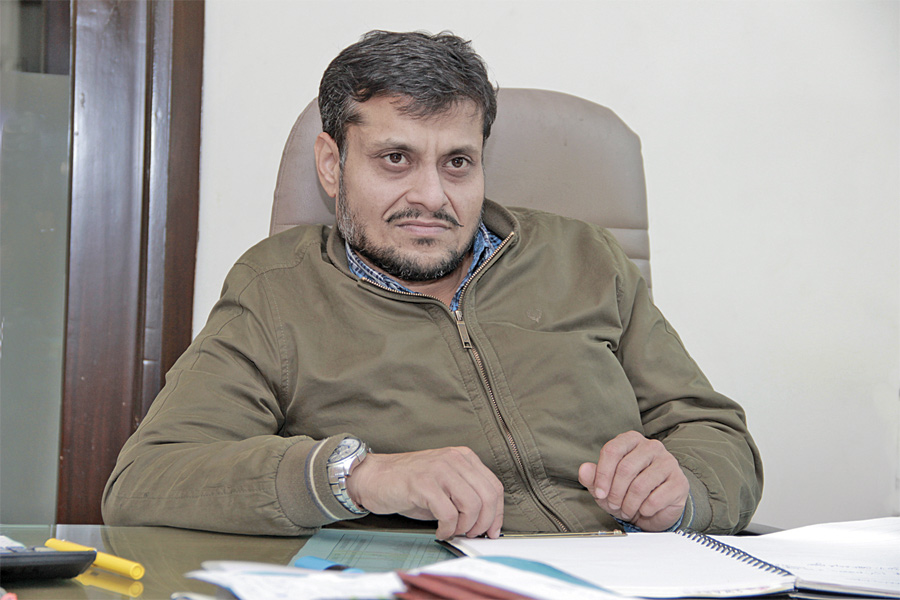
Even as a majority of spinners still rely heavily on the commodity market for business, Ganga Acrowools operates on the philosophy of innovation, and propelling the company on this path is a dedicated product development team consisting of 10 designers who are constantly seeking new ideas to give the flat knitting, blanket and carpet industry interesting concepts in worsted acrylic yarn, wool yarns and blends of the same. With total spindle strength of 22,372 spindles, the company produces 23,000 kgs of yarn per day, supported by acrylic yarn dyeing capacity of 15,000 kgs per day.
The company admits that acrylic is a very small segment of the spinning industry and is not really a growth segment, so what keeps the momentum going is innovation. “We don’t understand any other way to work,” says Amit Thapar, Commercial President, Ganga Acrowools Ltd. One of the major innovations that the company is proud of, is DAFLoPILL a low pill yarn made from anti-pilling fibre, which was introduced by them for the first time in India in 2003.
Dedication for R&D over the years has resulted in a very wide product basket and some of the fancy yarns available with the company are unique to them like Boucles for weaving, machine knitting, hand knitting in super bright Acrylic, Stretch Yarns for machine knitting (Flat and Circular), Acrylic PBT, Acrylic Nylon PBT, Acrylic Wool PBT, Wavy Yarns count Nm 2.7 in 100% acrylic and Acrylic Polyester blends, Angora like Yarns to name a few.[/tab]
[tab title=”8) Kaur Sain Spinners Ltd. riding high on wide product mix”]
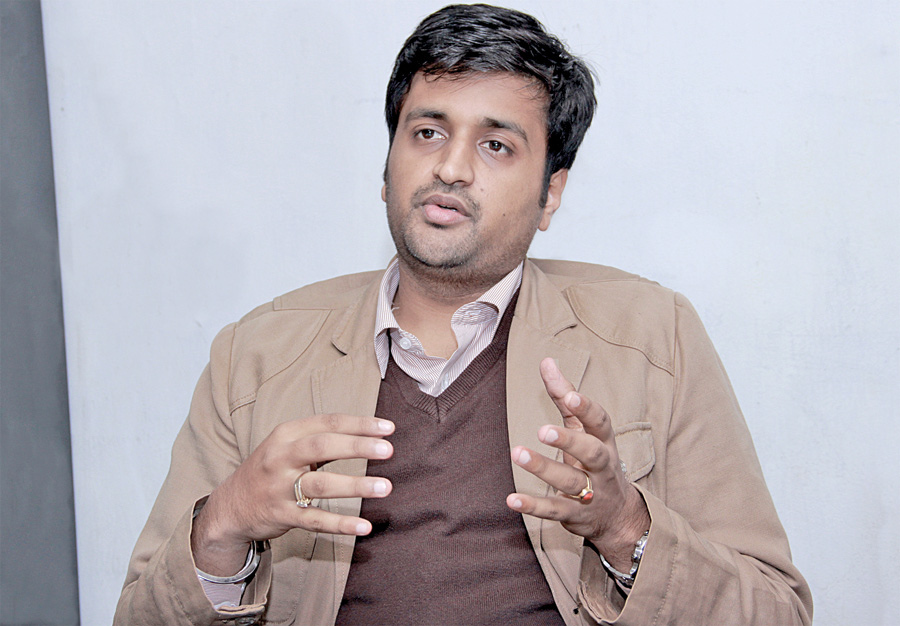
With one lakh spindles, producing acrylic, polyester, viscose, cotton and cotton yarn blends in a count range of Ne 16s to Ne 50s, for hosiery as well as weaving applications, Kaur Sain Spinners has taken a conscious decision to cater to a wide product basket to feed different market needs. “One of the biggest factors which has allowed us to grow even in times of recession is the fact that we maintain a balance between your commodity yarn which is a regular product and also few niche products which keeps us on the sourcing map,” says Ajay Mittal, Director, Kaur Sain Spinners Ltd.
To support its value-added yarn the company has a modern processing unit backed by an ETP plant meeting all norms as prescribed by Punjab Environmental Board with capacity to process seven-and-a-half tonnes per day, which is being upgraded to 15 tonnes by the end of this year. The processing unit is for captive consumption and the company is planning to invest in both spindle capacities and processing as they foresee increasing business in the value-added segment. Complimenting the company’s stress on ‘value yarns’, is a well-equipped R&D unit manned by textile engineers for constant innovation that includes organic yarns, BCI yarn and other certified yarns.
With a turnover crossing Rs. 450 crore (US $ 74.99 million), Kaur Sain exports 70% of its products to various destinations including Bangladesh and China.
[/tab]
[/tabs_container]