There could be more pain in the days to come for global apparel and textile industry. Lack of balance in demand and supply remains one of the strong pain points for buyer as well as supplier communities.
Looking at this, Indian apparel manufacturers have to evaporate their 40 per cent manufacturing capacities as they were already having over capacity much before the pandemic had started.
Nevertheless, looking at the past record, the industry will surely overcome the crisis and survive. However, it needs to understand that financial discipline should be the top priority for every stakeholder. There are no two ways about it.
These and few more points emerged strongly from a webinar on “Buying Practices – Creating an Equitable Fashion Industry” organised by NIFTA (Association of NIFT Alumni).
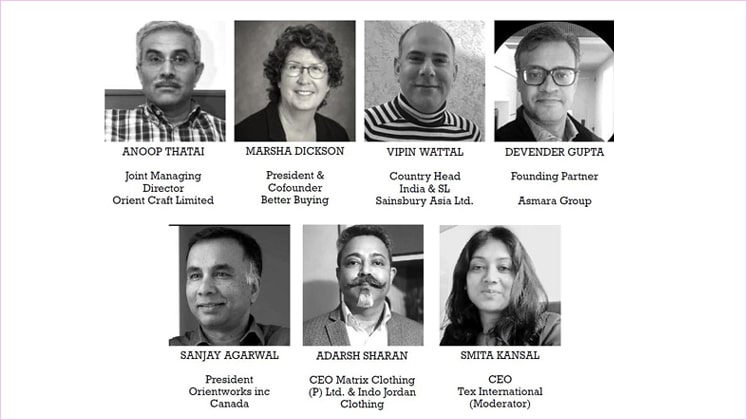
The webinar saw the presence of industry experts like Anoop Thatai, JMD, Orient Craft; Marsha Dickson, President and Cofounder Better Buying; Vipin Wattal, Country Head, India & Sri Lanka, Sainsbury Asia Ltd.; Devender Gupta, Founding Partner, Asmara Group; Sanjay Agarwal, President Orient Works Inc and Adarsh Sharan, CEO, Matrix Clothing and Indo Jorden Clothing.
Smita Kansal, CEO, Tex International, moderated the event.
Panellists presenting the apparel manufacturing side were of the view that while some brands worked with suppliers as a partner, there were some who did business more like a robbery – and that too with police protection.
It was also highlighted that as far as important issues of payment delay, default and bankruptcies are concerned, rather than expecting something from brands and buyers, apparel supplying nations with their national associations should come out with terms such that their business does not get impacted under any condition.
Experts insisted that overall industry needs to become lean at all level, and transparency needs to increase. Regarding transparency, now the onus is on brands and buyers in this regard.
“For less lead time, all pressure is on garment manufacturers but look at the buyer’s calendar, they should manage to shrink their calendar, not just expect everything from a garment manufacturer,” insisted one of the panellists.
As e-commerce is now growing massively in the COVID-19 phase, garment manufacturers should be ready to produce more styles with small quantities. If a buyer was earlier taking 10 styles, now the same buyer will take 50 styles in the same quantity.
“There will be very big acceleration once dust settles down and those, who will have a deeper relationship, better technology, and the way to give confidence to whole supply chain, will take a lead,” insisted one of the panellists.