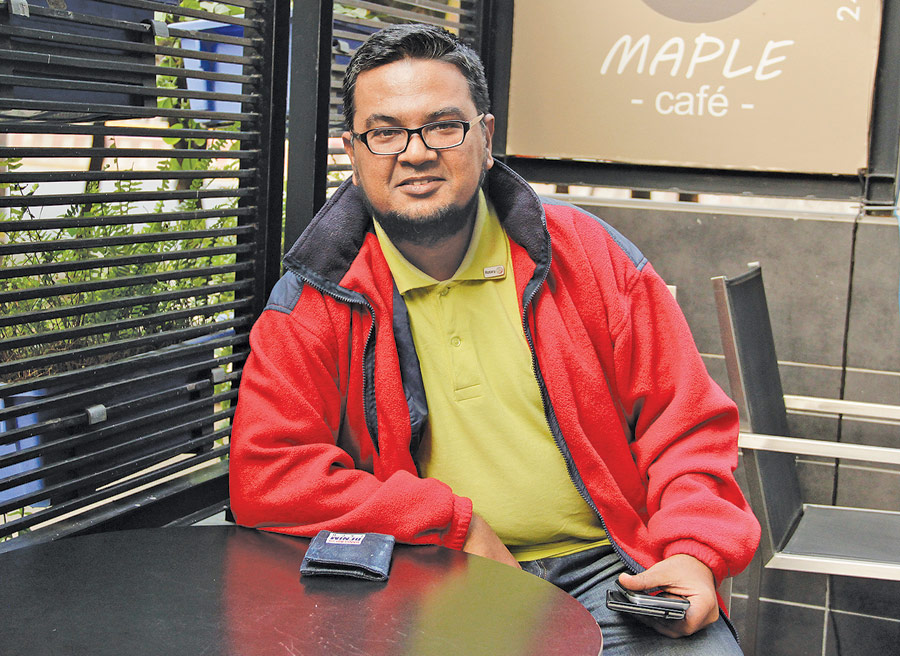
Bangladesh has many buying offices and sourcing agencies but Dhaka-based buying house Futura Corporation is not any run-of-the-mill sourcing agency. Helmed by M. N. Kabir as the CEO, the US $ 3.5 million Futura Corporation’s very unique business model is what distinguishes it from the rest. Kabir identifies and procures the right fabric for his buyer and then develops the right garments as part of his unique sourcing model and subsequently takes the orders based on samples which he then gets manufactured from various sources in his country, making the entire process easier for his buyers and the manufacturers.
Specializing in Denims, around which bulk of Kabir’s business revolves, he is rather steadfast in procuring the fabrics – which he by and large does from Pakistan, Turkey, India and China – and places final orders in the home countries too even if the same fabric could be replicated from other places and at a lesser cost. He gives no second thought in turning down any such request even if put forth. “I basically handle denims and fabrics associated with it… Based on the fabrics that I source, I get at least 15-25 pieces of garments in different washes, styles and finishes manufactured, which I then use as samples to get the orders subsequently,” elaborates Kabir about his business fundamental, based on which he incepted the company in 1997 and has been running it since with great success.
Once orders are booked, Kabir procures the very same fabrics from its country of origin and gets the end-product manufactured in Bangladeshi factories. Though manufactured in a different country and altogether different production unit, Kabir is firm on ensuring that the final output is in tune with the samples, be it in style, wash or finish. However as far as fabrics are concerned, Kabir’s preferred procuring destinations are all overseas. “Local denim factories are also doing a very good job, but as all my buyers are into high-fashion garments, we do not deal with the local fabric producers,” states the company’s CEO, whose products fetches FOB price in the range of US $ 8-11 apiece and are exported primarily to Europe, including Germany. “The quantities vary…, like for H&M it is around 10-20,000 pieces per style. It can also be around 50,000 pieces but never less than a container (20 feet container),” says Kabir “But when there are 4-5 styles, the quantity automatically goes up… One fabric is sometimes used in 10 styles, which translates to 2,00,000 pieces,” he adds.
As a responsive sourcing office, be there an issue in getting the desired look or finish, Kabir’s team of specialists – from various countries, including Turkey – is always ready to help the factories. “We don’t intervene in the production until there is a problem… Almost all Bangladeshi denim factories have technicians from Turkey these days; so there aren’t much of the problems in replicating the finishes and looks,” assures Kabir, who believes that the people he is working with are all part of an extended family and as such help is always forthcoming, be it in product development or logistics.
Besides denim, the buying office is also a one-stop sourcing entity for high-quality knitted and woven garments (polo shirts, T-shirts, lycra tops, sweatshirts, shorts, trousers and other apparels) for men, women and children.
Catering to brands such as Zara, H&M, NEXT, M&S, and the likes, Futura usually associates with the factories which are already certified by the buyers. “For smaller quantities, we prefer to work with medium or smaller factories with 10-11 lines facilities where we place our own QCs to ensure quality is not compromised,” says Kabir underling that no matter big or small, all the factories he works with are all fully compliant. “Denim is based on washes, which require chemicals. So all the factories that we deal with comply with the norms… They have their own ETP, WTP and every other eco-friendly procedures in place,” guarantees Kabir.
Despite the promises Bangladesh holds as a sourcing hub, Futura’s CEO is not very upbeat about the future of sourcing business in the country. “Even though Bangladesh’s share is steadily going up, but the volumes are still not satisfactory. This is basically due to the stiff competition that we are facing from countries like Cambodia, Myanmar, Vietnam, etc. which are eating into our shares now,” laments Kabir, who does not have any immediate plans to get into denim production on his own or for that matter initiate any major expansions in his current business.