Shunning the mass produced, ‘one size fits all’ notion about clothing, bespoke fashion, which was once a prerogative of wealthy style connoisseurs, is now fast becoming a trend among today’s men around the world and is taking over the apparel industry which quintessentially offers personalised clothing options to the discerning. While bespoke has been in India since generations and Indian population has been dressing up in tailored clothes until the late 1990s, the emergence of ready-to-wear garments with the entry and evolution of foreign as well as domestic apparel brands in India almost outpaced the bespoke segment with consumers gradually moving towards the other easily available options. With the rise in disposable income and growing awareness about the global brands, more people started opting for branded clothes with graded sizes that fitted most of them. However, this could put custom tailoring out of business for only a brief period of time. There still were a discerning few for whom the product expectations were undelivered and they yearned for better fit than the ready-made apparel brands and better quality than the old fashioned tailor-made. This new demand for the perfectly suave pair of shirts, suits and trousers led to the emergence of an organised bespoke clothing segment which initiated in the high streets of metros like Delhi, Mumbai and Bangalore and then was taken over by a number of start-ups, who are now excelling at what they offer to their target consumers. Sandeep Gonsalves, Co-founder & Director, SS Homme, agrees upon this stating, “Most of the Indian population has grown up wearing tailored clothing. Bespoke clothing in today’s world paves the way from past to the future, and it involves a rigorous process of careful measuring sessions, patterning on paper, cutting the fabric, rough stitching, trial fittings, final tailoring and alterations, if necessary. It was once a privilege of fashion connoisseurs with deep pockets, but over the years, it has evolved, and is becoming a growing trend among professional men due to its impeccable standards.”
The market scenario
When it comes to comparing mass scale manufacturing by ready-to-wear brands and bespoke clothing firms, the former definitely is more equipped in terms of technology/ machinery that they use and the obvious question that then arises is whether the bespoke brands have evolved enough to match these production quality standards. While there is a clear difference between the two as far as the purpose of production, the costs involved, the business model and lead times are concerned, the custom making process definitely goes into the intricacies with more human fabrication thereby offering a plethora of options in terms of customisation and creating a novelty product for the consumers. And this is one reason why the overall market potential is continuously growing for this category. “The bespoke industry is growing faster than the general menswear industry. It has a lot to do with personalisation and customisation because everyone looks for uniqueness and differentiators which they don’t get when they buy something off the rack,” asserts Rohan Khattar, Co-founder, Minizmo.
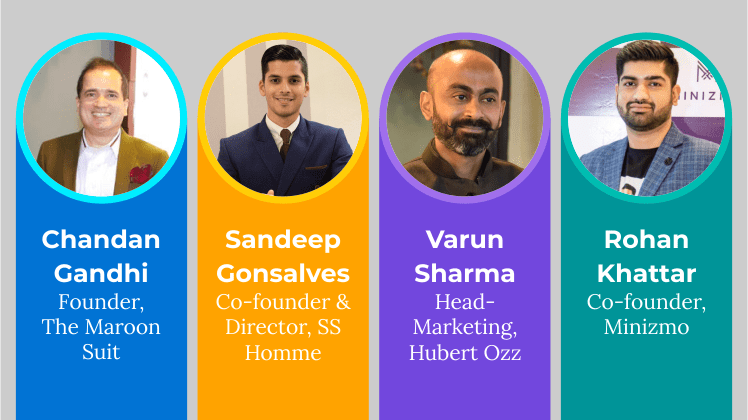
The organised players in the bespoke category offer the best of fabrics from around the world, designs and a perfect fit and definitely come at a premium price which make it an extension of the luxury market. According to a Technopak analysis, customised services account for 15 percent of the Rs.1,300 crore luxury apparel and accessories market in the country. Chandan Gandhi, Founder, The Maroon Suit, avers, “Unlike the traditional local tailor for the masses, premium bespoke service comprises of the luxury touch as it ensures that the tailored clothing suits the personality, social status and occasion of the client. While bespoke clothing accounts for 30-35 percent of the total luxury apparel market, it is dominated by menswear. Bespoke options for women are limited in India with few tailors offering this service.” People today demand a sense of ownership in their garments and pride in wearing something that is made from scratch to suit their personal style. It’s a good time for start-ups in the category to move ahead. Furthermore, the acceptance and popularity of bespoke garments is fundamentally growing with market shifting to customised tailoring segment which is ultimately narrowing the price difference between the two.
What’s fuelling the machine?
While we definitely are witness to the growing inclination towards bespoke category, what really is fuelling this shift? The one word for it is FIT, but that’s just not all. Bespoke garment are customised with utmost attention to the tiniest of details and give the customers what they are looking for without having to compromise on the comfort factor, unlike ready-to-wear suits. “Retail clothing has fixed sizing available starting with at the most a size of 36 and ending up at 50. This certainly leaves customers unhappy with the fit of the garment, which matters the most. From extra pockets or no pockets to details and trends, you can make an item more suited to your personal style and body shape in a customised suit than in a readymade one. In a country like ours, diversity can never be put on a standard scale, which ultimately makes up for the need for bespoke category,” apprises Varun Sharma, Head- Marketing, Hubert Ozz.

Even as we talk about the popularity and the growing curve being shown by the bespoke category, the concept is globally understood as dominated by menswear unlike the kids and women categories which are either not very sound value propositions or are too fragmented. The case in point – majority of start-ups in the segment performing phenomenally do not offer womenswear or kidswear range, even when they feel that there is a market in the women’s segment worth tapping essentially in India, where ‘majority of working women have to make do with either very expensive brands for their workwear or with fast fashion brands that do not have the permanence of class with them’. There is a void in the market but the potential is definitely huge for the women bespoke category as many designers and brands are catering to this segment and are performing well. Rohan concurs, “We, at Minizmo, offer only menswear. But 15-20 per cent of our customers are women who buy accessory gifts from us, and request for women’s made-to-measure. We are evaluating on getting into that segment. And honestly, if we do, I think it would be as big as menswear if not bigger because the best part of getting into this category is that there aren’t too many companies or brands that are doing it at the moment and this is the right time if we want to enter into the segment. I would agree that it’s a little more challenging because of the silhouettes, the cuts and patterns and our supply chain, etc. and all of that has to be created from ground up.”

Even as the start-ups are taking up the segment by storm, there are brand names in the segment offering bespoke clothing options with an already established market presence and experience of retailing for years now. The bigwigs like Raymond Made to Measure and Arvind’s Creyate, are definitely giving a tough competition to the start-ups in the category. However, the start-ups are creating their own niche and rules to serve the customers. “With detailed structure, numerous consultation appointments and provision for the utmost detailed and flexible services, small brands are making bespoke the pinnacle of luxury. Choosing your own set of strengths is very important to sustain in the bespoke business,” says Chandan. Every brand – big or small—is setting its own trend or is adopting to a ‘bespoke business model’ in order to perform in an evergrowing segment like bespoke clothing. Varun agrees and maintains, “We have 100-plus customisation options to choose from. With respect to competition, there are several brands which do customisations today but however, we feel that they are restrictive as they only cater to a certain segment of the target group, do not provide such an exhaustive list of customisations as we are providing and customer service facilities wherein we alter any defects free of charge. Start-ups in the segment are young and evolving and are introducing new designs, new styles and newer customisations to always meet the current trends.” And delving deeper into the functioning and intricacies that these start-ups offer, it hardly looks like a competition. SS Homme prides in its tie-ups with prominent fabric houses such as Dormeuil, Huddersfield, Holland & Sherry and Scabal. The brand has an extensive variety of high quality English and Italian fabrics by Zegna, Loro Piana, Vitale Barberis Canonico, etc. “For shirting, we have 100 percent cotton by Soktas, Vaugh and Pickett, Grandi and Rubinelli and Dormeuil. We also have pure linens by Solbiati amongst others. All SS Homme garments are finished with a 1/4th inch burgundy piping. We use horse hair on the chest piece as well as lapels. For closures, we use the finest zips sourced directly from Japan,” boasts Sandeep.
Who to target?

The bespoke clothing segment is a very potential market right now in India with the rise in disposable income of the consumers and growing awareness about the right fit and right quality and an urge to wear something that describes the personality of the wearer. And these factors have been noted even by the investors pan-India who consider the segment to have potential to scale moving forward. For SS Homme, the entire funding came from the Co-founders of the firm who believed in investing the profits into the brand to grow constantly while others like Minizmo do have plans to raise funding in the near future and are assured of securing a good round.
Talking about the core target audience of bespoke clothing, they include mostly men in the age bracket of 30-50 years who are corporates, high-level executives or grooms or anyone having their own personalised and unique style. While the average ticket size for SS Homme is Rs.85,000, it goes upto Rs.2,000 for Hubert Ozz for a single product even as the average ticket size at Minizmo for a bespoke suit ranges around Rs.30,000. In terms of store format, Rohan feels that there is no correct answer to it because different store sizes work differently on the basis of the location and all of them have their own pros and cons. For Minizmo, its all about offering the right experience to the consumers.
The verdict: Future is bespoke
The Indian bespoke industry is thriving despite the emergence of endless ready-to-wear brands in the apparel market. A slew of new brands, including regional players and online players have emerged in the last few years, but the demand and potential for bespoke clothing has remained consistent which reinforces the fact that the market is here to stay and has growth prospects in the years to come. This growing market is not only catering to the metros of the country but has successfully penetrated the Tier-2 and Tier-3 regions also, where the consumers are opening up to paying a premium for that exquisite piece of garment which defines their individuality. Sandeep informs, “We have experimented with Tier-2 and Tier-3 regions in the past with much success. The consumers that reside in these regions are particularly well-aware of the bespoke service and most are willing to travel to our Mumbai studio for bespoke appointments. Our digital audience comprises a fairly high percentage of consumers that live in Tier-2 and Tier-3 towns and during their visit, they are always up to date with the latest collection that is released in the store.” The segment is registering a noticeable year-on-year growth and going forward will become a rage with more and more people opting for cleaner, custom-made clothing rather than ready-to-wear garments.