 Contrary to many predictions and opinion polls, the people of Britain voted to leave the European Union, resulting in mayhem in the stock markets with the British pound hitting its lowest point in decades, another area that has been clouted with doubt and uncertainty is the retail sector. Although it is likely to take some years (two years at least) for Britain to untangle itself from the EU, yet many industry experts believe that it would adversely impact the fashion industry that contributes an estimated US $ 38 billion to the UK economy.
The major challenge to fashion retail is being posed by a weak currency (pound) and uncertainty about new tariffs for UK-based business, which often sources fabrics and produce from other parts of Europe. Experts believe that this will have an immediate impact on luxury businesses such as Burberry, Mulberry, Jimmy Choo, etc. who have already reduced their stocks. Burberry’s plan to build a new £ 50 million weaving facility in the UK has been put on hold amidst the Brexit fallout. “The biggest impact of Brexit is increased volatility in the market that is already volatile which probably means a decrease of consumer sentiment. This is not good for the luxury goods companies; and if we look at the trading of the shares of these companies, probably this Brexit decision will increase the pressure of the market going down, probably the luxury goods companies’ valuation will falter in the short-term amidst this volatility,” reveals Mario Ortelli, Senior Research Analyst, Sanford Bernstein.
Moreover, high street retailers who are already surviving on miniscule profits due to plummeting sales and decreasing footfall, face further threat due to Brexit. Retailers with stores across the country, apart from Brexit, are suffering due to unseasonal weather as well and from the hard facts that around 84 per cent of high street shops are already running promotions to shift stocks! Although, retailers such as Next have the scale and the cash flow to weather through difficult times, many of its peers will witness a dip in consumer confidence leading to dwindling footfall. In fact, Sports Direct, Marks & Spencer, Debenhams and Super Group have all suffered record intra-day falls since the ‘Leave’ result has come out. Department stores such as Debenhams, John Lewis and Selfridges and electrical retailers like Dixons Carphone who make their money on selling larger, expensive goods, like flat screen TVs, will also feel the pinch as consumers play a waiting game to find out whether it might be cheaper if they buy in the following week.
Though it’s too early for the consequences to show, but speculation has resulted in many retailers trying to gear up by putting strategies in place to brace through the Brexit storm.
In fact Brexit is expected to affect travel and immigration as travelling into and out of the UK for business and events like fashion week could be subjected to barriers depending on agreements reached in the coming years. This will impact young fashion businesses who source and manufacture from the continent, impacting European students who enrich British fashion schools and impacting the British Fashion Council, which has received millions of euros from the European Regional Development Fund. This could also significantly impact the bottom line of many companies as they outsource production to countries such as China, which require them to pay in dollars. According to Financial Services Firm UBS, British clothing and home furnishing retailers source about three-quarters of their goods from Asia. Therefore, a weaker pound would make these deals more expensive, leaving British businesses to either shoulder the costs, or pass them on to consumers.
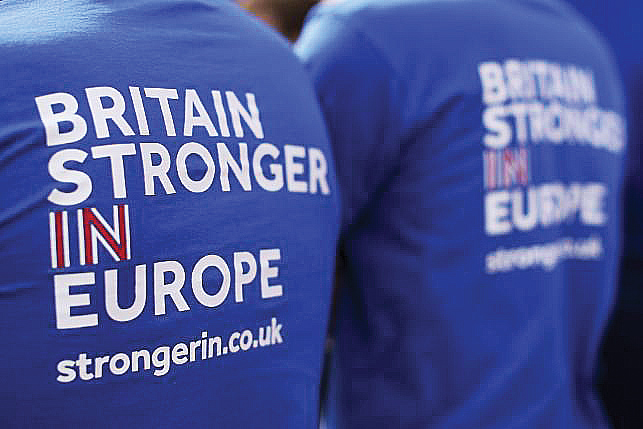
Many believe that ‘Britain will be stronger, safer and better off remaining a member of the EU’.
In this scenario the benefit could go to the concept of ‘Made in Britain’, as a weaker pound would also lead to lower rates which would create a good situation for investing in local manufacturing. “While Brexit poses a number of challenges for large-scale players, I think what you’ve hit on is an opportunity for smaller home-grown businesses,” points out Anusha Couttigane, Senior UK Analyst, Kantar Retail to Fashion United.
Yet, many British designers like Sibling, Sid Bryan and Cozette McCreery, in the week leading up to the votes, took to the runway of their Men’s Fashion Week show in T-shirts saying ‘In’, to show their opposition. In February, Christopher Bailey of Burberry was one amongst more than 100 business leaders who signed a letter in the London Times that argued, ‘Britain will be stronger, safer and better off remaining a member of the EU’. Amidst such practical opposition, still the Brexit did take place!
Despite the tensions and ambiguity surrounding Brexit, still the Fashion shows during Paris haute couture week did go jam-packed. Now many designers, entrepreneurs, retailers, investors have resigned to the fact that despite the immediate negative impact to the British economy and calls for a second referendum, the UK will indeed exit the EU. Many are trying to find the silver lining as foreign shoppers are descending on London to take advantage of the weak pound, falling from US $ 1.50 per pound to US $ 1.33 per pound in just a few days, i.e. a more than 10 per cent decline.
However, according to The Economist Intelligence Unit, the new report titled ‘Out and Down: Mapping the Impact of Brexit’, the decision by Britain to leave the European Union would have profound consequences for the future of both the UK and the EU.