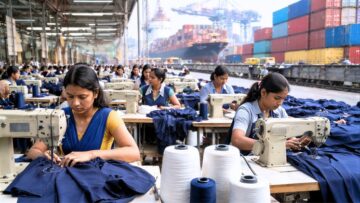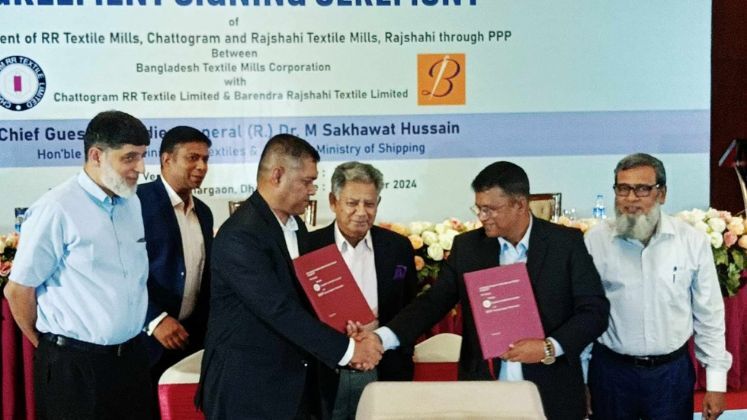
The PRAN-RFL Group has formally agreed to reopen two state-owned textile mills that had been shut down for almost thirty years, which is a major step forward for Bangladesh’s textile sector. A public-private partnership aimed at revitalising these facilities was launched on Sunday with the agreement between PRAN and the Bangladesh Textile Mills Corporation (BTMC).
The Rajshahi Textile Mill and the RR Textile Mill in Sitakunda, Chittagong, will be rebranded as Barendra Rajshahi Textiles Limited and Chittagong RR Textiles Limited, respectively, under a 30-year contract. “With seven mills approaching reopening and aspirations to build 17 more through comparable leasing and PPP arrangements, this agreement is a part of a larger endeavour,” said Brigadier General Sakhawat Hossain, the chief guest at the ceremony and the Jute and Textile Adviser.
The head of the PRAN-RFL Group, Ahsan Khan Chowdhury, was upbeat about the mills’ prospects, saying they want to start up again in a month and provide a large number of jobs for the community. Chowdhury declared, “We want to build a green factory,” highlighting the dedication to sustainability and the utilisation of solar panels to maximise the area surrounding the mills.
The RR Textile Mill was in operation from its founding in 1963 until its closing in 1997. Following a competitive tender process, the government authorised its reopening in December 2017 under the PPP model, choosing PRAN Consortium as the private partner. After a three-year grace period, the group would pay BTMC an annual charge of Taka 3.22 crore after making a one-time payment of Taka 10 crore for land use.
In a same vein, PRAN’s affiliate Charuka Textile will reopen the Rajshahi Textile Mill, which was established in 1975 and shut down in 1997. A one-time payment of Taka 6 crore and an annual charge of Taka 1.715 crore beyond the grace period are required for this mill.
The BTMC now manages 24 closed textile mills, 16 of which are scheduled to be operated under PPP agreements. Nevertheless, despite several tenders, attempts to revive Feni’s Dost Textile and Magura Textile have failed to attract any bidders. While property for Kaderia Textile Mills in Gazipur has already been given to Orion-Kaderia Textiles Limited, negotiations are still underway to transfer Ahmed Bawany Textile Mills in Dhaka to a private partner.
Furthermore, the government has authorised lease-based operations for a number of additional mills, such as Sylhet Textile Mills and Valika Woollen Mills in Chittagong. Ten more textile mills have been nominated by BTMC for possible PPP agreements as part of its future objectives.
After 74 textile mills were nationalised after Bangladesh gained its independence, the BTMC was founded on 1st July 1972, and it remains a vital part of the nation’s textile industry.