When you see an ‘80% discount’ sign outside a store, you walk in with high expectations. But once inside, the conditions apply, the options narrow and the excitement fades. That is how much of the industry is responding to India’s new labour codes. At first glance, they look promising. Dig a little deeper and the picture becomes more familiar.
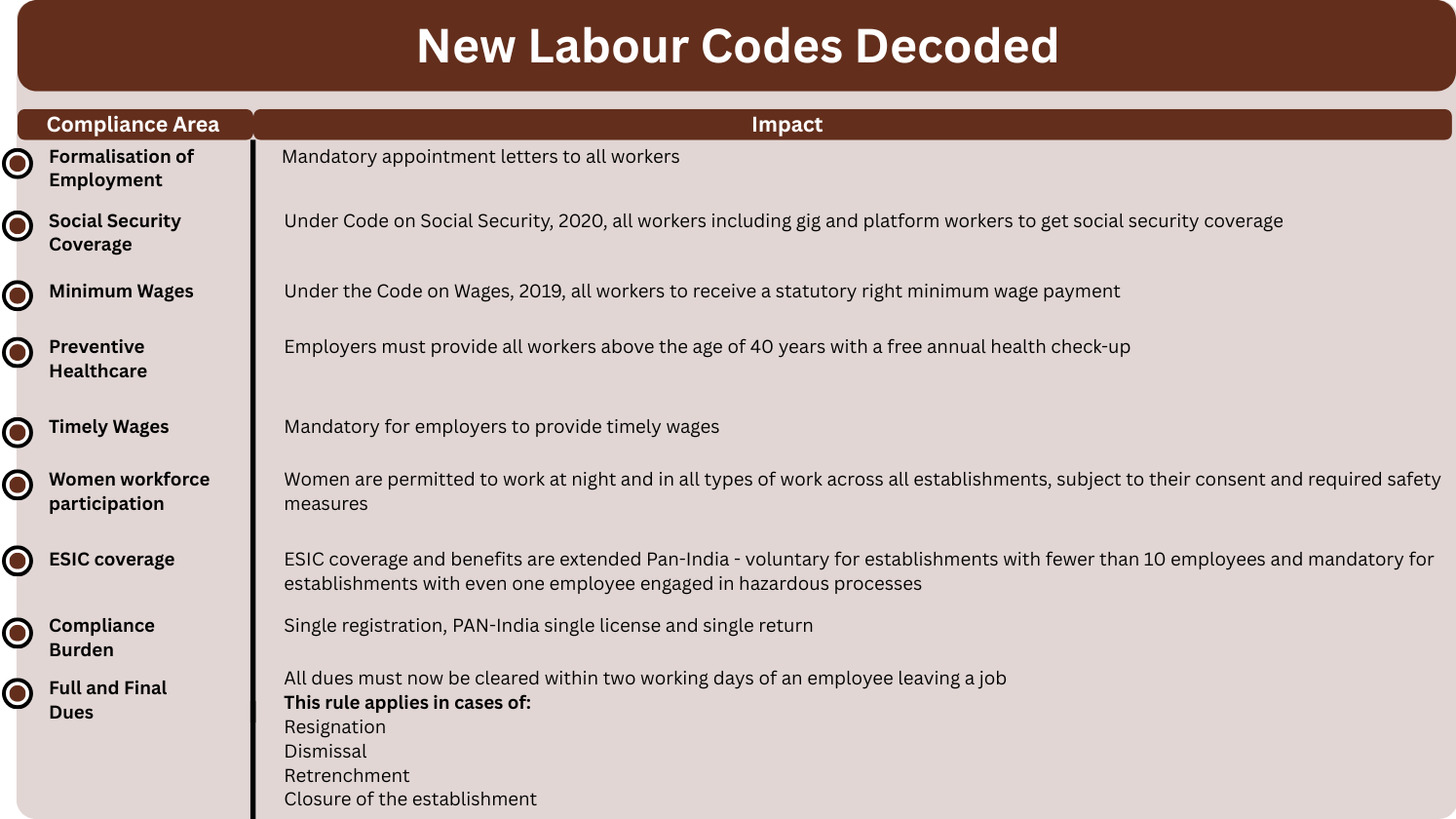
To be fair, the codes do get some important things right. They collapse 29 overlapping labour laws into four, bring a uniform definition of wages and push digitisation in compliance. Flexibility around fixed-term employment, higher thresholds for government approval on layoffs and clearer rules for women working in night shifts are all steps in the right direction.
| The expanded definition of wages pushes up provident fund, gratuity and overtime payouts. Mandatory social security contributions, faster full and final settlements, tighter contract labour liability and higher compliance requirements increase nonwage costs, particularly for MSMEs, which account for nearly 80% of India’s textile capacity |
However, for the textile and apparel industry, the country’s second largest employment generator after agriculture, employing over 45 million people and contributing 2.3% to GDP, 13% to industrial production and 12% to exports, the changes feel more like old wine in a new bottle.
Much of this is because many of the headline reforms are not entirely new. Several states had already moved in this direction years before the codes were formally notified. Between 18 and 25 states had incorporated key provisions, including higher thresholds for layoffs, fixed-term employment and permissions for women to work night shifts, largely driven by the need to attract investment and signal a business-friendly stance. What is new, however, is the cost pressure.
Rising compliance costs set to bite industry
The expanded definition of wages pushes up provident fund, gratuity and overtime payouts. Mandatory social security contributions, faster full and final settlements, tighter contract labour liability and higher compliance requirements increase non-wage costs, particularly for MSMEs, which account for nearly 80% of India’s textile capacity.
“With changes in the definition of wages and statutory contributions, we expect an initial 6% to 8% increase in our wage bill. For example, mandatory overtime at double the basic wage will further push up production costs, especially during festive and wedding seasons when demand spikes,” said Vishal Pacheriwal, MD, Parnika India, a Surat-based women’s ethnicwear manufacturer with a monthly production capacity of 5 lakh pieces and a workforce of over 700 workers. In key competing nations such as China and Vietnam, overtime is typically capped at 150% of the regular wage. ILO conventions also place this closer to 125% of the regular rate.
Echoing similar concerns, DS Narula, Owner, Kerlin Xpress, a Noida-based woven garment exporter to the UK with a monthly capacity of 1 lakh pieces and a workforce of over 1,000 workers, said compliance costs are set to rise sharply.
“The new labour codes could push wages up by around 20%,” Narula said.
Sharing a similar view, Dhananjay Bhalreo, HR Head, Zeel, which claims to be India’s largest rainwear manufacturer with an annual production capacity of 20 million pieces, said costs are expected to rise by about 10% to 15%.
“Under the new wage structure, around 50% of the total cost-to-company will be treated as gross salary, which increases PF and gratuity payouts,” he said. Zeel’s main manufacturing unit is located in Bhiwandi and employs around 1,100 people, including 475 staff and the rest shopfloor workers.
Trade bodies, while welcoming the overall reforms, have also aired similar concerns.
“The centrally determined Floor Wage may raise wage outlays in states with lower existing wage levels. Additional requirements such as mandatory annual medical examinations and journey allowances for interstate migrant workers, could further elevate compliance costs,” said Ashwin Chandran, Chairman, Confederation of Indian Textile Industry (CITI).
Whereas, Rahul Mehta, Chief Mentor, Clothing Manufacturers Association of India (CMAI), highlighted the complexity of the new minimum wage structure, under which the labour codes propose four skill categories across six different working conditions, resulting in 24 different minimum wage slabs.
Even smaller manufacturers are likely to feel the impact. Manoj Dadlani, Director, Vijeta TexFab, a Bhilwara-based maker of trousers and shirts with an annual production capacity of six lakh pieces, said higher wages could worsen worker absenteeism.
“Many workers aim to earn a fixed amount each month. If they can reach that amount in fewer working days, they may choose to work fewer days. This could increase absenteeism, something manufacturers are already struggling with,” Manoj said.
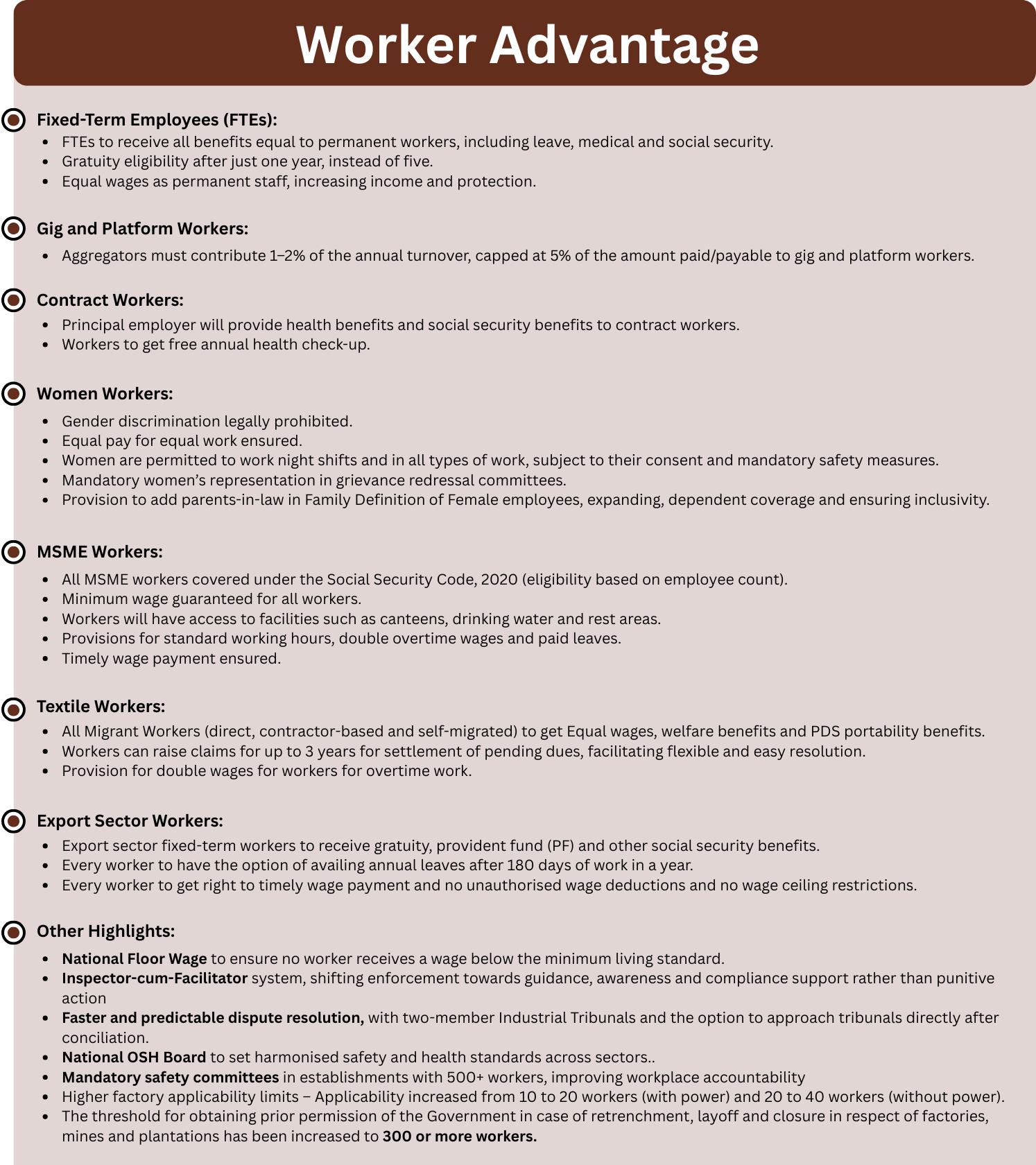
While the threshold for requiring government permission for layoffs, retrenchments and closures has been raised from 100 to 300 workers, large manufacturers say this offers limited relief. To compete with export-friendly labour regimes in Bangladesh and Vietnam, experts suggest raising the threshold to at least 1,000 workers or more for apparel units.
At the same time, the industry has broadly welcomed the move to allow women to work night shifts. Experts say this change brings greater flexibility to run more efficient 24×7 operations, particularly in areas such as embroidery, packaging and finishing, where women form a significant part of the workforce.
However, companies will need to invest in safe transport facilities, CCTV surveillance, female security staff, well-lit internal pathways and strong emergency response systems.
Talent tug-of-war with the Gig economy
Industry leaders also expressed concerns about rising competition from the gig economy and other manufacturing sectors, arguing that the new labour codes may inadvertently make alternative employment options more attractive than traditional textile and garment jobs.
For the first time, the labour codes formally define gig work, platform work and aggregators, extending social security coverage to this segment. Aggregators will be required to contribute 1% to 2% of their annual turnover towards social security, capped at 5% of the amount paid or payable to gig and platform workers. Aadhaar-linked Universal Account Numbers will make welfare benefits more accessible and fully portable. According to NITI Aayog estimates, India had 7.7 million gig and platform workers in 2020–21, a number expected to rise to 23.5 million by 2029-30.

Competition from fast-growing manufacturing sectors such as electronics, defence, automotive and EVs, energy and pharmaceuticals is also intensifying pressure on the textile and garment industry. Government initiatives such as the Production Linked Incentive (PLI) scheme have helped several of these sectors scale up rapidly, creating new employment opportunities with often better wages, working conditions and career visibility than garment manufacturing.

| “With changes in the definition of wages and statutory contributions, we expect an initial 6% to 8% increase in our wage bill. For example, mandatory overtime at double the basic wage will further push up production costs, especially during festive and wedding seasons when demand spikes.”
Vishal Pacheriwal, |
“With large investments coming into sectors like electronics and defence, workers have more employment options. In cities such as Bengaluru, garment manufacturers are already competing with players like Foxconn. Going forward, we will need to focus strongly on skill training and workforce deployment if garmenting is to remain attractive in an increasingly industrialised economy,” said Manish Bharati, CBO, Garmenting and International Business, Raymond Lifestyle. The company offers a diverse portfolio that includes formal, casual and ethnicwear, available as both high-quality fabrics and ready-to-wear apparel.
In their current form, the labour codes tidy the rulebook, but stop short of rewriting the game for India’s apparel industry.





 Bharat Tex Special Report 2026