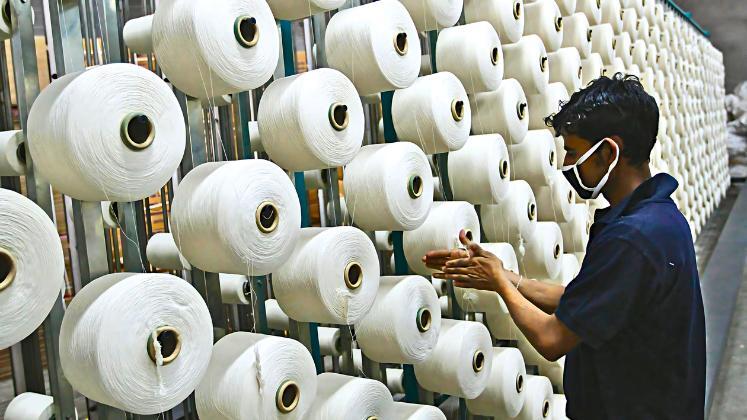
Owing to increased production costs, domestic textile millers particularly spinners are losing orders for yarn even from local ready-made-garment exporters and are experiencing “uneven” competition from overseas counterparts.
The foreign sourcing of raw materials is currently preferred by RMG exporters, impeding the continued expansion of the domestic spinning industry.
In the first nine months of the current fiscal year (FY), imports of yarn increased by double digits, but imports of other raw materials, such as raw cotton, textile and article, and staple fibre, decreased, according to data from the central bank.
According to Bangladesh Bank data, during the July–March period of FY 2023–24, yarn imports increased by more than 10 per cent over the same time in the previous fiscal year.
Bangladesh imported yarn worth US $ 2.32 billion during the period which was US $ 2.10 billion in July-March period of FY 2022-23.
Overall imports of RMG inputs recorded a 9.1 per cent decline during the first nine months – raw cotton 24.9 per cent, followed by textile and articles 8.2 per cent, staple fibre 6.1 per cent and dying and tanning materials 3.1 per cent.
The country spent US $ 12.17 billion during the review period on those imports, compared to US $ 13.39 billion during the same period in the previous fiscal year.
Textile millers contended that their high production costs were caused by inadequate gas supply and high utility expenses, which in turn drove up the price of locally made yarn.
Exporters countered that the price of locally produced yarn is higher than that of imported varieties. The fact that yarn imports are rising even if imports of other raw materials have decreased is concerning, according to Faruque Hassan, the former president of the Bangladesh Garment Manufacturers and Exporters Association (BGMEA).
BGMEA President SM Mannan Kochi said local yarn prices are higher than imported ones. He clarified that even though exporters receive financial incentives for sourcing from the local market, they are still obtaining yarn from outside since they are not price competitive.
Industry experts claim that local textile mills can fulfil 35–40 per cent of the demand for woven fabrics and roughly 80 per cent of the demand for the knitwear subsector.