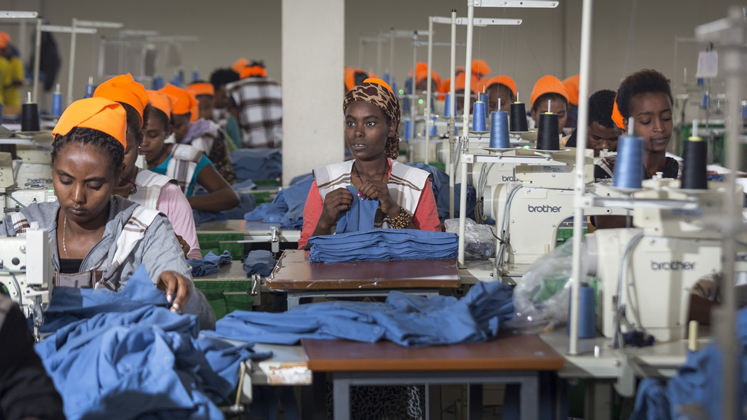
Least developed countries (LDCs) have always attracted apparel manufacturing companies due to duty benefits, low-cost labour, international FTAs and plenty of other industry-friendly policies…The very same reason has lured big garmenting groups to invest and establish their factories in countries such as Ethiopia, Madagascar, Sri Lanka, Jordan, Indonesia, Oman and Togo; and Indian textile and apparel industry is no exception when it comes to moving overseas to establish their factories. Apart from a few exceptions, in most of the cases, manufacturing operations in these countries have proved beneficial for the Indian players, however, Ethiopia that was once a big attraction for Indian companies– Arvind Ltd., Raymond Ltd., KPR Mill and Best Corp. – has been dwindling now, especially after the recent decision of USA to end AGOA agreement with this African country.
What’s going on in Ethiopia?
The ongoing civil war (Ethiopian Government’s continuing conflict with forces aligned with the Tigray People’s Liberation Front) in the country has not just impacted the entire nation but in some areas,it has created a huge ruckus.And, this situation has taken a turn that’s leading nowhere now.
US-based leading retailer PVH Corp. (which can be said to be the flag bearer of the buying community to promote garment manufacturing operations in Ethiopia) was the first major retailer that announced the shutting down of its manufacturing unit in the country during November ’21 and the closure was attributed to civil war. PVH arrived in Ethiopia in 2017 when it started operations in Hawassa Industrial Park (the flagship industrial park of the country). However, PVH claims it is still ‘committed’ to its third-party manufacturing partners in Ethiopia. H&M, another high-profile occupant at the Hawassa Park, says, “We are following all developments carefully but refrain from taking any decision regarding our long-term presence in the country.”
Also Read: Ethiopian garment industry in trouble; bleak exports may continue as USA suspends duty-free access
The impact is being seen largely on the Indian establishments also. Coimbatore-based KPR Mill, one of the leading vertical integrated companies, set up its factory ‘KPR Exports PLC’ at Mekelle Industrial Park, Mekelle, Tigray Region during 2018. In its annual report (FY 2021), the company mentioned, “While things were smooth till October 2020, suddenly due to emergence of some ethnic conflict resulting in riot and tension near Mekelle, Tigray Region, entire activities in the said Industrial Park became standstill. Like other textile companies established therein, we also had to shut down our entire activities and the workers had to be pulled out to safety places considering their safety and security.”
A senior official of the company told Apparel Resources(AR) that operations are closed in Ethiopia and even if the things get normal there in future, it is difficult to say that the company will have an operation there or not. During financial year ’21, the company (Ethiopian subsidiary) earned a revenue of Rs. 393 lakh.
Not only KPR Mill, even Stephen Lamar, President, American Apparel & Footwear Association said, “As the crisis spreads — and as Ethiopia does lose AGOA eligibility — companies will increasingly be unable to source from Ethiopia.”
These developments show that Ethiopia might not be a preferred choice for buyers anymore in the near future and they will gradually shift their sourcing base out of this country.
India’s Kanoria Africa Textiles also established its factory in Ethiopia in KETA Industrial Park, Bishoftu to initially manufacture 12 million metres of denim fabric per annum. The unit was inaugurated by the Ethiopian’s Prime Minister in 2015. Reportedly, Kanoria Africa Textiles has also felt the heat and is undergoing huge challenges there!
Sudhanshu Singhal, an experienced professional who has worked in some leading companies and recently worked as CEO of Kanoria Africa Textiles, Ethiopia said to AR, “Low productivity in Ethiopian garment factories was a major issue and now including various reasons it is very difficult that Indian factories will achieve desired results at least in next few years.”
Best Corp, Arvind Ltd., and Raymond are continuing their operations there but they are also under pressure. Arvind Ltd. has the vision of building capacity for 2.8 million garments per month in Ethiopia. In fact, it has a joint venture with PVH Arvind Manufacturing PLC, Ethiopia. As per the annual reports (2020 and 2021) of the company, its Ethiopian operation are in a loss. A senior official of the company told on the request of anonymity, “Due to less efficiency, workers’ negative attitude, our Ethiopian factories were never a successful initiative.” In June 2020, it was planning to merge its two factories in Ethiopia into one.
None of them replied to Apparel Resources (AR) regarding this story.
Will India gain anything out of this tussle?
In short-term – yes; in long-run – uncertain!
Some of the buyers have already shifted their orders to the India-based units. Few months back,Stephanie Pang, Vice President, EH Sourcing & Production, Jockey Far East Limited appreciated SCM Garments, Tirupur and said, “When the civil war broke out in Ethiopia last year, SCM offered us an immediate backup in India, minimised delays and ensured supply consistency.”
Rajesh Verma, Ex. GM Production, Best Corporation, Ethiopia has first-hand experience to dealing with Ethiopian workers.He shared with AR, “It takes a lot of efforts to train local workers and once you train them for a specific operation, it is very difficult to prepare for other operation as they are very reluctant to change their work on the shopfloor. Not only workers, even supervisors have a similar scenario. With incentive plans, strong data-base and monitoring, we were able to prepare a good workforce. Now it is the time to take advantage of efforts put in for skills but buyers’ down sentiments are having negative impact.”
Apart from the negative impact on existing factories’, there is also a distinct question mark on the future opportunities as the companies which had planned to enhance their business in Ethiopia, have put their plans on hold.
Sharing an insight on why Indian factories have not seen the growth expected, based on his experience of working in Ethiopia for almost eight years, Dr. Sandeep Prasad, Dean, School of Design, Sandip University, Nasik said, “To the best of my understanding, the major issue is the working culture and HR-related activities in Indian factories. Ethiopia doesn’t have any world-class institutes like NIFT or Pearl Academy. So, Indian factories’ management was forced to send the top and mid-level professionals there from India. These professionals are used to working in a set culture which is not viable in Ethiopia.” He very honestly feels that the local people in Ethiopia have a different mindset, and by and large their IQ is lower compared to Indian workers, hence Indian factories’ culture can’t work there. And in this whole system/process, local workers suffer which ultimately affects factories too. It will take at least five years more to develop local talent and to develop a good working culture. A positive step that is there is that the civil war is now coming under control.”
“Despite a lot of factories still running there, the negative developments certainly killed the sentiments of industry stakeholders who were planning to invest in Ethiopia or wish to increase business there, at least for some time. Big players in Ethiopia might not be facing that much of heat because they have a good relationship with the buyers, but it’s the smaller companies that may find it difficult to sustain business in this competitive world,” informed Ashok Chhajer, Director, Krishna Lamicoat, Bengaluru. The company is one of the most respected companies offering a large variety of speciality papers. Ashok further added that this global turbulence will trigger some of the order shifting to India, however shifting projects from one country to another country that too at a time when you are not even certain of the future, is a very difficult task…“It’s not an easy task to pull off from a country where you have invested millions of dollars in a project and once politics disrupt things there, you just go back to your native country and lose some million dollars. Now is the time for wait and watch situation and things will get clearer only after some time,” averred Ashok.
However, Raymond, which has a suit factory in Ethiopia shares a completely different picture and is happy with the results it has achieved. In fact, it is very confident that the AGOA will be restored soon and business will boom.“We have closed a few lines as operations were slow during the pandemic, but now we are overbooked and increasing manpower there. Developing a suit plant and achieving buyers’ confidence in terms of quality, delivery takes time. Yes, working in India and Ethiopia are quite different, but leading capabilities of Ethiopian people are very high and once they learn, there is no need to tell them again and again. They are aware of their rights. As of now, we have around 2200 workers there and in the future, we will increase the number. As far as AGOA is concerned, there are chances that it can be restored, as US’s labour department can influence US’s State department as labour and employment is also a humanitarian issue,”concluded Kaushlendra Narayan, Director Operation- India, Raymond (Silver Spark Apparel Ltd).